
Why urgent septic repairs protect your home and wallet
Discover why septic repairs are urgent to protect your home and wallet. Delay can lead to costly damage and health risks—act now!

Most homeowners in Alamance County treat their septic system like a smoke detector with dead batteries: they know it matters, but they keep putting it off. That mindset is costly. A malfunctioning septic system can contaminate groundwater and surface water with disease-causing bacteria, viruses, and excess nutrients like nitrogen and phosphorus, often long before you ever smell anything or see sewage in your yard. This article walks you through exactly what happens when repairs get delayed, what silent failures look like, and why acting fast almost always saves you serious money and stress.
Table of Contents
- The hidden dangers of untreated septic issues
- How septic systems fail and why speed matters
- The true cost of waiting: Emergency vs. preventive repairs
- Pumping isn’t always enough: Real repairs vs. quick fixes
- What most homeowners miss about septic urgency
- Protect your home with expert septic repair
- Frequently asked questions
Key Takeaways
| Point | Details |
|---|---|
| Silent damage risk | Septic failures often harm water and health before obvious symptoms appear. |
| Prevention saves money | Routine maintenance and fast repairs are far cheaper than full system replacements. |
| Not all fixes are equal | Pumping helps, but real repairs are needed for clogged drainfields or failed components. |
| Act early | Timely intervention protects your property and the whole community. |
The hidden dangers of untreated septic issues
Most people picture a septic emergency as raw sewage bubbling up through the grass. The reality is far less dramatic and far more dangerous. Your system can be silently leaking partially treated wastewater into the soil and nearby groundwater for months before you notice a single symptom inside your home.
A failing septic system releases bacteria, viruses, and nutrients into the surrounding environment, threatening not just your well water but the wells and water sources of your neighbors. In rural and suburban areas like Burlington, Mebane, and Whitsett, where many properties rely on private wells, this is not a theoretical risk. It is a real, documented public health concern that local health departments take seriously.
Here is what can happen before you ever see a warning sign:
- Effluent (partially treated wastewater) seeps into shallow groundwater and migrates toward neighboring properties
- Nitrogen and phosphorus from waste accelerate algae growth in nearby ponds, streams, and drainage ditches
- Coliform bacteria from the system can enter private well water, making household water unsafe to drink
- Soil around the drainfield becomes saturated and biologically overloaded, killing the beneficial bacteria that treat waste
- Family members, especially children and elderly adults, face increased exposure to pathogens through yard contact
“A failing septic system is not just a plumbing problem. It is an environmental problem that can affect an entire neighborhood, and it often starts long before anyone calls for help.”
The tricky part is that none of these events require you to see sewage. The damage is happening underground, invisibly. That is why waiting for obvious symptoms is one of the most expensive mistakes a homeowner can make. If you are building a new home or replacing a failed system, understanding how a proper septic system installation works from the start helps you recognize when something has gone wrong later.
How septic systems fail and why speed matters
To understand why repairs are urgent, you need to understand how failure actually happens inside the system. It is not random. It follows a predictable pattern, and every stage of that pattern costs more to fix than the one before it.
When solids accumulate in the tank faster than they break down, they eventually overflow into the drainfield. Once that happens, solids clog the drainfield and the soil loses its ability to absorb and treat effluent. At that point, you are no longer dealing with a tank problem. You are dealing with a drainfield problem, and those are far more expensive to fix.
Here is how the failure sequence typically unfolds:
- Solids accumulate in the tank beyond normal levels, usually due to missed pump-outs or excessive use
- Scum and sludge layers grow until they leave little room for liquid effluent to settle properly
- Solids escape the tank and travel into the distribution pipes leading to the drainfield
- Drainfield pipes clog and the surrounding soil becomes biologically overloaded
- Soil absorption fails completely, causing sewage to surface in the yard or back up into the home
- Full drainfield replacement becomes the only option, costing thousands of dollars
The timeline between steps one and six can be surprisingly short. A tank that has not been pumped in seven or eight years can move through these stages within a single season, especially during heavy rainfall when groundwater levels rise and put extra pressure on the system.
| Problem stage | Typical repair | Estimated cost range |
|---|---|---|
| Routine pump-out | Tank pumping | $300 to $600 |
| Minor line clog | Hydro jetting | $400 to $800 |
| Broken distribution pipe | Pipe repair | $500 to $1,500 |
| Partial drainfield failure | Partial replacement | $3,000 to $7,000 |
| Full drainfield failure | Full replacement | $8,000 to $20,000+ |
These numbers make one thing clear: catching a problem at stage one or two costs a fraction of what it costs at stage five or six. Speed matters because the system does not pause and wait for you to get around to calling someone.
The true cost of waiting: Emergency vs. preventive repairs
Let’s talk dollars and cents, because that is often what finally motivates action. The EPA recommends having your tank inspected every one to three years and pumped every three to five years. For most households, that means spending a few hundred dollars every few years on routine maintenance. That is a manageable, predictable expense.
Compare that to what happens when you skip maintenance. Delaying repairs turns potentially fixable problems into drainfield failure and replacement-level costs. A full drainfield replacement in North Carolina can easily run $10,000 to $20,000 or more, depending on soil conditions, lot size, and system type. That does not include the cost of landscaping restoration, permit fees, or the time you spend without a functioning system.
| Maintenance approach | Average 10-year cost | Risk level |
|---|---|---|
| Regular pumping and inspections | $1,500 to $3,000 | Low |
| Pumping only when problems appear | $4,000 to $8,000 | Medium |
| No maintenance until failure | $15,000 to $25,000+ | Very high |
Statistic to know: Homeowners who follow routine septic maintenance schedules spend up to 90% less on repairs over a 10-year period compared to those who wait for visible system failure.
Pro Tip: Set a calendar reminder every three years for a septic inspection. Treat it the same way you treat a furnace tune-up or a roof inspection. It is not optional maintenance. It is the cheapest insurance policy you can buy for your property.
The financial case for early action is overwhelming. But there is also a practical reality: emergency repairs almost always happen at the worst possible time. A drainfield that fails during a holiday gathering or a week of heavy rain does not wait for a convenient schedule. Emergency service calls cost more, take longer to arrange, and often require temporary alternatives while the work is completed. Preventive care keeps you in control of the timeline and the budget.
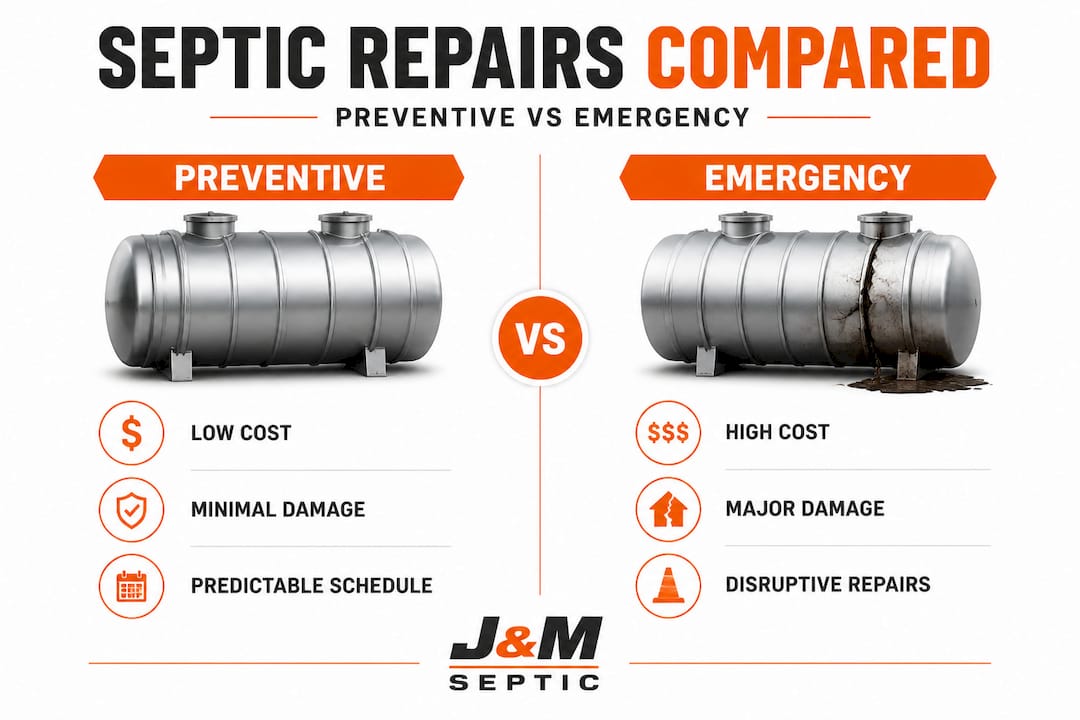
When you factor in septic replacement options for your specific property and soil type, the investment in a properly installed and maintained system becomes even clearer. The right system, properly maintained, can last 25 to 30 years. A neglected system might last half that long before requiring a full replacement.
Pumping isn’t always enough: Real repairs vs. quick fixes
Here is something many homeowners in Alamance County get wrong: they assume that getting the tank pumped fixes the problem. Pumping is important, but it is not a repair. It is maintenance. And there is a big difference between the two.
If solids have already escaped the tank and clogged the drainfield, pumping only provides temporary relief and does not solve the deeper failure. You might get a few weeks or months of improved drainage after a pump-out, but the underlying damage to the drainfield continues. In some cases, homeowners pump their tank three or four times in a single year, spending hundreds of dollars each time, without realizing that the real problem is in the drainfield or distribution system.
Real repairs address the source of the failure, not just the symptom. Here is what that can look like in practice:
- Hydro jetting clears biofilm and solid buildup from pipes that pumping cannot reach
- Distribution box repair or replacement restores even flow to all drainfield zones
- Baffle replacement prevents solids from escaping the tank in the first place
- Drainfield restoration treatments can sometimes revive partially clogged soil without full replacement
- Full professional septic repair addresses structural failures in tanks, lids, risers, and outlet pipes
The only way to know which of these your system actually needs is a proper evaluation by someone who knows what to look for. DIY efforts, like pouring additives into the tank or running a garden hose into cleanout pipes, rarely accomplish anything meaningful and can sometimes make the situation worse by pushing solids further into the drainfield.
Pro Tip: If you have pumped your tank within the last 18 months and you are still seeing slow drains or wet spots in the yard, stop pumping and start diagnosing. The problem is not in the tank. It is downstream, and it needs professional attention before it gets worse.
Being proactive does not mean obsessing over your septic system every week. It means scheduling regular maintenance, paying attention to the early warning signs like slow drains, gurgling pipes, and faint odors, and calling a professional before those signs turn into a sewage backup or a failed drainfield.
What most homeowners miss about septic urgency
After working with homeowners across Alamance County and the Piedmont Triad, we have noticed a consistent pattern: the most expensive repairs are almost always the ones that surprised someone. Not because the system failed without warning, but because the warnings were easy to explain away.
A slow drain becomes “probably just grease buildup.” A faint smell outside becomes “must be the neighbor’s yard.” Standing water near the drainfield becomes “it rained a lot this week.” Each of these explanations might occasionally be correct. But when they become a habit of thinking, they turn a $500 repair into a $15,000 replacement.
The uncomfortable truth is that systems can silently fail by letting solids slip into the drainfield or by not adequately treating wastewater, creating real environmental and health risks even when nothing looks wrong from the surface. You are not just protecting your investment when you act early. You are protecting your family’s health, your neighbors’ water supply, and your standing as a responsible property owner in your community.
We have seen homeowners in Burlington and Graham go years without a pump-out, convinced their system was fine because they had no backups. Then one heavy spring rain pushes the system past its limit, and suddenly they are looking at a full replacement, a health department notice, and a yard that needs to be torn up and rebuilt. None of that was inevitable. It was the result of waiting.
Our honest advice: do not wait for a crisis to take your septic system seriously. The cost of prevention is predictable. The cost of failure is not.
Protect your home with expert septic repair
If anything in this article sounds familiar, whether it is slow drains, a smell you cannot quite place, or a pump-out that is overdue, now is the time to act. Waiting even a few more weeks can push a manageable repair into a much larger problem.
At J&M Septic Installation & Repair, we serve homeowners throughout Burlington, Mebane, Elon, Graham, Whitsett, and McLeansville with honest diagnostics and real solutions. From routine maintenance to emergency drainfield work, we handle it all with the kind of straightforward service that local families can count on. If you are ready to stop guessing and start fixing, our team offers trusted septic system installation and repair services designed to protect your property for the long haul. Call us before a small problem becomes a very expensive one.
Frequently asked questions
How do I know if my septic system repair is urgent?
If you notice slow drains, odors, or pooling water in your yard, repairs are likely urgent. The EPA recommends pumping every three to five years, and missed maintenance alone is enough reason to schedule an inspection right away.
Can I wait to repair a minor septic issue?
Waiting almost always leads to higher costs and more serious damage, even when the issue seems small. Delaying repairs turns manageable problems into drainfield failures that require full replacement.
Is septic pumping the same as a repair?
No. Pumping removes sludge from the tank, but it does not fix damaged pipes, failing drainfields, or broken components. Pumping provides temporary relief but does not address deeper system failures.
What happens if I ignore septic problems?
Ignoring septic problems can lead to groundwater contamination, health risks for your household and neighbors, and the need for a full system replacement. Insufficiently treated sewage spreads bacteria and viruses into the surrounding environment.
How often should I schedule septic maintenance?
The EPA recommends having your tank inspected every one to three years and pumped every three to five years, though households with heavy use or older systems may need more frequent service.