
Why regular septic inspections matter for homeowners
Discover why regular inspections matter for homeowners—prevent costly septic failures and protect your home with smart maintenance strategies.

Your septic system handles everything that goes down your drains, toilets, and sinks every single day, yet most homeowners in Alamance County never think about it until raw sewage backs up into the house. That mindset is expensive. 94% of septic failures trace directly back to poor maintenance, which means the vast majority of costly, disruptive system breakdowns are completely preventable. This guide walks you through what a professional inspection actually involves, what North Carolina law requires, and why scheduling routine checkups is one of the smartest financial decisions you can make as a homeowner.
Table of Contents
- What regular septic inspections involve
- Why regular inspections are essential: evidence and impact
- North Carolina rules for septic inspections and sales
- How regular inspections protect your investment
- A professional perspective: Why “out of sight, out of mind” is a costly myth
- Connect with trusted local experts for peace of mind
- Frequently asked questions
Key Takeaways
| Point | Details |
|---|---|
| Most failures preventable | Ninety-four percent of septic failures happen due to poor maintenance, which regular inspections can avoid. |
| Save money over time | Routine inspections and pumping cost far less than major system repairs or replacements. |
| NC laws require inspections | Certified inspections are mandatory for home sales and strongly recommended by state health agencies. |
| Protects your property | Timely inspections boost home value, safeguard your family’s health, and support community well-being. |
What regular septic inspections involve
Now that you understand the risk of neglect, let’s look closely at what actually happens during an inspection. Many homeowners picture someone glancing at the yard and calling it done. The reality is far more thorough, and understanding each step helps you know exactly what you’re paying for.
Tank access and visual assessment
A certified inspector starts by locating and uncovering the tank access lids. This alone tells them a lot. Cracked lids, soil erosion around the tank, or signs of settling can indicate structural problems before anyone even opens the tank.
Scum and sludge measurement
Inside the tank, two layers build up over time: a floating scum layer on top and a sludge layer on the bottom. The inspector uses a specialized probe to measure the thickness of each. When the combined layers take up more than one third of the tank’s total volume, pumping is overdue. Skipping this measurement is like never checking the oil in your car.
Drain field evaluation
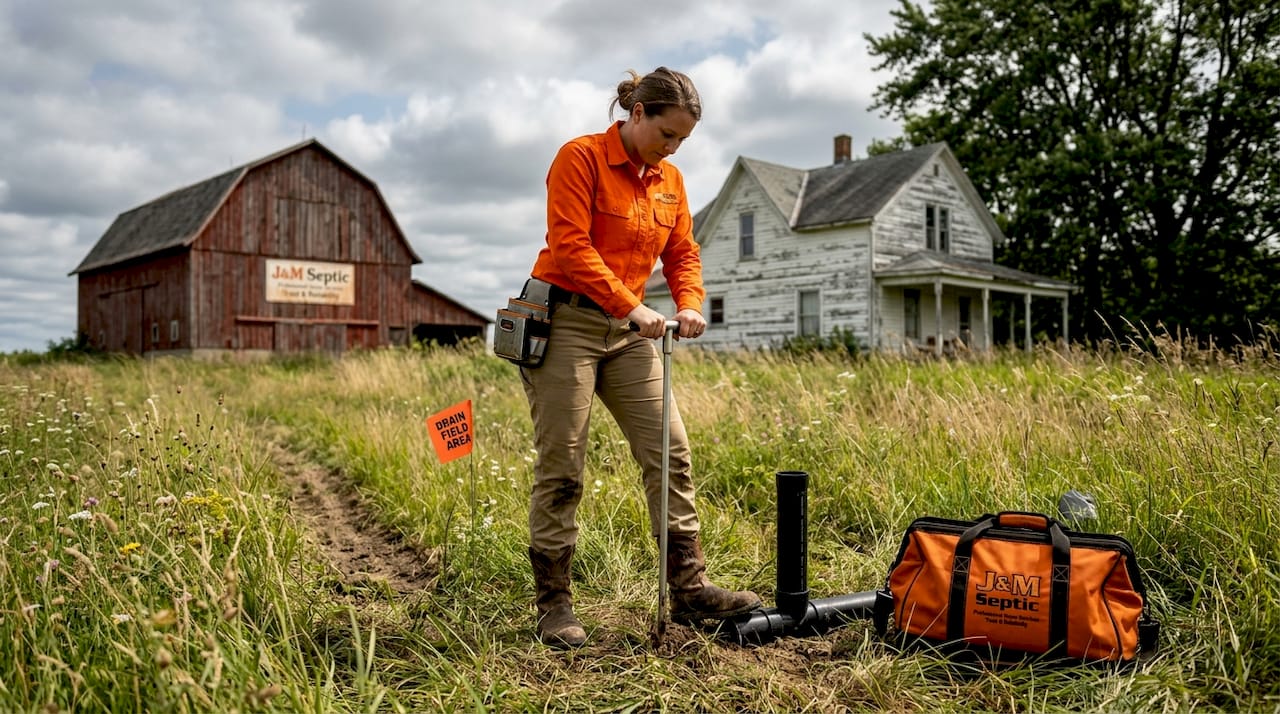
The drain field, sometimes called the leach field, is where treated wastewater disperses into the soil. Inspectors walk the drain field looking for soft or spongy ground, standing water, unusually lush grass, and odors. Any of these signals that the field is saturated or failing. A failing drain field is the most expensive repair a homeowner faces, often running $5,000 to $20,000 or more.
Checking inlet and outlet baffles
Baffles are the internal components that direct flow inside the tank. Broken or corroded baffles allow solids to escape into the drain field, which is one of the fastest ways to destroy it. Inspectors check these every visit.
Identifying wear and early damage
Inspectors also check pipes, tank walls, and distribution boxes for cracks, root intrusion, and corrosion. Catching a hairline crack early costs a few hundred dollars to fix. Ignoring it until the tank collapses costs much more.
Both the EPA and NC DHHS recommend scheduling a professional inspection every three years for conventional systems. Systems with mechanical components, like pumps or aerators, need annual checks. In North Carolina, only DHHS-registered, certified inspectors are authorized to perform these evaluations, so always verify credentials before hiring anyone.
“A septic inspection is not just paperwork. It is a detailed physical assessment of a system that protects your family’s health and your home’s value.”
Pro Tip: Keep a dedicated folder, either physical or digital, with every inspection report, pumping receipt, and repair record. When you sell your home, this documentation can speed up the transaction and give buyers confidence. It also helps your inspector spot trends over multiple visits.
Common findings during routine inspections include:
- Sludge buildup requiring immediate pumping
- Cracked or missing outlet baffles
- Root intrusion into pipes or the tank itself
- Saturated soil in the drain field
- Improper slope on inlet pipes causing backflow risk
- Evidence of non-biodegradable items flushed into the system
Why regular inspections are essential: evidence and impact
With a clear picture of the inspection process, consider why these routine checks are far more than just a bureaucratic box to check.
The numbers make the case plainly. Regular inspections and pumping can extend a septic system’s functional life to 20 to 40 years, and 94% of failures are directly linked to poor maintenance. That is not a small margin. That is an overwhelming pattern showing that homeowners who stay on top of inspections almost never face catastrophic system failure.
The real cost comparison
Here is what the numbers look like when you break down the cost of routine care versus reactive repairs in Alamance County:
| Service | Typical cost range |
|---|---|
| Routine inspection | $300 to $600 |
| Tank pumping | $300 to $500 |
| Baffle replacement | $150 to $400 |
| Drain field repair (partial) | $1,500 to $5,000 |
| Full drain field replacement | $5,000 to $20,000 |
| Complete system replacement | $10,000 to $30,000+ |
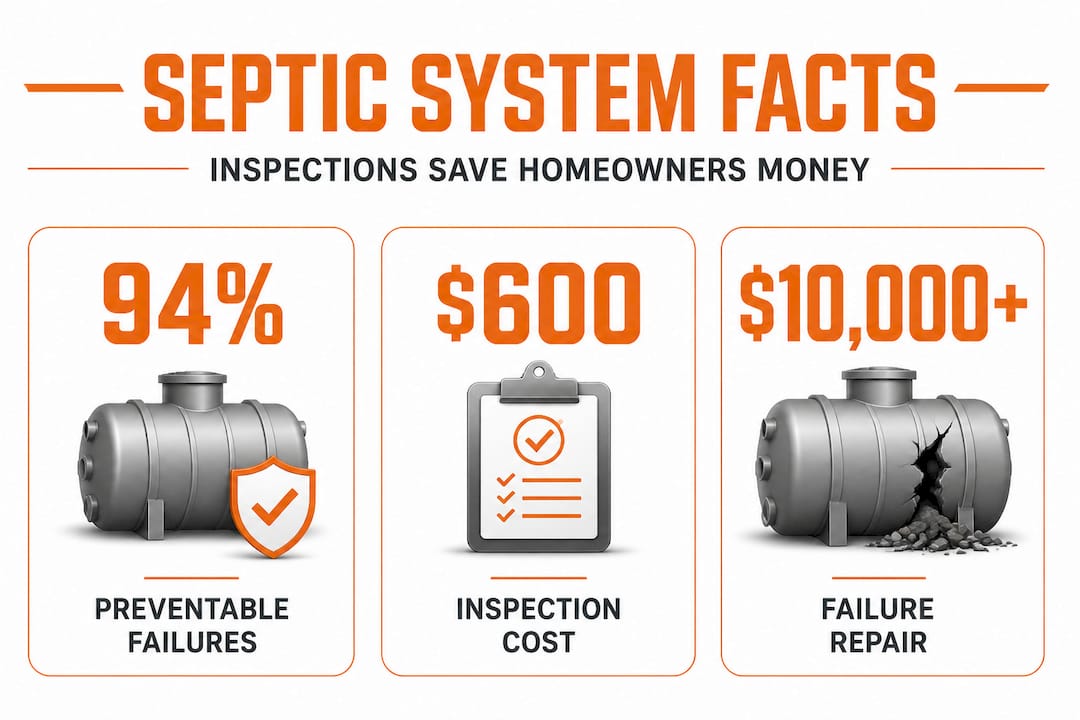
A homeowner who spends roughly $900 every three years on inspection and pumping is making a small, predictable investment. A homeowner who skips those checkups risks a repair bill that can exceed $20,000 overnight.
Health and environmental stakes
A failing septic system does not just hurt your wallet. Untreated wastewater can contaminate nearby wells, creeks, and groundwater. Alamance County has a mix of rural and suburban properties, many of which rely on private wells for drinking water. A neighbor’s failing system can affect your water quality, and yours can affect theirs.
Beyond water quality, sewage backups inside the home create serious health hazards. Exposure to raw sewage introduces bacteria, viruses, and parasites into living spaces. Cleanup after a backup is expensive and disruptive, often requiring professional remediation services on top of the septic repair itself.
Legal and property risks
A neglected system can also create liability. If your system contaminates a neighbor’s well or a nearby waterway, you may face legal consequences. When you go to sell your home, a failed inspection can kill the deal entirely or force you into emergency repairs under time pressure, which always costs more than planned maintenance.
Key reasons homeowners in Alamance County prioritize regular inspections:
- Avoid surprise repair bills that can reach tens of thousands of dollars
- Protect drinking water for your household and neighbors
- Maintain home resale value and pass required pre-sale inspections
- Stay compliant with North Carolina environmental regulations
- Prevent sewage backups that damage flooring, walls, and personal property
North Carolina rules for septic inspections and sales
Having explored the benefits, it is important to understand the legal requirements that impact septic system care locally.
North Carolina takes septic system oversight seriously. Under NC General Statute §130A-335.1, a certified inspection is required when a home with a septic system is sold. The inspection must be completed within 30 days of the sale. This is not optional, and it is not something you can skip with a handshake agreement. Certified inspections are mandatory for home sales in North Carolina, and inspectors must hold active DHHS registration to perform them legally.
Who can inspect your system
Not every plumber or contractor qualifies. In North Carolina, only inspectors who are registered with the state DHHS and certified through the NC On-Site Water and Wastewater Certification and Inspection Board are authorized to conduct official septic inspections. You can verify credentials at ncowcicb.info before hiring anyone.
What inspections typically cost locally
In Alamance County and the surrounding Piedmont Triad area, standard inspections run between $300 and $600 depending on system type, property size, and accessibility. More complex systems with pumps or multiple tanks may cost more.
Steps homeowners should take to stay compliant
- Locate your septic system permit and any prior inspection records.
- Confirm the location of your tank and drain field on your property.
- Schedule an inspection with a DHHS-registered inspector every three years, not just when selling.
- Get the inspection report in writing and keep it with your home records.
- Address any flagged issues promptly rather than waiting for the next inspection cycle.
- If selling your home, initiate the inspection process early so results do not delay closing.
NC vs. EPA guidance at a glance
| Requirement | EPA recommendation | NC state rule |
|---|---|---|
| Inspection frequency | Every 3 years | Every 3 years (mandatory for sales) |
| Who can inspect | Qualified professional | DHHS-registered, certified inspector only |
| Pre-sale inspection | Strongly recommended | Required within 30 days of sale |
| Records retention | Keep all reports | Required for compliance documentation |
| Mechanical system checks | Annually | Annually recommended |
Pro Tip: Do not wait until you are listing your home to schedule an inspection. If an inspector finds a problem during a pre-sale evaluation, you will be under pressure to fix it fast, which means less time to shop for competitive repair quotes. Scheduling a routine inspection 12 to 18 months before you plan to sell gives you time to address any issues calmly and on your own terms.
How regular inspections protect your investment
Understanding and acting on these rules leads to direct benefits for you, your neighbors, and the local environment.
Your septic system is not just a utility. It is a core component of your home’s value and your family’s safety. Treating it that way changes how you think about maintenance costs.
Home resale value
Buyers and their agents in Alamance County increasingly ask for septic inspection history upfront. A clean inspection record signals that the home has been well cared for. Conversely, a system flagged during the pre-sale inspection can give buyers leverage to demand price reductions or walk away entirely. Homes with documented, up-to-date septic maintenance sell faster and with fewer complications.
Neighborhood and environmental impact
Septic systems that fail do not just affect one property. Contaminated groundwater moves. Saturated drain fields can affect adjacent lots. In communities near streams and lakes in the Piedmont Triad, failing systems contribute to water quality problems that affect everyone downstream. Staying current on inspections is a form of being a responsible neighbor.
The real cost of ignoring inspection cycles
Consider two realistic scenarios. Homeowner A schedules inspections every three years, pumps the tank when needed, and addresses minor repairs as they come up. Over 20 years, they spend roughly $6,000 to $8,000 on maintenance. Their system runs reliably for 30 or more years.
Homeowner B skips inspections for a decade. Sludge builds up, solids escape into the drain field, and the field fails. They face a full drain field replacement at $15,000 or more, plus the cost of emergency pumping, pipe repair, and possible landscaping restoration. Their total cost over the same period easily exceeds $20,000, and their system may not last another decade without further investment.
“Proactive maintenance extends system life and aligns with expert recommendations, reducing costly emergencies.”
Benefits homeowners consistently report after committing to regular inspections:
- Fewer plumbing emergencies and drain backups
- Greater confidence when listing the home for sale
- Lower overall maintenance costs spread predictably over time
- Peace of mind knowing the system is functioning safely
- Stronger relationships with certified local service providers who know your system’s history
A professional perspective: Why “out of sight, out of mind” is a costly myth
Having reviewed homeowner benefits and obligations, let’s tackle a persistent misconception head-on.
After years of working with septic systems across Alamance County and the Piedmont Triad, the pattern we see over and over is this: the homeowners who call us in a panic are almost never the ones who skipped one inspection. They are the ones who skipped five. They assumed that because nothing smelled bad and the toilets flushed fine, everything underground was healthy. That assumption is wrong, and it costs them dearly.
A septic system can be quietly failing for years before you see a single surface symptom. Sludge accumulates slowly. Baffles corrode gradually. Drain field soil compacts over time. None of these processes announce themselves with an obvious warning sign. By the time you notice standing water in the yard or a slow drain in every fixture, the damage is already significant.
The “if it isn’t broken, don’t fix it” mindset works for some things. It does not work for underground infrastructure that handles biological waste. The consequences of being wrong are not a minor inconvenience. They are a five-figure repair bill, a potential health hazard, and a home sale that falls apart at the worst possible moment.
All expert sources agree: proactive, not reactive maintenance is what keeps systems running for decades. We have seen $500 inspections prevent $18,000 drain field replacements. We have seen homeowners who invested in routine care sell their homes smoothly while neighbors scrambled to fix systems that had been ignored.
The maintenance mindset is not about following a checklist. It is about understanding that your septic system is doing hard, constant work every single day. Giving it a professional checkup every three years is the least it deserves, and the smartest thing you can do for your home’s long-term health.
Pro Tip: Set a calendar reminder every three years tied to a memorable date, like the anniversary of your home purchase. Pair the inspection with tank pumping if you are approaching the recommended interval. Doing both at once saves you a service call fee and gives your inspector a cleaner view of the tank’s interior components.
Connect with trusted local experts for peace of mind
If you have made it this far, you already understand more about septic system care than most homeowners in Alamance County. Now the question is what you do with that knowledge.
At J&M Septic Installation and Repair, we work with homeowners across Burlington, Mebane, Graham, Elon, Whitsett, and McLeansville every day. We know the soil conditions, the local regulations, and the inspection requirements that apply specifically to your area. Whether you need a routine inspection, a pre-sale evaluation, tank pumping, or emergency repair, our certified team is ready to help. Explore everything we offer at J&M Septic services and schedule your next inspection before a small issue becomes a major one. Honest work, local expertise, and long-term results are what we bring to every job.
Frequently asked questions
How often should my septic system be inspected in Alamance County?
Both the EPA and NC DHHS recommend inspections every three years to maximize system lifespan and catch problems before they become expensive repairs.
Is a septic inspection required when selling a home in North Carolina?
Yes. North Carolina law requires a certified inspection for home sales to be completed within 30 days of the transaction, and only DHHS-registered inspectors may perform it.
How much does a septic system inspection typically cost?
A standard inspection in Alamance County typically costs between $300 and $600, depending on system complexity and property access.
Who can legally inspect my septic system in North Carolina?
Only DHHS-registered inspectors certified through the NC On-Site Water and Wastewater Certification and Inspection Board are authorized to perform legal septic inspections in North Carolina.