
Surface Application Septic Systems: What Homeowners Need to Know
Discover what is a surface application septic system and its benefits. Learn essential information for homeowners facing drainage challenges.

A surface application septic system disposes of secondary-treated effluent onto the ground surface rather than into a subsurface drainfield, and it is reserved for sites where conventional underground systems simply cannot work. Think high groundwater tables, bedrock sitting just a foot or two below grade, or soil so dense it barely absorbs water. The EPA and state agencies like the Texas Commission on Environmental Quality (TCEQ) classify it as an engineered alternative, not a shortcut. It requires professional design, a permitted installation, and ongoing maintenance that is more demanding than a standard septic system.
Sites that typically require surface application:
- Seasonal high groundwater that rises within a few feet of the surface
- Shallow bedrock leaving no room for a drainfield
- Very low soil permeability (clay-heavy soils that won’t absorb effluent)
- Insufficient depth of unsaturated soil beneath the proposed dispersal area
If your property has any of these conditions, a licensed professional needs to evaluate whether surface application or another alternative system is the right fit.
Table of Contents
- How does surface application differ from a conventional septic system?
- How does a surface application system actually work?
- What site conditions make surface application the right choice?
- What permits and professional credentials does surface application require?
- What maintenance does a surface application system require?
- What are the pros and cons compared with other systems?
- What does surface application cost, and how long does installation take?
- Who should design and install a surface application system?
- What are the warning signs that something is wrong?
- How is permitted surface application different from illegal discharges?
- Jmseptic: licensed septic services for Alamance County homeowners
- Key Takeaways
- The part most homeowners get wrong about surface application
- Authoritative resources for homeowners
How does surface application differ from a conventional septic system?
A conventional septic system works in two stages: a septic tank settles and partially treats waste, then effluent flows underground into a drainfield where soil does the final treatment. The soil is the workhorse. Subsurface systems depend on at least 2–4 feet of unsaturated soil beneath the drainfield to fully remove bacteria, viruses, and other pathogens before effluent reaches groundwater.
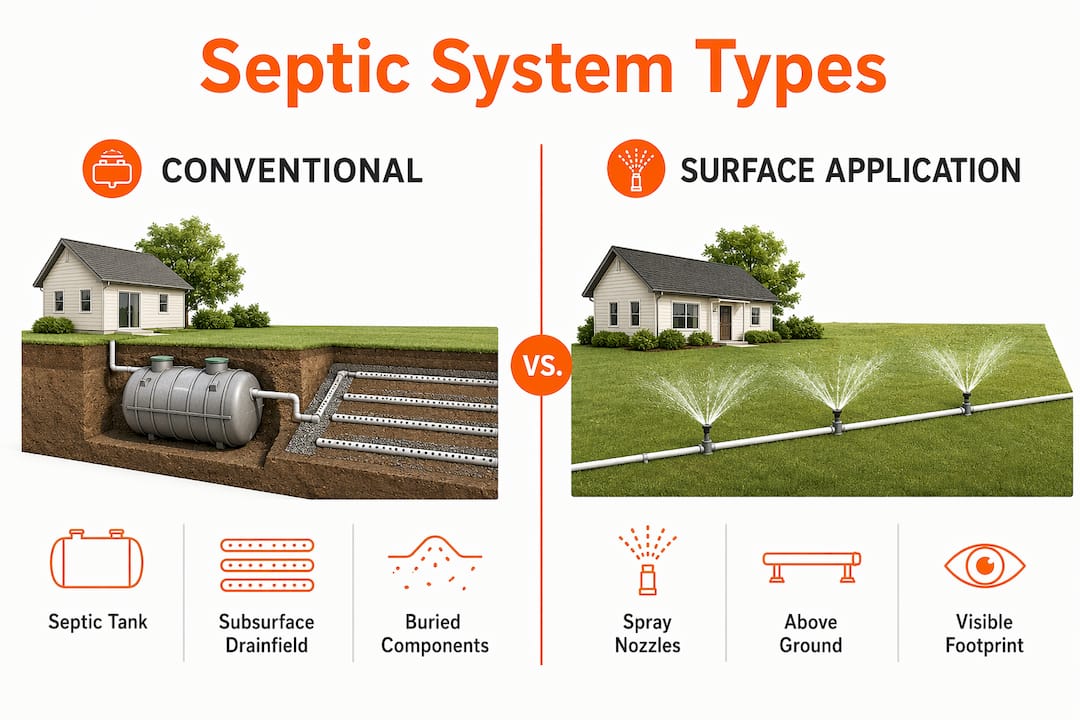
Surface application flips the final dispersal point above ground. Instead of relying on passive soil infiltration, it sprays treated effluent onto a designated area of your property. That single difference drives everything else: the treatment requirements, the mechanical complexity, and the maintenance burden.
Key distinctions at a glance:
- Final dispersal: Conventional systems discharge below grade; surface application sprays onto the ground surface
- Treatment level required: Surface application mandates secondary treatment before any effluent reaches the spray area; raw or primary-treated sewage cannot be sprayed
- Active vs. passive: Conventional drainfields are passive; surface application uses pumps, nozzles, and distribution manifolds that require power and regular attention
- Regulatory oversight: Surface application systems face stricter permitting and design requirements in most states
When subsurface options are ruled out, designers typically evaluate a short list of alternatives for constrained sites:
- Mound systems: A raised sand bed built above grade when native soil is shallow or wet; still disperses below the mound surface
- Low-pressure dosing (LPD): Pressurized distribution through shallow drainfield laterals; improves uniformity but still relies on subsurface soil
- Drip irrigation: Subsurface drip emitters deliver small, frequent doses of treated effluent just below the surface
- Surface application: The option of last resort when all subsurface methods are infeasible
How does a surface application system actually work?
The system runs through four distinct stages, and each one depends on the previous stage functioning correctly.
Core components
- Primary clarifier or septic tank: Receives raw household wastewater and removes settleable solids
- Secondary treatment unit: A sand filter, aerobic treatment unit (ATU), or similar device that brings effluent to secondary treatment standards before dispersal
- Pump and dosing chamber: Stores treated effluent and delivers it to the spray area in timed, controlled doses
- Distribution manifold and spray nozzles: Pipes and heads that spread effluent evenly across the designated disposal area
- Control panel and alarm system: Monitors pump cycles, float levels, and system faults; alerts the homeowner when something goes wrong
The operating cycle
- Household wastewater enters the septic tank or primary clarifier, where solids settle out
- Clarified effluent flows to the secondary treatment unit, where biological and physical processes reduce pathogens and organic load
- Treated effluent collects in the dosing chamber until a timer or float triggers the pump
- The pump pressurizes the distribution manifold, and spray nozzles distribute effluent across the disposal area in a controlled pattern
- Effluent contacts the soil surface, where short-term interaction with grass and topsoil provides additional treatment before evaporation and shallow uptake occur
Pro Tip: Spray nozzles are the most overlooked maintenance point on these systems. A single clogged nozzle shifts the hydraulic load to adjacent heads, which can saturate one section of the disposal area while leaving another dry. Check nozzles every time a licensed technician visits, and ask them to document which heads were tested.
What site conditions make surface application the right choice?
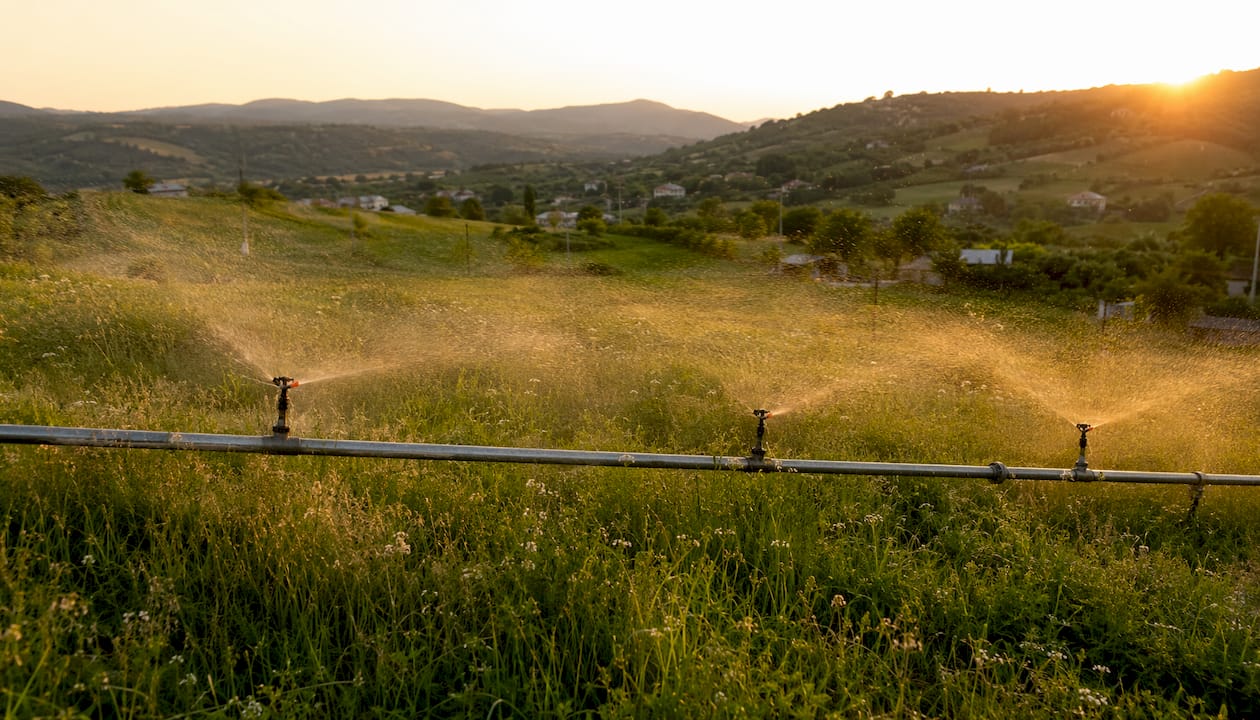
Surface application is not a first choice. Regulators and designers reach for it after evaluating and ruling out subsurface options. Understanding what drives that decision helps you know what to expect during a site evaluation.
Site conditions that often lead to surface application:
- High seasonal groundwater: When the water table rises within the minimum required separation distance of a drainfield, subsurface dispersal risks contaminating groundwater
- Bedrock near the surface: Shallow rock leaves no room for a drainfield trench or mound base; surface application sidesteps the need for deep soil entirely
- Very low soil permeability: Dense clay soils absorb water so slowly that a conventional drainfield would flood and fail; surface application moves the dispersal point above the problematic layer
- Small unsaturated soil depth: When the gap between the surface and a limiting condition (rock, clay pan, or seasonal water) is too thin for any subsurface method, surface application may be the only permitted option
Two scenarios that illustrate this in practice: A lakeshore lot with limestone bedrock two feet down has no viable drainfield depth, but a flat, grassed area away from the water may qualify for surface application with proper setbacks. A small rural parcel with a clay hardpan at 18 inches might fail every perc test for subsurface systems, yet have enough open land for a spray disposal area. In both cases, a professional site evaluation and soil analysis are required before any design can begin.
Surface application does carry a larger visible footprint than a buried drainfield. The spray area must stay open, grassed, and accessible. That tradeoff is worth understanding before you commit to the design. For a broader look at how different system types compare on constrained lots, the types of septic systems guide covers the full range of options.
What permits and professional credentials does surface application require?
Surface application is tightly regulated across the U.S., and the rules vary significantly by state. In Texas, for example, the TCEQ requires that surface application designs be prepared by a professional engineer or licensed sanitarian, and installation must be performed by a certified installer holding an Installer Class II credential. Most other states have comparable requirements, though the specific license classes and agency names differ.
What to expect in the permitting process:
- Site evaluation and soil testing: A licensed professional assesses soil conditions, groundwater depth, and available disposal area before any design work begins
- Engineered design: A professional engineer (PE) or professional sanitarian stamps the design drawings; no permit application moves forward without this
- Permit application: Submitted to the local health department or state environmental agency, along with the stamped design and site plan
- Construction inspection: An inspector typically visits during installation to verify the system is built to the approved design
- Final approval: The system cannot be placed in service until the permitting authority signs off
For North Carolina homeowners specifically, the NC septic system regulations guide covers the state’s permit process and what documents you will need.
Codes also restrict where effluent can be applied. Surface application cannot be used on unseeded bare ground or on areas used to grow food for human consumption. Your permit documents will specify the exact boundaries and restrictions for your disposal area.
Action item: Before hiring anyone, contact your county health department or state environmental agency and ask specifically about permit requirements for surface application systems. Request a list of approved designers and installer classes. Any contractor who tells you permits are optional is a red flag.
What maintenance does a surface application system require?
Surface application systems need more frequent attention than a conventional drainfield. Because the system relies on pumps, nozzles, and a secondary treatment unit, ongoing mechanical maintenance is mandatory, not optional. Neglect moves fast on these systems.
Routine homeowner tasks
- Check the control panel and alarm indicators weekly; a triggered alarm means something needs attention now, not next month
- Keep the spray disposal area free of standing water, which signals either system overload or drainage problems
- Prevent heavy foot traffic and vehicle access over the disposal area; compacted soil reduces the area’s ability to handle effluent
- Do not plant trees, shrubs, or vegetable gardens in the disposal area; grass is the appropriate cover
- Avoid pouring harsh chemicals, grease, or large amounts of antibacterial products down drains; these disrupt the secondary treatment unit’s biological processes
- Limit or eliminate garbage disposal use; excess solids accelerate tank and filter fouling
Professional inspection schedule
Most jurisdictions require scheduled service visits by a licensed professional. A typical inspection covers:
- Inspect and test the pump, floats, and control panel
- Check and clean spray nozzles and distribution manifold for clogs
- Evaluate secondary treatment unit performance (sand filter media condition, ATU aeration, etc.)
- Measure sludge and scum levels in the primary tank; pump when needed
- Review alarm logs and document any fault events since the last visit
- Confirm the disposal area shows no signs of ponding, odor, or surface breakout
How often a licensed professional visits depends on your state’s rules and your specific system type, but annual visits are a common minimum. Some states and system types require more frequent checks. Ask your designer to include a written maintenance schedule in the project documents.
For guidance on how inspections are structured and what to expect, the septic inspection overview from USA Plumbing & Septic is a useful reference.
What are the pros and cons compared with other systems?
Surface application solves a real problem. When a site genuinely cannot support any subsurface system, it is often the only permitted path to legal wastewater treatment. That said, it comes with tradeoffs that homeowners should weigh honestly.
Advantages
- Works on constrained sites: Surface application allows treatment and dispersal where conventional systems are physically impossible, making it a critical option for properties with shallow rock, high water tables, or dense clay
- Protects nearby water bodies: When properly designed and maintained, secondary treatment before dispersal reduces pathogen and nutrient loads compared with a failing conventional system
- Adaptable footprint: The disposal area can sometimes be configured around existing site features more flexibly than a buried drainfield
Disadvantages
- Mechanical complexity: Pumps, nozzles, manifolds, and treatment units all require active maintenance; more moving parts means more potential failure points
- Higher maintenance burden: Compared with a passive drainfield, surface application requires more frequent professional service visits and homeowner vigilance
- Visible and odor-sensitive: The spray area is above ground and visible; under certain conditions (wind, overloading, nozzle failure), odors can be noticeable
- Stricter regulatory requirements: Design, permitting, and installation standards are more demanding than for conventional systems
- Higher operating costs: Electricity for pumps, periodic component replacement, and service contracts add ongoing expenses
How it compares with other alternatives
Mound systems also address shallow soil but keep dispersal below the mound surface, which reduces visibility and odor risk. They are generally less mechanically complex than surface application. Low-pressure dosing systems work well when some subsurface soil depth exists but distribution needs to be more uniform. Drip systems offer precise, subsurface micro-dosing but require high-quality secondary treatment and careful filtration to prevent emitter clogging.
Pro Tip: Surface application tends to make the most sense when the site has no viable subsurface option at all, not just a difficult one. If a mound or drip system is feasible on your lot, the lower maintenance burden usually makes it the better long-term choice. A licensed designer who evaluates all options before recommending surface application is doing their job correctly.
What does surface application cost, and how long does installation take?
Installation costs for surface application systems vary widely based on site conditions, system size, and local labor rates. No single number applies to every property, but understanding the cost drivers helps you budget realistically.
Cost drivers
- Secondary treatment unit type: An aerobic treatment unit costs more than a sand filter; the choice depends on site conditions and local code requirements
- Pump and distribution equipment: Pump size, manifold length, and number of spray heads all affect equipment costs
- Site preparation and access: Rocky or wet sites require more excavation and grading work
- Permitting and engineering fees: Stamped design drawings, permit applications, and inspection fees add to the total; these are non-negotiable costs
- Ongoing service contracts: Many jurisdictions require a maintenance contract with a licensed provider as a condition of the permit
For a detailed breakdown of what drives costs in North Carolina specifically, the cost factors for NC septic installation guide covers the key variables.
Installation timeline
- Site evaluation and soil testing: Typically one to three weeks, depending on scheduling and lab turnaround for soil samples
- Design and permitting: Several weeks to a few months; permit review times vary significantly by county and state
- Equipment procurement: Specialized secondary treatment units may have lead times of several weeks
- Installation and startup: Active construction usually takes a few days to a week for a residential system
- Inspection and final approval: Scheduling the final inspection and receiving written approval can add days to weeks after construction
Plan for a total project timeline of two to six months from initial site evaluation to an approved, operational system. Permit delays are the most common source of schedule slippage.
Operating costs
Ongoing costs include electricity to run the pump (continuous for most systems), periodic nozzle and filter replacement, scheduled professional service visits, and eventual pump replacement. These costs are real and recurring. Budget for them before you commit to the system.
Who should design and install a surface application system?
This is not a system you hire a general contractor to build. Surface application requires specific credentials at both the design and installation stages, and verifying those credentials before signing anything is one of the most important steps you can take.
Required credentials
- Designer: A licensed professional engineer (PE) or professional sanitarian with experience in onsite sewage systems; design drawings must carry a professional stamp
- Installer: A state-certified onsite sewage system installer; in Texas, this means an Installer Class II credential; other states have equivalent license classes
- Verify both: Ask for license numbers and check them against your state agency’s online lookup tool before work begins
Hiring checklist
- Request stamped design drawings before any installation work starts
- Confirm the installer’s license class covers surface application systems in your state
- Ask for a permit history: how many surface application systems has this contractor installed and permitted in your county?
- Require proof of general liability insurance and ask for references from recent similar projects
- Get a written maintenance plan as part of the contract, not a verbal promise
Red flags to watch for
- A contractor who says permits are optional or offers to “handle it later”
- Reluctance to provide stamped design drawings or installer license documentation
- Pressure to start work before permits are approved
- No written maintenance plan or service contract offered
- Unusually low bids that do not include engineering and permitting fees
Any of these signals should send you to a different contractor. An unpermitted surface application system exposes you to fines, mandatory removal, and potential liability for environmental contamination.
What are the warning signs that something is wrong?
Surface application systems can fail quickly when components malfunction. Catching problems early is the difference between a service call and a full system failure.
Warning signs to watch for
- Persistent odors near the spray area or downwind of it
- Soggy, waterlogged, or discolored patches in the disposal area
- Alarm lights or audible alerts on the control panel
- Unusually lush, dark-green vegetation in one section of the disposal area (a sign of effluent concentration)
- The pump running far more frequently than normal, or not running at all
- Slow drains or sewage backups inside the house
Immediate action steps
- Stop running nonessential water in the house: no laundry, dishwasher, or long showers until the problem is assessed
- Check the control panel for active alarms and note any fault codes
- Call a licensed septic service professional; do not attempt to open or adjust system components yourself
- Avoid walking through or mowing the spray area until a professional clears it
- If you see sewage or effluent running off your property toward a ditch, stream, or neighbor’s land, treat it as an environmental emergency and contact your local health department or state environmental agency
For urgent situations in Alamance County, emergency septic repair is available through Jmseptic.
When distribution components fail, the consequences are immediate. A clogged nozzle or failed pump can cause direct surface contamination, which is both a health hazard and a regulatory violation. The TCEQ notes that failure of the secondary treatment or distribution system can expose people and the environment to improperly treated wastewater. Speed matters.
How is permitted surface application different from illegal discharges?
This distinction matters, and it gets confused more often than it should. A permitted surface application system and an illegal straight pipe are not the same thing, even though both result in wastewater reaching the ground surface.
- Permitted surface application: Uses secondary-treated effluent that meets regulatory standards; designed by a licensed professional; installed under a permit; monitored and maintained under a service contract; effluent is applied to a designated, grassed disposal area with required setbacks from water bodies, property lines, and structures
- Illegal straight pipe: Discharges raw or primary-treated sewage directly to the surface or to a ditch or stream with no treatment; prohibited everywhere in the U.S.; a public health hazard and an environmental violation
The EPA is explicit that legitimate engineered alternatives like surface application are fundamentally different from prohibited straight-pipe discharges. The treatment step is what separates them.
Additional restrictions homeowners must follow in the disposal area:
- No application to unseeded bare soil; the area must be vegetated, typically with grass
- No application to areas used for growing food for human consumption
- No grazing of animals in the disposal area without specific regulatory approval
- Maintain required setbacks from wells, surface water, property lines, and structures
Contact avoidance is also important. Treated effluent is not sterile. Limit access to the spray area during and after dosing cycles, and consider signage if children or pets regularly use the yard. For a broader look at eco-friendly septic options that minimize environmental impact, Jmseptic covers several approaches suited to sensitive sites.
Jmseptic: licensed septic services for Alamance County homeowners
Jmseptic is a locally owned septic installation and repair company based in Mebane, serving homeowners across Alamance County and the surrounding Piedmont Triad area, including Burlington, Elon, Graham, Whitsett, and McLeansville. The company handles the full project lifecycle for alternative systems: onsite evaluation, permit support, installation, and ongoing maintenance.

What Jmseptic offers for homeowners considering or already managing a surface application or alternative septic system:
- New system installation: Custom-designed systems built to your property’s specific soil conditions and regulatory requirements
- Permit support: Help navigating county health department requirements and coordinating with licensed engineers and sanitarians
- Maintenance and diagnostics: Scheduled service visits, pump checks, nozzle inspections, and alarm system testing
- Emergency repairs: Fast response for pump failures, distribution problems, and system alarms in Alamance County
- Tank replacement and repairs: Replacement of failing tanks, broken lines, and distribution components
When you call for an evaluation, have your property survey, any previous septic records, and your most recent permit documents ready. That information speeds up the site assessment and helps the team recommend the right system for your lot. To get started on a new installation or review your current system’s condition, the NC septic installation guide walks through what to expect at each step. You can also reach Jmseptic directly to schedule an onsite evaluation.
Key Takeaways
A surface application septic system is a permitted, engineered solution for sites where no subsurface drainfield is feasible, and it requires professional design, licensed installation, and ongoing mechanical maintenance to stay safe and compliant.
| Point | Details |
|---|---|
| Definition and purpose | Surface application disperses secondary-treated effluent onto a designated ground surface area when subsurface systems are not feasible. |
| When it is used | High groundwater, shallow bedrock, very low soil permeability, or insufficient unsaturated soil depth are the primary triggers. |
| Professional design and permits required | A licensed PE or professional sanitarian must stamp the design; a certified installer must build it; no permit means no legal system. |
| Maintenance is ongoing and mandatory | Pumps, nozzles, and secondary treatment units require regular professional service; neglect can cause immediate surface contamination. |
| Jmseptic for local homeowners | Jmseptic serves Alamance County and the Piedmont Triad with installation, permit support, maintenance, and emergency repairs for alternative septic systems. |
The part most homeowners get wrong about surface application
Most of the questions I see about surface application come from homeowners who were told by a contractor that it is “basically the same as a regular septic system, just above ground.” That framing does real damage. It sets people up to underinvest in maintenance and to be genuinely surprised when the system triggers an alarm or saturates a section of the yard.
The honest picture is this: surface application is a more demanding system, not a simpler one. The secondary treatment unit has to perform correctly every single time effluent reaches the spray area. The pump has to cycle reliably. The nozzles have to stay clear. When any one of those components fails, the consequences are visible, immediate, and potentially a regulatory violation. That is a fundamentally different risk profile than a passive drainfield that degrades slowly over years.
What I think homeowners consistently underestimate is the importance of the maintenance contract. Many jurisdictions require one as a permit condition, but even where they do not, skipping scheduled service visits on a surface application system is a gamble that rarely pays off. The cost of a service visit is a fraction of the cost of a failed secondary treatment unit or a contaminated disposal area.
The other thing worth saying plainly: if a designer recommends surface application without first demonstrating that mound, drip, or low-pressure dosing systems are genuinely infeasible on your site, ask why. Surface application is the right answer on some lots. It is not the right answer on every difficult lot, and a designer who reaches for it first without ruling out less complex alternatives is worth questioning.
Authoritative resources for homeowners
Before you finalize any design or permit application, confirm the current rules with the agencies that govern your specific location. Regulations change, and what applies in one county or state may differ significantly from another.
- U.S. EPA, Types of Septic Systems: epa.gov/septic/types-septic-systems covers definitions, system categories, and the distinction between permitted alternatives and prohibited discharges; a good starting point for understanding where surface application fits in the regulatory framework
- TCEQ, Choosing a Septic System (OSSF): tceq.texas.gov/permitting/ossf/ossfsystems.html provides Texas-specific system descriptions, installer class requirements, and design standards; useful as a model for understanding what state-level regulation looks like even if you are outside Texas
- Your county health department or state environmental agency: This is the most important contact for site-specific permit requirements, approved designer lists, and installer license verification; search “[your state] onsite sewage system permit” to find the right agency
- North Carolina homeowners: The NC septic regulations guide covers the state’s specific permit process, required credentials, and what documents to prepare
This article provides general information about surface application septic systems and is not a substitute for professional engineering advice, a site-specific evaluation, or guidance from your local permitting authority. Confirm current rules and requirements with your county health department or state environmental agency before making any design or installation decisions.