
What Is a Percolation Test for Septic Systems?
Discover what a percolation test for septic systems measures and how it determines your land's drainage capabilities. Learn more today!

A percolation test times how fast water drains from a standard test hole into the surrounding soil, giving you a percolation rate in minutes per inch (MPI) that determines whether your land can support a septic drainfield. The UNL Extension and county health departments across the country rely on this single number to decide what kind of septic system, if any, your property can host. Jmseptic runs these tests routinely across Alamance County, and the results shape everything that follows.
- Unit measured: minutes per inch (MPI)
- Immediate consequence: sets your drainfield size and system type
- Before you dig: confirm your local health department’s specific rules first
Key Takeaways
A percolation test measures how fast soil absorbs water in minutes per inch, and that single number determines whether your land supports a conventional septic system, an alternative design, or nothing at all.
| Point | Details |
|---|---|
| Know the unit | Percolation rate is measured in minutes per inch (MPI); lower numbers mean faster drainage. |
| Timing affects accuracy | Test during wet season when possible to avoid a falsely fast reading from dry soil. |
| Failing isn’t final | Mounds, sand mounds, engineered systems, or larger fields can rescue a failed site. |
| Hire the right person | Confirm your tester is authorized locally and get a written report for permitting. |
Table of Contents
- What Does a Percolation Test Actually Measure?
- Why Do Health Departments Require Perc Test Results?
- How to Perform a Percolation Test Step by Step
- What Percolation Rates Count as a Pass or Fail?
- When Is the Best Time to Schedule a Perc Test?
- Who Performs a Perc Test and What Does It Cost?
- What Are Your Options If the Land Fails a Perc Test?
- How Jmseptic Handles Perc Testing for Local Homeowners
- The Part of Perc Testing Homeowners Get Wrong
- Frequently Asked Questions
- Sources
What Does a Percolation Test Actually Measure?
The percolation rate is simply how many minutes it takes water in a test hole to drop one inch. Slower drainage means more minutes per inch. Picture a hole about six to eight inches wide, lined with a couple of inches of gravel at the bottom, with a board laid across the top and a yardstick poked through a hole in that board down into the water. A technician checks the stick at set intervals and logs how far the water level fell.
That number tells engineers how long wastewater will stay in contact with the soil for natural filtering to happen. Soil that drains too fast doesn’t hold sewage long enough to treat it before it reaches groundwater. Soil that drains too slowly backs up and surfaces in your yard. Either extreme is a public health problem, which is exactly why this test exists in the first place.
Why Do Health Departments Require Perc Test Results?
Local health and building departments require perc test results because they’re on the hook for protecting groundwater and public health, and a septic system is essentially a private wastewater treatment plant sitting in your backyard. Without proof the soil can handle it, no permit gets issued.
The results directly shape your design options. Good, moderate drainage usually clears the way for a conventional leach field at standard size. Slower rates often mean a larger drainfield or a switch to an alternative system design. Very poor results can rule out a conventional system entirely and push you toward something engineered. Our guide to key factors for septic design breaks down how these numbers translate into actual system specs.
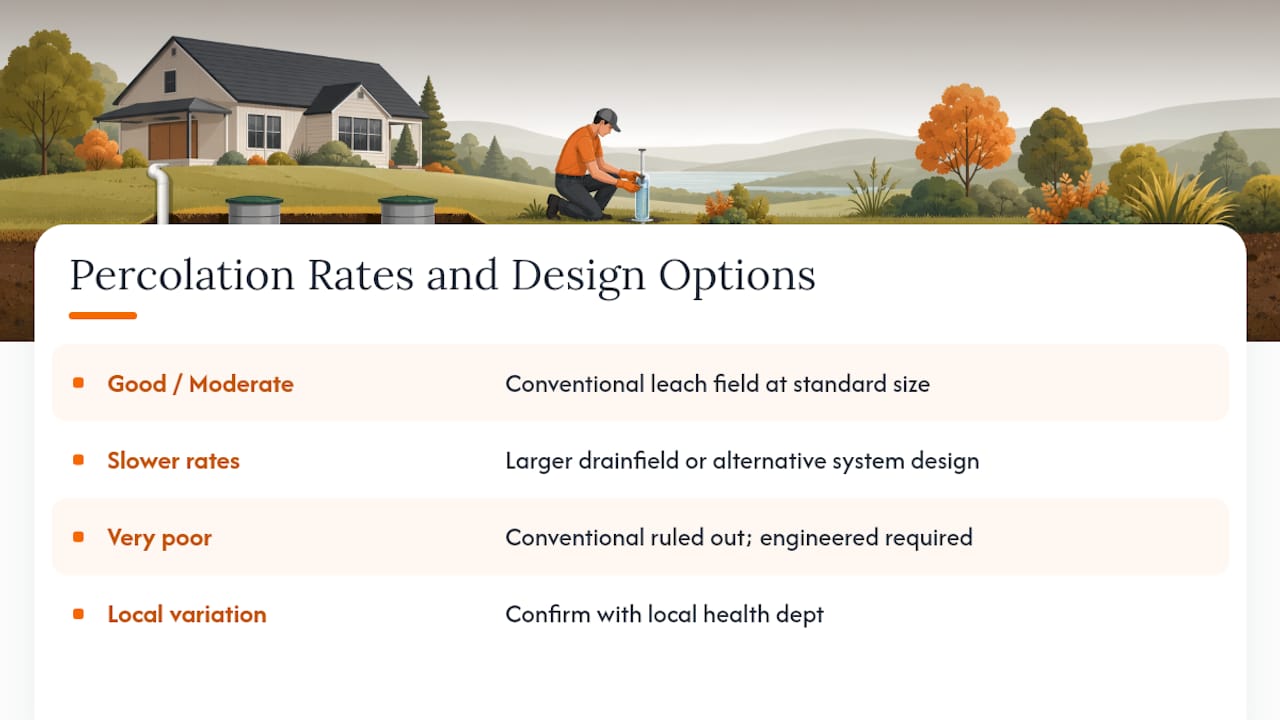
One caution worth repeating: thresholds are not universal. What passes in one county might fail in the next, so always confirm the numbers with your local health department before assuming anything.
How to Perform a Percolation Test Step by Step
Here’s the sequence a technician actually follows on-site, whether that’s you supervising a hire or a contractor doing the full job.
- Pick test locations where the proposed drainfield will actually sit. Skip disturbed fill dirt, compacted areas, and anywhere still frozen.
- Contact your local health department first if a permit or scheduled inspection is required. Many jurisdictions insist on this before any digging starts.
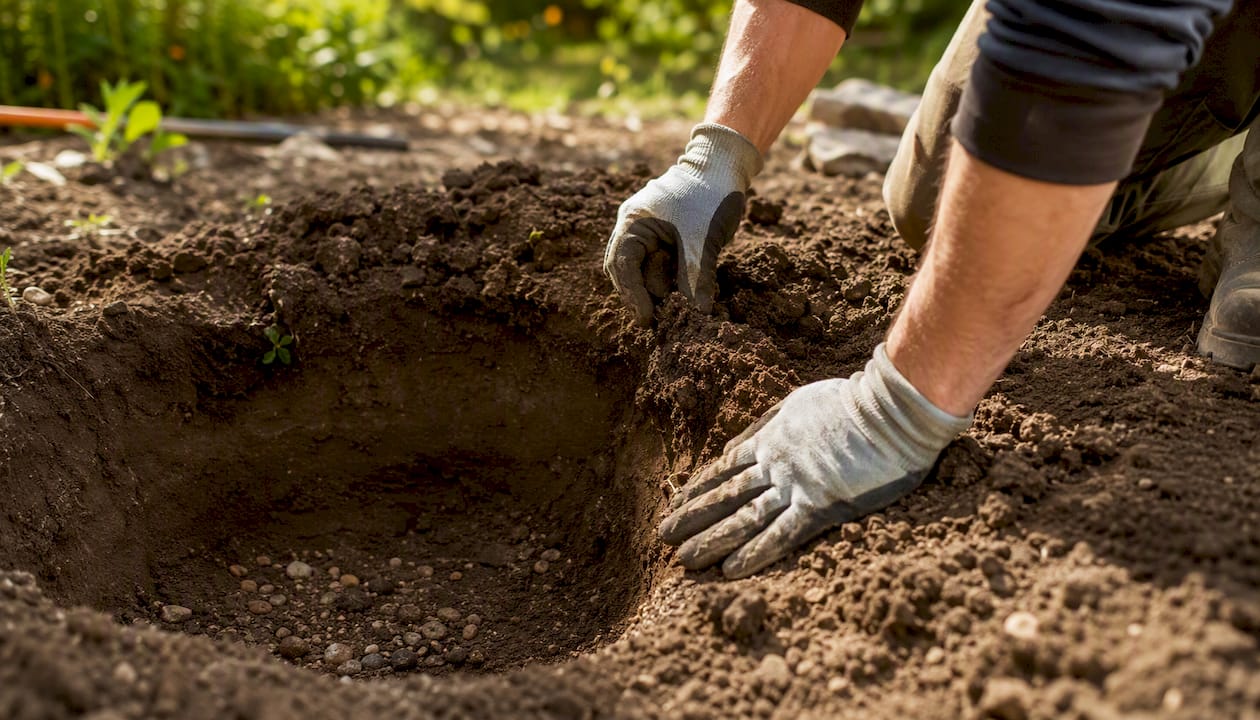
- Dig 3 to 6 holes, each 4 to 12 inches in diameter, down to the depth of the proposed trench, typically 24 to 30 inches. Some counties add a rule requiring extra holes dug to 4 feet below the proposed system to check for rock or groundwater, according to Carroll County Health Department guidance.
- Presoak each hole by filling it with about 12 inches of water over a gravel base. Clay soils may need to soak for hours or even overnight; sandy soils often skip the long soak because they drain fast enough on their own, per Monona County’s testing instructions.
- Take readings at set intervals, commonly every 30 minutes, though fast-draining soils get checked every 10 minutes so nobody misses the drop. Record every measurement.
- Collect at least three stable readings per hole using the board-and-yardstick setup, then move to the calculation.
Avoid testing frozen ground, right after a drought, or during flood conditions. Any of those will hand you a number that doesn’t reflect how the soil behaves the rest of the year.
Pro Tip: Ask whoever runs your test to keep the hole walls from sloughing in during the soak. Crumbled sidewalls are one of the most common reasons a perc test gets rejected and has to be redone.
How to Calculate the Percolation Rate
The formula is straightforward: percolation rate equals minutes elapsed divided by inches of drop. If the water level drops 2 inches in 30 minutes, that’s 15 minutes per inch. Where results vary widely between holes, many departments instruct designers to use the slowest reading rather than an average, since the system has to work everywhere in that field, not just the fast spots.
What Percolation Rates Count as a Pass or Fail?
Ranges vary by jurisdiction, but a few benchmarks show up consistently in health department guidance:
- Under 2 to 5 MPI: Too fast. Water moves through before it’s treated, risking groundwater contamination.
- 5 to 30 MPI: Generally suitable for a conventional leach field, per Carroll County’s published ranges.
- 30 to 60 MPI: Slower. Often workable, but usually requires a larger drainfield or a different system design.
- Over 60 MPI: Conventional fields are unlikely to pass. Expect a conversation about mounds, lagoons, or other engineered alternatives.
Sand mound systems can sometimes tolerate rates up to 60 MPI where a conventional field can’t. That’s a meaningful difference if your soil sits right at the edge, which is exactly why the system choice matters as much as the raw number. Our breakdown of soil conditions for septic systems goes deeper into how soil texture drives these outcomes. Check your county’s specific cutoffs before assuming any of these ranges apply to your lot.
When Is the Best Time to Schedule a Perc Test?
Testing during a dry summer stretch can hand you a misleadingly fast reading that doesn’t reflect conditions the rest of the year. Some jurisdictions now require wet-season testing specifically to capture the water table at its seasonal high, which is a smarter baseline for design purposes.
Avoid testing frozen ground, right after prolonged drought, or during active flooding. In much of the country, late winter through spring, when the water table typically runs highest, is the window that produces the most reliable numbers.
Who Performs a Perc Test and What Does It Cost?
Depending on your state, the test might be run by a certified soil evaluator, a registered environmental health specialist, a licensed professional engineer, or a local health department inspector. Requirements vary enough that it’s worth asking your county directly who’s authorized before you hire anyone.
The permitting flow generally looks like this:
- File an application and pay a fee with your local health or planning department.
- Schedule the excavation and test, either with the department itself or an approved private inspector.
- Wait for results and a written determination before finalizing any septic design.
Expect the on-site portion to take a few hours once holes are dug and presoaked, though scheduling lead time with a busy health department can stretch to a couple of weeks. Costs run anywhere from a couple hundred dollars to over a thousand depending on your market, number of holes required, and whether an engineer needs to be involved. Our septic permitting guide walks through the paperwork side in more detail.
What Are Your Options If the Land Fails a Perc Test?
A failed test doesn’t automatically mean the land is worthless. Start by confirming the results, ideally with a second test if the numbers were borderline or inconsistent. From there, check what your local code allows for alternative systems before ruling anything out.
Common paths forward include mound systems, sand mounds, other engineered designs, lagoons, an oversized conventional drainfield if there’s room, or, where available, connecting to municipal sewer. Each comes with tradeoffs. Mounds cost more and need more land but work on marginal soil. Engineered systems add design and inspection costs but can rescue an otherwise unbuildable lot. Our page on septic systems without leach fields covers these alternatives in more depth.
If your results are truly bad across every test hole, you’ll likely need an engineer-stamped design and a special permit, and in some cases it’s genuinely more cost-effective to walk away and look at a different lot. That’s not a fun conversation, but it’s a cheaper one to have now than after you’ve bought the property.
How Jmseptic Handles Perc Testing for Local Homeowners
Jmseptic handles site evaluation, arranges or performs the test holes, logs every measurement, and prepares the report your local health department needs for approval. We also recommend system type and size based on what the numbers actually show.
Before hiring anyone for this work, ask to see:
- A sample test report so you know what documentation to expect.
- Credentials and whether they’re authorized to test in your county.
- References from past septic installs, not just testing jobs.
- Whether they handle the permitting paperwork or leave that to you.
Expect logged measurements, a calculation example, a site plan, and a report formatted for your county’s submission process. Our septic system installation guide walks through what comes after the test clears.
The Part of Perc Testing Homeowners Get Wrong
Most guides treat the perc test like a one-time pass/fail event. It isn’t. The real value is in what the number tells you about long-term system performance, not just whether you clear a permitting bar today.
Homeowners chase the “pass” and stop thinking about it. That’s a mistake. A borderline result, say 28 MPI when your county’s cutoff is 30, is worth a second test rather than a sigh of relief. Seasonal swings are real, and a test run during a dry stretch can hide a water table problem that surfaces the first wet spring after installation.
The other overlooked piece: a failed test is a design problem, not a verdict on the property. Too many buyers walk away from land that would work fine with a mound system or an oversized field, because they hear “failed” and assume “unbuildable.” Get a second opinion from someone who installs these systems, not just someone who tests soil, before you make that call.
Frequently Asked Questions
What is a percolation test used for?
A percolation test determines whether soil on a property can absorb and treat wastewater from a septic system, and its results decide the size and type of drainfield your permit will require.
How long does a percolation test take?
The on-site portion typically takes a few hours once holes are presoaked, though slow-draining soils requiring overnight soaking can stretch the process over two days.
What is a good percolation rate for a septic system?
Rates between roughly 5 and 30 minutes per inch generally suit a conventional leach field, though exact cutoffs vary by county, so always confirm local thresholds.
Can you build on land that fails a perc test?
Often, yes. Alternatives like mound systems, engineered designs, or connecting to sewer can make an otherwise unbuildable lot workable, though usually at higher cost.
Who is qualified to perform a percolation test?
Depending on your state, that could be a certified soil evaluator, environmental health specialist, licensed engineer, or health department inspector. Check with your local health department before hiring anyone.
Sources
- Residential Onsite Wastewater Treatment: Conducting a Soil Percolation Test (UNL Extension)
- Percolation Tests/Wet Weather Testing (Carroll County Health Department, MD)
- Percolation test instructions (Monona County, Iowa PDF)