
What Is a Licensed Septic Contractor? A U.S. Guide
Discover what a licensed septic contractor is and how they ensure proper installation and maintenance of septic systems in your state.

A licensed septic contractor is a professional authorized by a state or local agency to legally install, repair, maintain, and service septic systems. That authorization comes with real teeth: passing a written exam, logging documented field experience, carrying a minimum level of liability insurance, and completing approved training hours. There is no federal license for this work. Every requirement flows from the state level, which means what qualifies someone in Florida looks different from what Texas or North Carolina demands.
The scope of work a licensed contractor can perform depends on the specific license class they hold. Some licenses cover installation only. Others authorize pumping, inspection, or system design. Agencies like the Florida Department of Environmental Protection, the Texas Commission on Environmental Quality (TCEQ), and North Carolina’s onsite wastewater board each define these boundaries differently. Hiring someone without the right class of license for your specific job is just as risky as hiring someone with no license at all.

What licensing requirements do septic contractors need to meet?
Requirements vary by state, but several elements appear consistently across jurisdictions.
- Training hours: Most states require between 8 and 40 hours of approved coursework before an applicant can sit for the licensing exam.
- Written exam: Candidates must pass a state-approved test covering soil science, hydraulic calculations, system installation standards, and local regulations. Many states set the passing threshold at 70–80%, with South Carolina requiring at least 80% to pass.
- Field experience: Documented hands-on work is required, often verified by a supervising contractor or employer.
- Liability insurance: Most states mandate a minimum of $300,000 in general liability coverage.
- License class: Different credentials cover installation, pumping, inspection, and design separately. Exceeding a license’s scope risks fines or revocation.
| Requirement | Typical Standard | State Example |
|---|---|---|
| Training hours | 8–40 hours | Varies by state |
| Exam passing score | 70–80% | South Carolina: 80% minimum |
| Field experience | Documented hours with supervisor sign-off | Florida: three years of experience (6,000 hours) or approved coursework covering up to 4,000 hours |
| Liability insurance | $300,000 minimum | Florida DEP standard |
| License classes | Installation, pumping, inspection, design | Texas: four distinct tiers |
How do you apply for a septic contractor license?
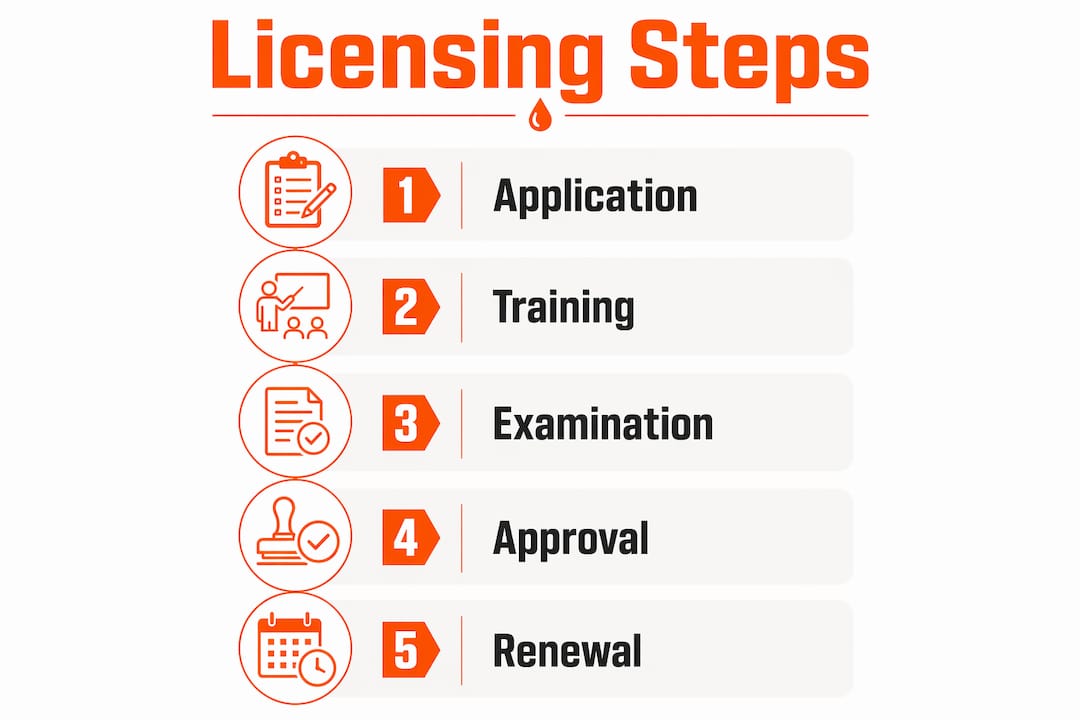
The application process follows a predictable sequence, though the paperwork differs by state.
- Review eligibility requirements for your state’s specific license class before submitting anything.
- Accumulate and document field experience, verified by a licensed supervisor, employer, or regulatory agency.
- Complete required training through a state-approved course provider.
- Schedule and pass the licensing exam through your state agency or a designated testing center.
- Gather supporting documentation: proof of insurance, experience verification forms, and any required certifications.
- Submit the application with all supporting materials and applicable fees.
In Florida, applicants file DEP Form 4075 with the Department of Environmental Protection. Businesses operating under a fictitious name or structured as a corporation must also file DEP Form 4077 for a certificate of authorization, along with a $250 fee. At least one principal officer of that business must hold a registered or master septic tank contractor license.
Pro Tip: If you have an out-of-state license, Florida accepts that experience on a year-for-year basis, provided the original license required an equivalent exam covering topics like soil classification, system sizing, and drainfield construction standards.
How does license renewal work, and what continuing education is required?
Licenses do not stay active on their own. Most states require annual or biennial renewal, and letting a license lapse carries real consequences.
- Renewal cycles: Annual renewal is standard in South Carolina; other states use two-year cycles. Fees vary by tier and license type.
- Continuing education units (CEUs): Most states require contractors to complete approved courses each renewal period to stay current on code changes, environmental regulations, and new system technologies.
- Late fees and expiration: In South Carolina, failure to pay renewal fees within 90 days of the due date results in full license expiration.
- Consequences of lapsed renewal: An expired license typically means starting the entire application process over, including retaking the exam.
Staying current matters beyond just keeping the license active. State codes change, and a contractor who last renewed five years ago may be working from outdated standards on your property.
How do Florida, Texas, and North Carolina each handle septic contractor licensing?
These three states illustrate just how much licensing structures can differ.
Florida requires applicants to document at least three years of experience, totaling 6,000 hours, or complete approved coursework covering up to 4,000 of those hours. The Florida DEP oversees registration and distinguishes between registered contractors and master septic tank contractors, the latter having unlimited scope including system design where permitted by law.
Texas takes a tiered approach through the TCEQ. The four main license categories are:
- Installer I: authorized for standard systems including septic tanks and absorptive drainfields.
- Installer II: authorized for all OSSF system types.
- Site Evaluator: performs preconstruction site evaluations; must hold a TCEQ license or a Texas Professional Engineer license.
- Designated Representative: works for an authorized TCEQ agent, performing site evaluations, complaint investigations, and construction inspections.
Apprentices in Texas may only work under constant, direct supervision of a licensed installer, and the supervising installer must visit the job site at least once per workday when not physically present.
North Carolina regulates onsite wastewater professionals through its own board structure, requiring education courses followed by a certification exam. For homeowners in Alamance County and the Piedmont Triad, understanding NC septic regulations helps clarify what credentials to look for before hiring.
Why hiring a licensed septic contractor protects you
A licensed contractor brings more than a piece of paper. Licensed status means the professional is bonded, insured, and bound by state codes that protect public health and the environment. If something goes wrong with an unlicensed installation, the homeowner often absorbs the legal and financial fallout.
The cost difference between licensed and unlicensed work looks smaller before the job than after. System failures caused by improper installation, fines from code violations, and the expense of tearing out and redoing the work can far exceed what a licensed contractor would have charged. Unlicensed septic repairs also create problems during property sales, since buyers and lenders increasingly require documentation of permitted, licensed work.
One detail most homeowners miss: a contractor’s license must match the specific service you need. A pumping license does not authorize installation. A site evaluator cannot legally perform the installation itself. Verifying license scope through your state’s licensing portal before signing any contract is the single most practical step you can take.
Pro Tip: Always check your contractor’s license status directly through your state agency’s online portal. A license that was valid last year may have lapsed, and a contractor is not required to tell you.
The benefits of licensed professionals extend beyond septic work specifically. Any trade where improper work creates health or environmental risk follows the same logic: licensing exists because the consequences of getting it wrong fall on people who had no say in how the work was done.
If you’re in Alamance County or the surrounding Piedmont Triad area and need a licensed professional for installation, repair, or maintenance, Jmseptic handles the full scope of septic work with the credentials and local knowledge to back it up.

Key Takeaways
A licensed septic contractor is a state-authorized professional who must pass exams, document experience, carry insurance, and hold the specific license class that matches the work being performed.
| Point | Details |
|---|---|
| Licensing is state-level | No federal septic license exists; requirements vary by state and license class. |
| Insurance minimum | Most states require at least $300,000 in general liability coverage. |
| Exam standards | Passing scores typically fall between 70–80%, depending on the state. |
| License scope matters | Installation, pumping, inspection, and design each require a separate credential. |
| Renewal is mandatory | Letting a license lapse often means restarting the full application process, including retesting. |