
Septic Alarm Going Off? What It Means and What to Do
Wondering what does it mean when septic alarm goes off? Learn essential steps to take immediately to protect your septic system and home.

Your septic alarm is telling you one thing: the water level in your pump chamber is too high. That usually means the pump isn’t keeping up, whether from overuse, a power issue, or a pump problem. The single most effective thing you can do right now is stop all water use in the house. Every flush, every load of laundry, every running faucet adds more liquid to a chamber that’s already struggling.
According to Septic Alarm Going Off? What It Means and What to Do, a typical pump chamber has a buffer volume between the pump-on float and the alarm float, and additional buffer before the tank outlet gets submerged. In a typical 1,000-gallon pump chamber, there are 100–200 gallons between the pump-on and alarm floats and another 200–400 gallons of buffer before the tank outlet is submerged. That buffer is your window. Use it wisely.
- Stop all water use in the house immediately (toilets, sinks, showers, dishwasher, washing machine).
- Silence the buzzer on the alarm panel. The red warning light will stay on — that’s intentional. It keeps reminding you something needs attention.
- Check the circuit breaker for the septic pump. A tripped breaker is one of the most common causes.
- Look for signs of backup inside the house or standing water near the tank or drain field.
The alarm itself is not a septic emergency in most cases. It’s a warning system doing its job. What you do in the next hour determines whether this stays a minor inconvenience or becomes a costly backup.
Table of Contents
- What a septic alarm actually is and how it works
- Step-by-step: what to do right now when the alarm sounds
- When to call a septic professional
- How to prevent alarms before they happen
- Is remote monitoring worth it for your septic system?
- Key Takeaways
- What I’ve seen on-site: a local technician’s perspective
- Jmseptic is ready to help when the alarm won’t clear
- Useful sources and next steps
What a septic alarm actually is and how it works
A septic high-water alarm is a float-activated sensor mounted inside the pump chamber (also called the receiving chamber or wet well). When the water level rises above a set point, the float triggers a control panel that sounds a buzzer and lights up a red indicator. The alarm doesn’t mean your tank is full of solids; it means the liquid level in the pump chamber is higher than it should be.
Most systems use three floats stacked at different heights:
- Off float: the pump shuts off when the level drops to this point.
- Pump-on float: the pump kicks on when the level rises to here.
- Alarm float: if the level keeps rising past the pump-on float, this one triggers the alarm.
The control panel is usually a gray or beige box mounted on a wall near the tank access or inside a utility area. It has a silence/test button and one or more indicator lights. Pressing the silence button cuts the buzzer but leaves the red light active. InspectApedia notes that the alarm is designed to distinguish between a pump that’s simply behind on demand versus one that has stopped entirely.
A septic alarm is not a “tank full” warning. It’s a high-water signal in the pump chamber, telling you the pump isn’t moving liquid out fast enough. Silencing the buzzer is safe and expected. The red light stays on as your visual reminder to follow up.
Duplex vs. single-pump systems: Duplex systems have two pumps. If one fails, the second takes over and the alarm fires as a heads-up. Single-pump systems have no backup, so an alarm there carries more urgency.
Quick glossary:
- Pump chamber: the compartment where effluent collects before being pumped to the drain field.
- Float switch: a buoyant device that rises and falls with the water level to trigger pump on/off and alarm states.
- Control panel: the electrical box that receives float signals and controls the pump and alarm outputs.
Step-by-step: what to do right now when the alarm sounds
Follow these steps in order. Most of them take under five minutes and can prevent a backup or help you avoid an unnecessary emergency call.
- Stop all water use immediately. Every drop going down a drain adds to the problem. Turn off the washing machine, skip the shower, and hold off on flushing unless absolutely necessary.
- Press the silence button on the alarm panel. The buzzer cuts off. The red light stays on. That’s correct behavior.
- Check the circuit breaker. Find the breaker labeled for the septic or sewage pump. If it’s tripped, reset it once. Listen for the pump to start running within a minute or two.
- Listen for the pump. Stand near the tank access area. A working pump makes a low hum or gurgling sound during its run cycle. Silence where you’d expect to hear it running is a bad sign.
- Look for backup inside the house. Check the lowest drains first: basement floor drains, ground-floor toilets. Slow drains or gurgling pipes are early warnings.
- Check for pooling water outside. Walk the area around your tank and drain field. Wet, spongy ground or standing water near the tank is a sign the system is overwhelmed.
- Wait 30–60 minutes with all water off. If the pump is working and the cause was water overload, the level should drop and the alarm light should clear. According to homeowner guides, this wait period is the most reliable way to confirm whether the pump is functional.
- Call a professional if the light doesn’t clear. If the red light is still on after an hour of zero water use, the pump is likely not running or the system has a more serious issue.
What NOT to do:
- Don’t open the tank cover or reach into the wet well. Septic gases including hydrogen sulfide can be lethal in confined spaces.
- Don’t reset a breaker that immediately trips again. Repeated tripping means an electrical fault that needs a licensed electrician or septic technician.
- Don’t run the dishwasher or washing machine “just one more time.” The buffer volume is finite.
For a broader look at signs your septic system needs service, that guide covers symptoms beyond the alarm that warrant a professional visit.
When to call a septic professional
Some alarm situations resolve on their own after you stop water use. Others need a technician on-site the same day. Here’s how to tell the difference.
Call now if any of these are true:
- Sewage is backing up into toilets, sinks, or floor drains.
- The alarm light stays on after 60 minutes with no water use.
- The circuit breaker trips again immediately after you reset it.
- You smell sewage inside the house or see it pooling in the yard.
- You can’t safely access or silence the alarm panel.
What a technician will do on arrival:
- Inspect the control panel and check all indicator lights and wiring.
- Test the pump manually to confirm it runs.
- Check each float switch for position, tangling, or damage.
- Inspect the effluent filter and outlet for clogs.
- Pump out the chamber if the level is too high to work safely.
- Test the drain field for saturation or failure.
- Confirm the system cycles correctly before leaving.
Service call costs vary by region and the scope of work. A basic diagnostic visit typically runs $150–$300. Pump replacement tends to fall in the $500–$1,500 range depending on pump type and access. Emergency or after-hours service adds a premium. These are approximate ranges; get a written estimate before work begins.
Urgent repairs protect more than just the system. Sewage backups can damage flooring, drywall, and HVAC equipment, and remediation costs often exceed the repair itself by a wide margin.
How to prevent alarms before they happen
Most septic alarms are preventable with consistent maintenance and a few simple habits; for detailed advice on local installation practices and groundworks, see Septic tank installation in Cambridge: A guide to local groundworks – GCS Contractors Ltd. The EPA’s SepticSmart guidance centers homeowner responsibility around reducing inflow and keeping the system inspected.
Routine maintenance tasks:
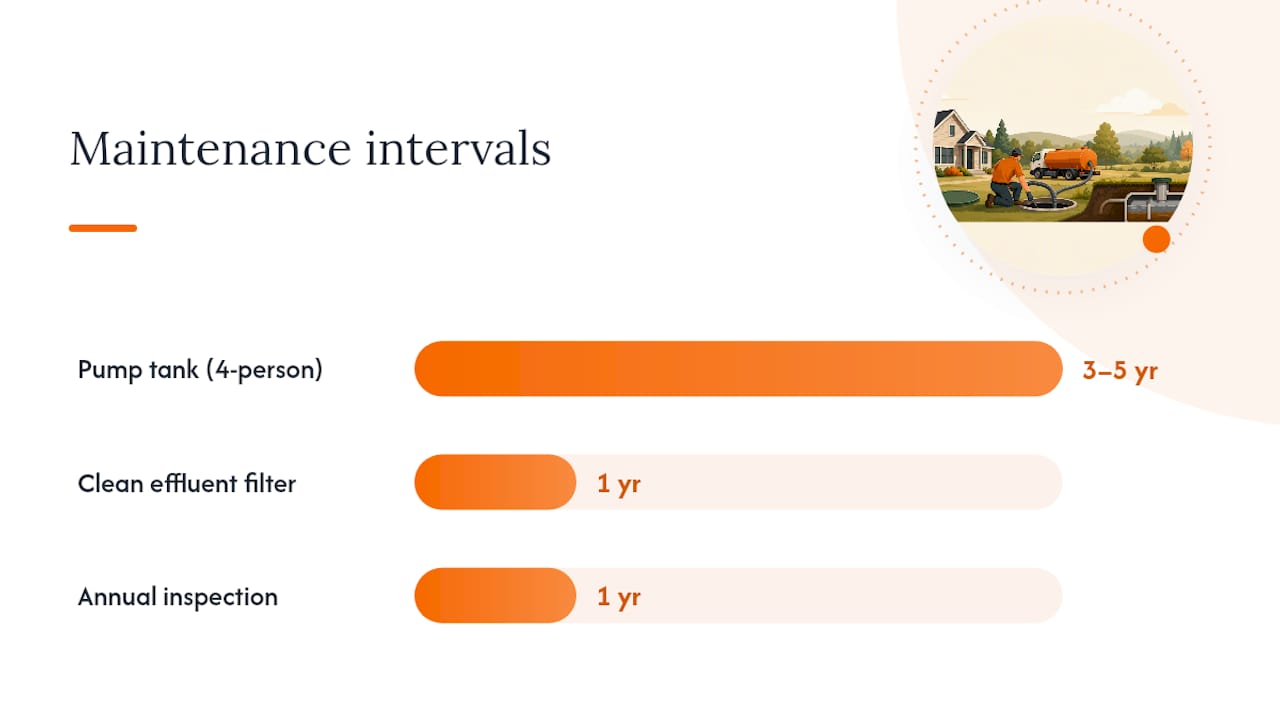
- Pump the tank on schedule. For a typical household of four, that means every 3–5 years. Smaller households or larger tanks can stretch that interval; larger households or garbage disposals shorten it. Follow your local pro’s recommendation based on your specific system.
- Clean the effluent filter annually. Most filters are accessible at the outlet baffle of the septic tank. A clogged filter is one of the most common causes of high-water alarms and one of the cheapest fixes.
- Schedule an annual inspection. A technician can catch a failing float, a worn pump, or a slow drain field months before it becomes an alarm event.
- Keep a maintenance log. Record every pump-out, inspection, and alarm event with the date and what was found. This is the most useful thing you can hand a technician.
Daily habits that reduce load:
- Spread laundry across multiple days instead of running six loads on Saturday.
- Fix running toilets promptly. A toilet that runs continuously can add hundreds of gallons per day to the system.
- Avoid flushing wipes (even “flushable” ones), grease, medications, or paper towels. These clog filters and damage pumps.
- Direct roof drainage and surface runoff away from the drain field area.
Pro Tip: After any heavy rain event, wait at least 24 hours before running high-volume appliances like the dishwasher or washing machine. Saturated soil around the drain field can’t absorb effluent normally, and adding household load right after a storm is one of the fastest ways to trigger an alarm.
For a full prevention plan, how to prevent septic failure before it gets costly covers the maintenance schedule in more detail.
Is remote monitoring worth it for your septic system?
An audible alarm only helps if someone is home to hear it. For vacation properties, rental homes, or homeowners who travel frequently, a horn going off in an empty house does nothing. That’s the core argument for remote monitoring, and industry reviewers note that mobile alerts can prevent expensive emergency repairs by enabling faster response regardless of where you are.
Monitoring approaches available today:
- Retrofit boards inside the control panel: Devices like SeptiSense from SumpAlarm install inside existing control panels and send remote alerts for high water and power loss. They include short backup power to guarantee alert delivery even after an outage.
- Non-invasive pipe and tank sensors: Products like TankSense use capacitive sensors mounted outside the tank to detect abnormal level trends without any moving parts inside the wet well. Cloud analytics can flag developing problems weeks before a failure.
- Cloud platforms with pump history logs: Some monitoring boards record pump run times and cycle frequency. A pump that’s running twice as often as usual is a warning sign you’d never catch from a single alarm event.
Features worth prioritizing:
- Power-loss alerts (so you know if the pump lost electricity, not just if the level is high)
- Pump run-history logging for trend analysis
- False-alarm reduction through non-mechanical sensors or averaging algorithms
- Backup power sufficient to transmit at least one alert after an outage
The upfront cost of a monitoring system is real, but a single prevented sewage backup or emergency pump replacement typically covers it many times over. For vacation homes and properties where nobody is on-site regularly, remote monitoring shifts from a convenience to a practical necessity.
Pro Tip: Before buying any monitoring device, confirm it’s compatible with your existing control panel voltage and wiring. A local septic technician can check compatibility in minutes and install and test the notification system at the same time.
| Feature | Why it matters |
|---|---|
| Power-loss alert | Catches outages that stop the pump before the level rises |
| Pump run-history log | Reveals overworked or failing pumps before they trip an alarm |
| Non-invasive sensor | No moving parts in the tank means fewer false alarms |
| Backup power for alerts | Guarantees notification delivery even during power outages |
| Phone/app notifications | Protects vacant or remote properties where no one hears the horn |
Key Takeaways
A septic alarm signals a high-water condition in the pump chamber, and stopping all water use immediately is the single most effective first response a homeowner can take.
| Point | Details |
|---|---|
| Stop water first | Cutting all household water use is the fastest way to slow rising levels and buy time. |
| Silence buzzer, keep watching | Press the silence button safely; the red light stays on as a reminder to follow up. |
| Buffer gives you hours, not minutes | A typical pump chamber holds 100–200 gallons between the pump-on and alarm floats, plus another 200–400 gallons of buffer before the tank outlet is submerged, giving you meaningful time to act before backup risk rises. |
| Call a pro if alarm persists | An alarm light still on after 60 minutes of zero water use means the pump needs inspection. |
| Jmseptic for Alamance County | Jmseptic provides same-day septic alarm diagnosis, pump repair, and emergency service across Alamance County and surrounding areas. |
What I’ve seen on-site: a local technician’s perspective
Most homeowners who call about a septic alarm have already done the right thing by the time we arrive. They stopped the water, silenced the buzzer, and checked the breaker. That’s exactly right. What separates a quick fix from a half-day job is usually the information they have ready when we pull up.
The most useful thing you can do before a technician arrives is write down four things: the time the alarm started, any unusual water events in the past 24–48 hours (big laundry day, guests, heavy rain), whether the breaker was tripped when you checked it, and which fixtures, if any, are draining slowly. That information cuts diagnostic time significantly.

One pattern I see repeatedly: homeowners reset a tripped breaker, the alarm clears, and they assume the problem is solved. Two weeks later, the same thing happens. A breaker that trips once might be a fluke. One that trips twice in a month is telling you the pump motor is drawing too much current, usually because it’s failing or running against a partial clog. Don’t wait for the third trip.
[Placeholder: Jason’s certifications and years of experience with J&M Septic.]
[Placeholder: A specific case example from a service call in Alamance County.]
Jmseptic is ready to help when the alarm won’t clear
When the red light stays on and stopping the water hasn’t fixed it, you need a technician who knows these systems and can get there the same day. Jmseptic serves homeowners across Alamance County and the surrounding Piedmont Triad area, including Burlington, Mebane, Elon, Graham, Whitsett, and McLeansville.

For a septic alarm that won’t clear, the relevant services are pump diagnosis and repair, control panel inspection, effluent filter cleaning, hydro jetting for clogged lines, and emergency tank pumping. Jmseptic handles all of it in a single visit when possible, so you’re not waiting on a second appointment to finish the job.
For immediate help, request emergency septic repair in Alamance County or visit jmseptic.com to reach the team directly. Same-day service is available for active alarm situations.
Useful sources and next steps
Vetted references for deeper reading:
- Septic Alarm Going Off? What It Means and What to Do
- How to care for your septic system – EPA
- Septic alarm reset, install, repair — InspectApedia
- Septic alarm going off: here’s what it means and how to respond – Gateway Septic
- What do you do when your septic alarm goes off? – Ability Septic
- TheSeptic.Guide — reviews: best septic system alarms
- TankSense — non-invasive septic monitoring
- SeptiSense — SumpAlarm product page
Your next steps after an alarm event:
A note on local regulations: Septic system repair and installation in North Carolina requires a licensed contractor and, for certain work, a permit from your county health department. Always confirm licensing and permit requirements with your local authority before any major repair or installation work begins.
This article provides general homeowner information, not professional advice. Confirm current rules and system-specific guidance with a licensed septic professional or your county health department.