
UV light for septic systems: Smart solutions for Piedmont Triad homes
Discover smart solutions using UV light for septic systems in Piedmont Triad homes. Learn how UV disinfection protects your property today!

If you own a home in Alamance County or anywhere across the Piedmont Triad, you already know that septic system limitations can turn a routine property decision into a serious headache. Small lots, high groundwater, and clay-heavy soil all work against traditional drainfield installations. UV light disinfection has stepped in as a practical, chemical-free alternative that satisfies both your treatment needs and North Carolina’s environmental standards. This guide walks you through how UV technology works, how to evaluate it for your specific property, what options exist, and how it stacks up against other treatment methods.
Table of Contents
- UV light basics for septic systems
- Criteria for choosing UV light: What matters most
- UV light options and maintenance essentials
- Pretreatment and clear effluent: Making UV work
- Head-to-head: UV vs. other septic treatments
- The real story: What Piedmont homeowners need to know
- Next steps: Expert help for your septic and UV choices
- Frequently asked questions
Key Takeaways
| Point | Details |
|---|---|
| UV suits sensitive sites | UV light is ideal for septic systems in environmentally sensitive or small-site areas. |
| Maintenance is critical | Annual servicing prevents common UV failures like dead bulbs and biofilm. |
| Clear effluent boosts efficacy | UV treatment depends on pre-treatment for clear effluent and maximum pathogen removal. |
| Compare alternatives wisely | UV compares favorably to chlorine but lacks residual protection, so site context matters. |
| Consult local experts | Local regulations and expert advice drive the right choice for Piedmont Triad homeowners. |
UV light basics for septic systems
UV disinfection works by exposing wastewater to ultraviolet light at a specific wavelength (typically 254 nanometers) that destroys the DNA of bacteria, viruses, and other pathogens. Once that DNA is damaged, the microorganisms can no longer reproduce or cause illness. No chemicals enter your water supply, nothing toxic remains after treatment, and the process happens almost instantly as the effluent (treated wastewater) passes through the UV chamber.
This matters a lot for homeowners in sensitive areas. When your property sits near a creek, a wetland, or a neighborhood well, you need a treatment method that does its job without introducing chlorine byproducts or chemical residue into the environment.
Here are the core benefits UV brings to residential septic treatment:
- Chemical-free process. No chlorine tablets to store, handle, or monitor for proper dosing.
- Fast acting. Disinfection happens in seconds as water moves through the unit.
- Low ecological impact. Treated water discharged to the surface carries no chemical residue.
- Compact footprint. UV units fit into tight mechanical spaces without major construction.
- State approval for surface discharge. NC has approved specific UV-equipped systems for situations where drainfields simply aren’t viable.
That last point is especially relevant here in the Piedmont Triad. The AdvanTex AX20-RTUV system is approved in North Carolina for surface discharge where conventional drainfields aren’t feasible, demonstrated in a Chapel Hill case close to our region. That’s a direct solution for homeowners who have run out of traditional options.
“UV disinfection gives Piedmont Triad homeowners a path forward when their lot simply can’t support a drainfield. It’s state-approved, eco-friendly, and delivers reliable pathogen removal when properly installed and maintained.”
Pro Tip: Before assuming your property needs a UV system, get a licensed soil evaluation. Some lots that seem too small or too wet for a drainfield can still qualify for alternative drainfield designs at lower cost.
Criteria for choosing UV light: What matters most
UV treatment isn’t the right call for every property. Knowing when it fits, and when it doesn’t, saves you money and avoids regulatory headaches with Alamance County or the NC Department of Health and Human Services (DHHS).
Here’s how to think through whether UV makes sense for your home:
- No viable drainfield area. If your lot is too small, too steep, or has groundwater too close to the surface to support a conventional or alternative drainfield, UV with surface discharge may be your only permitted option.
- Proximity to sensitive water resources. Properties near streams, wetlands, or municipal water supply watersheds face stricter discharge standards. UV meets those standards without chemical risks.
- Regulatory compliance. NC DHHS and your county environmental health office govern what treatment systems are approved. You can’t simply install a UV unit and start discharging to the surface without proper permits, inspections, and ongoing reporting.
- Preference over chlorine. For properties near waterways or ecologically sensitive areas, the eco-friendly advantage of UV over chlorine is a meaningful reason to choose UV even when chlorine disinfection might technically be permitted.
- Commitment to ongoing maintenance. UV systems require regular professional service. If you’re not prepared to budget for annual maintenance, a UV unit will degrade in performance quickly.
The regulatory piece trips up a lot of homeowners. You might find a UV system online, read positive reviews, and assume installation is straightforward. It isn’t. In North Carolina, advanced treatment systems that discharge to the surface go through a formal approval and permitting process. Working with a licensed professional isn’t optional here.
“For Alamance County homeowners, UV fits best in advanced systems on sensitive or small lots without drainfields. It requires professional installation and ongoing maintenance per NC DHHS and county environmental health rules.”
Pro Tip: Call your county environmental health office before investing in any advanced treatment system. Ask specifically which systems are pre-approved for surface discharge in your area. This one call can save you thousands of dollars in misdirected expenses.
UV light options and maintenance essentials
Once you’ve confirmed your property qualifies, the next step is understanding what’s actually available and what each option demands from you as an owner.
System types available for residential use:
- Basic residential UV units. These attach to existing septic systems after a treatment stage. They’re simpler and less expensive, but they depend heavily on the quality of effluent coming from your primary treatment system.
- Integrated advanced systems (like AdvanTex AX20-RTUV). These combine textile-based treatment media with a built-in UV disinfection chamber. They’re designed as complete solutions and are the type approved for surface discharge in NC.
- Commercial-grade UV systems. Larger units designed for higher flow rates. Rarely needed for single-family homes.
Maintenance is where most homeowners underestimate the commitment. A field study from Washington State found that 25% of UV units had dead bulbs, 8% had biofilm buildup on the quartz sleeves (the protective tubes around the UV bulbs) that blocked the light, and 51% of bulbs were over two years old, well past the recommended replacement interval. Those numbers represent real systems failing silently in people’s yards.
| Maintenance Task | Recommended Frequency | Consequence If Skipped |
|---|---|---|
| UV bulb replacement | Every 12 months | Reduced or zero disinfection |
| Quartz sleeve cleaning | Every 6 to 12 months | Biofilm blocks UV light |
| Full system inspection | Annually (by licensed tech) | Undetected component failures |
| Effluent quality check | Annually | Turbidity problems undetected |
The biofilm and maintenance challenge is particularly sneaky because the system looks operational even when it isn’t disinfecting properly. A bulb can glow with dimmed output and still appear functional to the untrained eye. Only a professional with proper testing equipment can confirm the system is hitting required disinfection standards.
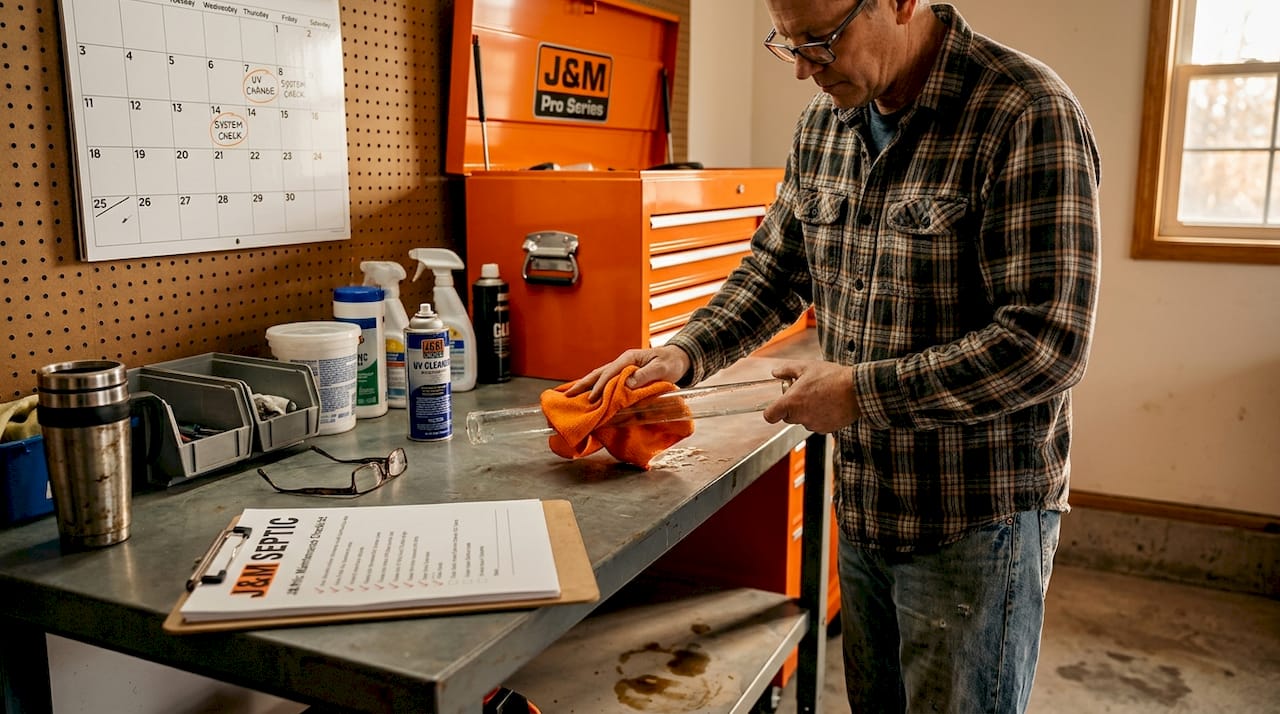
Field data also shows a 25 to 33% failure rate in UV systems without active management. That’s not a scare tactic. That’s real-world performance data from systems in the field across varied climates and property types.
Pro Tip: Set a calendar reminder for annual UV maintenance the same week you schedule your septic pumping. Combining service visits lowers your total cost and keeps everything on one schedule.
Pretreatment and clear effluent: Making UV work
Here’s something most homeowners don’t realize until after they’ve installed a UV system: the UV light itself isn’t the whole story. The quality of the water entering the UV chamber determines whether disinfection actually works.
UV requires clear effluent to function properly. When turbidity (cloudiness caused by suspended solids in the water) is too high, particles physically block the UV light from reaching pathogens. A pathogen hiding inside or behind a solid particle can pass right through the UV chamber without being neutralized. This means your system passes a visual inspection and still lets harmful microorganisms through.
Pretreatment steps that protect UV performance include:
- Primary settling. The septic tank itself removes large solids before water moves on. A well-functioning tank is the first line of defense.
- Secondary treatment. Systems like AdvanTex use textile filters to remove finer organic material before the UV stage.
- Effluent filters. Installed at the outlet of the septic tank, these catch smaller particles that would otherwise cloud the effluent.
- Routine pumping. Overfull tanks release cloudy, high-solids effluent. Regular pumping every 3 to 5 years keeps your pretreatment chain functional.
| Factor | UV disinfection | Chlorine disinfection |
|---|---|---|
| Effluent clarity needed | High (turbidity reduces efficacy) | Moderate |
| Residual protection after treatment | None | Yes (chlorine remains active) |
| Chemical handling required | No | Yes |
| Environmental risk near waterways | Very low | Moderate (chlorine byproducts) |
| Ongoing supply costs | Bulb/sleeve replacement | Chlorine tablets/dosing equipment |
The “no residual protection” column for UV deserves extra attention. Chlorine stays active in the water after treatment, continuing to kill pathogens downstream. UV treatment stops the moment the water passes the bulb. This means UV-treated water must be managed carefully after disinfection, particularly in surface discharge applications. It’s another reason why the complete integrated system approach (rather than a bolt-on UV unit) makes more sense for UV protection and water quality best practices in demanding site conditions.
Understanding UV clarity and its impact on effectiveness helps homeowners ask better questions when evaluating systems and talking to installers.
Head-to-head: UV vs. other septic treatments
Let’s put the options side by side so you can see where UV fits in the broader picture of septic treatment choices.
| Treatment Method | Effectiveness | Eco Impact | Maintenance | Best For |
|---|---|---|---|---|
| UV disinfection | High (clear effluent) | Very low | Annual bulb/sleeve service | Sensitive sites, surface discharge |
| Chlorine tablets | High (any turbidity) | Moderate | Monthly tablet replenishment | Standard lots, less sensitive areas |
| Ozone treatment | Very high | Low | Complex equipment service | Commercial or large-scale systems |
| Standard drainfield | High (soil filtering) | Very low | Periodic inspection | Properties with adequate soil/space |
The choice for most Piedmont Triad homeowners comes down to this: if you have the land and soil conditions for a standard or alternative drainfield, that’s almost always your simplest and lowest-cost long-term option. But when surface discharge is the only path, UV is the preferred disinfection method over chlorine because it introduces nothing chemical into the environment.
Scenarios where UV clearly wins:
- Small urban lots in Burlington or Graham where expansion space simply doesn’t exist
- Properties near waterways or wetlands with strict discharge permit requirements
- Homeowners who want to minimize chemical handling and storage
- Sites with high water tables that rule out buried drainfield options
Scenarios where chlorine might still be considered:
- Sites where turbidity control is difficult to maintain consistently
- Older systems being retrofitted on a tight budget without full pretreatment upgrades
- Areas without access to licensed UV maintenance technicians
Ozone treatment delivers excellent pathogen removal but requires far more complex equipment and specialized servicing. For most single-family homes in Alamance County, the cost and complexity of ozone don’t justify its benefits over a properly maintained UV system.
The real story: What Piedmont homeowners need to know
We see a pattern with UV systems across the homes we service in this region. The technology works. The problems come from how it’s managed after installation.
Most of the UV systems we’ve encountered that are underperforming aren’t failing because of bad equipment. They’re failing because someone assumed “install and forget” was a reasonable approach. Annual maintenance sounds like a small ask until you skip it two years in a row and find out your UV bulb hasn’t been producing effective output for 18 months. At that point, you’ve been discharging inadequately treated water without knowing it.
Here’s what we believe most articles on this topic gloss over: pretreatment quality matters as much as the UV unit itself. You can install the most advanced UV chamber on the market and still see poor results if your septic tank is overdue for pumping and your effluent filter is clogged. The UV stage is the last step in a chain, and every link in that chain has to work.
We’d also push back on the idea that the “best” system is always the most advanced or most expensive one. For some Piedmont Triad homeowners, the right answer is a straightforward conventional system with proper sizing and maintenance. For others, an integrated UV system like AdvanTex is genuinely the only viable path. The difference comes down to a proper site assessment, not a product catalog.
Local regulations shape your options more than any marketing claim you’ll read online. What’s approved in one county may require additional permits in another. NC DHHS approval for a system type doesn’t automatically mean your county environmental health office will sign off without additional review. Always start with a professional site assessment and a conversation with local regulators before committing to any system.
Eco-friendly claims only hold up with regular monitoring. UV is genuinely better for the environment than chlorine when the system performs as intended. But a UV unit with a dead bulb or biofilm-coated sleeve isn’t protecting the environment at all. The eco-friendly label is earned through consistent maintenance, not through the purchase decision alone.
Next steps: Expert help for your septic and UV choices
If you’ve made it this far, you’re already thinking more clearly about your septic options than most homeowners do before they call us.
At J&M Septic Installation & Repair, we serve homeowners across Burlington, Mebane, Elon, Graham, Whitsett, McLeansville, and the surrounding Piedmont Triad with honest assessments and practical solutions. Whether you’re trying to figure out if your property qualifies for a UV-equipped advanced system or you just need a reliable maintenance partner to keep an existing system running right, we’re here to help. Find local septic solutions from a team that knows Alamance County’s soil, regulations, and site conditions firsthand. Ready to talk specifics? Request expert septic advice and we’ll start with a thorough site assessment before recommending anything.
Frequently asked questions
Is UV light safe for septic system water treatment?
Yes, UV light is a safe, chemical-free option preferred for environmental reasons, especially near sensitive areas. UV is preferred over chlorine for eco-friendliness near waterways.
Do UV systems for septic require regular maintenance?
Yes, UV units need annual bulb replacement and sleeve cleaning to maintain effectiveness and prevent failures. Field data shows 25% of UV units had non-functioning bulbs and 51% had bulbs over two years old.
What happens if the effluent isn’t clear before UV treatment?
If effluent is not clear, UV efficiency drops and pathogens may survive in the treated water. Turbidity reduces UV efficacy significantly, making pretreatment essential before the UV stage.
How does UV compare with chlorine disinfection?
UV is eco-friendlier and effective when properly maintained, but it doesn’t offer residual protection post-treatment the way chlorine does, meaning pathogens aren’t neutralized after the water leaves the UV chamber.
Is UV treatment approved for septic systems in North Carolina?
Yes, UV treatment is approved in NC for advanced systems like AdvanTex AX20-RTUV, particularly where conventional drainfields aren’t feasible and surface discharge is required.