
Understanding Leach Fields: A Homeowner’s Guide
Discover what is leach field and how it affects septic systems. Learn tips to prevent costly repairs and keep your home safe!

When your drains slow down or a soggy patch of grass appears above your yard, most homeowners assume the septic tank is to blame. That assumption sends many Alamance County residents down a costly path of tank pumping and repairs that do nothing to fix the actual problem. The truth is, a large share of septic failures originate in the leach field, the underground filtration zone that most people have never even heard of. This guide breaks down what leach fields are, why they fail, and what you can do about it before the situation becomes a full-blown emergency.
Table of Contents
- What is a leach field and how does it work?
- Warning signs and symptoms of leach field failure
- What causes leach field failure and how to prevent it
- Regulations and permitting for leach fields in North Carolina
- Why most homeowners misdiagnose septic issues—and what to do differently
- Local solutions for leach field issues in Alamance County
- Frequently asked questions
Key Takeaways
| Point | Details |
|---|---|
| Leach fields filter wastewater | They’re the essential soil-based component for cleaning septic tank effluent before it reaches groundwater. |
| Watch for common symptoms | Slow drains, odors, and soggy patches signal leach field trouble that shouldn’t be ignored. |
| Prevention is easier than repair | Regular maintenance and proper use keep leach fields healthy and save on costly replacements. |
| Regulations are strict locally | Alamance County and all North Carolina septic work requires permits, planning, and compliance with setback rules. |
| Expert help is available | Local services guide you through diagnosis, repair, and installation for septic systems and leach fields. |
What is a leach field and how does it work?
Now that you know most septic troubles trace back to the leach field, let’s look at exactly what it is and how it works beneath your yard.
A leach field (also called a drain field) is the soil-based final treatment and dispersal zone of a conventional septic system, where septic effluent is distributed into gravel and soil and cleaned through natural biological and soil processes. It is not just a hole in the ground. It is a carefully engineered system that works silently every single day.
You may hear it called several different things depending on who you are talking to. Here is a quick breakdown of common terms:
- Leach field: The most common homeowner term, used widely across the Southeast
- Drain field: Preferred by engineers and contractors in many regulatory documents
- Soil absorption system (SAS): The technical term used by state health regulators in North Carolina
- Subsurface wastewater infiltration system: The formal regulatory label in some state codes
These terms all refer to the same thing. The terminology difference is mostly regional and code-specific. As terms vary by location, what matters most is that you understand the function, regardless of what it is called on a permit.
Here is how the system actually works from tank to field:
| Stage | What happens |
|---|---|
| Wastewater enters the tank | Solids settle to the bottom, forming sludge; grease floats to the top |
| Effluent moves to the field | Partially treated liquid exits through an outlet pipe |
| Distribution begins | Effluent flows through perforated pipes or a distribution box into trenches |
| Soil filtration starts | Microorganisms in the soil break down remaining contaminants |
| Clean water enters groundwater | Treated water is absorbed safely into the earth |
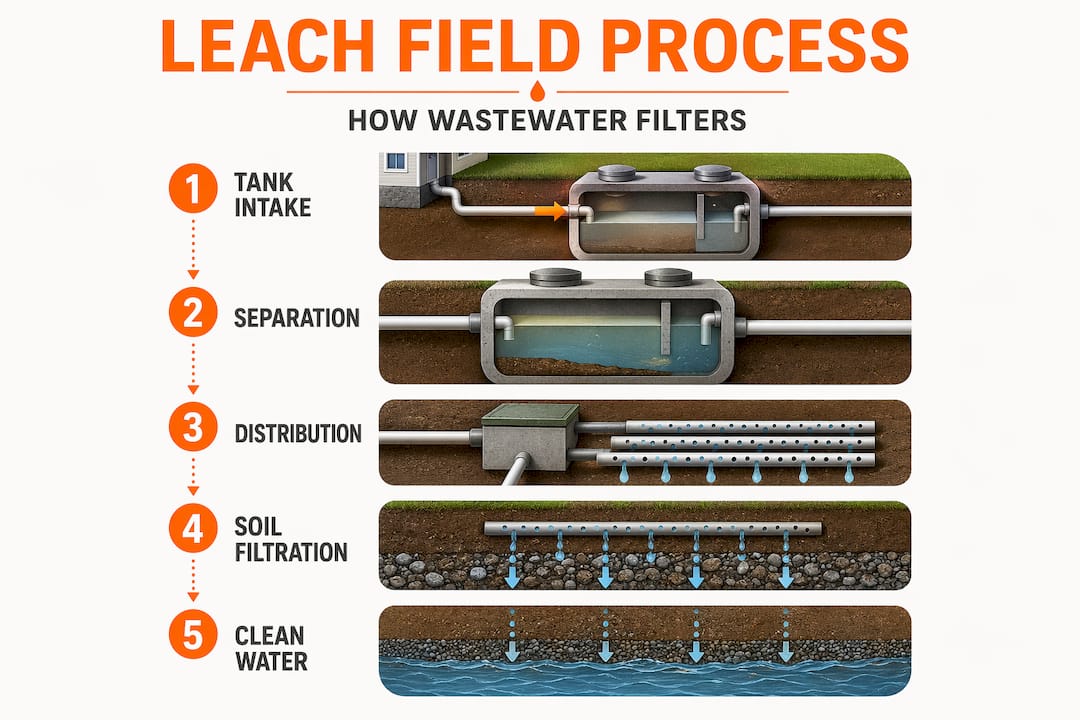
The most critical and least understood part of this process is the biomat layer. This is a thin biological layer that forms naturally at the soil-gravel interface in the trenches. Healthy biomat is actually a good thing. It slows effluent just enough for microorganisms to do their filtration work. But when the biomat grows too thick from overloading or neglect, it blocks absorption entirely. That is when you start seeing the wet spots and odors that signal serious trouble.
If your property cannot support a conventional leach field due to soil type or lot size, exploring leach field alternatives may be your best path forward. And if you are wondering whether your tank itself is adding to the problem, septic tank issues can sometimes compound field stress and are worth reviewing alongside field performance.
The leach field does not just dispose of wastewater. It treats it. Your soil is the last line of defense before treated water reaches groundwater, and keeping that system healthy protects your family and your neighbors.
Warning signs and symptoms of leach field failure
Understanding how leach fields function sets the stage for recognizing the signs when something goes wrong.

Common warning signs of a failing leach field include slow household drains, sewage odor, wet or soggy ground or standing water over or near the field, and wastewater backing up into the home. Catching these early can mean the difference between a manageable repair and a complete field replacement.
Here are the specific symptoms to watch for:
- Slow drains throughout the house: Not just one drain, but multiple fixtures sluggish at the same time, often a field issue rather than a clog
- Sewage odors inside or outside: A strong sulfur smell near the yard or coming through drains points toward effluent not absorbing properly
- Wet or spongy ground: Soggy areas directly above the field that do not dry out even in dry weather
- Unusually green or lush grass: A strip of grass that stays greener than the rest of the yard is a classic leach field warning sign
- Black slimy residue on the soil surface: This is surfacing effluent, an advanced sign of failure that requires immediate action
- Gurgling sounds from toilets or drains: Air displacement caused by a backed-up system
One mistake homeowners often make is assuming any plumbing problem is a tank problem. The comparison below helps clarify the distinction:
| Symptom | Likely source |
|---|---|
| One slow drain | Pipe clog, not a septic issue |
| Multiple slow drains + odor | Leach field or distribution issue |
| Tank backing up frequently | Possibly a full tank or inlet issue |
| Wet yard above field area | Leach field oversaturation |
| Odor inside + wet yard | Likely field failure, not just a tank issue |
Pro Tip: Walk your yard once a month during rainy seasons and again in dry spells. Wet patches that appear during dry weather are far more telling than those that show up after heavy rain. Dry-weather saturation almost always points to a leach field problem.
The septic system lifespan of your field matters here too. Most conventional leach fields last 20 to 30 years under normal conditions, but heavy use, poor soil, or improper maintenance can cut that significantly. If your home is older and has never had the system inspected, the risk of field failure is much higher. If you are already seeing symptoms, emergency septic repair services can assess the situation quickly before it gets worse.
What causes leach field failure and how to prevent it
Spotting symptoms is crucial, but preventing issues is even better. Let’s look at what causes leach field failure and how you can stop problems before they start.
When soil absorption capacity is exceeded, you see surface wetness, odors, and plumbing backups. That capacity gets overwhelmed in several ways, both mechanical and biological.
The most common causes of leach field failure include:
- Excessive water use: Running the dishwasher, multiple loads of laundry, and multiple showers in the same day sends more effluent to the field than the soil can absorb. Give your system recovery time between heavy water use cycles.
- Infrequent tank pumping: When the septic tank is not pumped every 3 to 5 years, solids escape into the field and clog the distribution pipes and soil. This is one of the most preventable causes of field failure.
- Flushing non-biodegradable materials: Wipes, paper towels, cotton products, and feminine hygiene items do not break down and will physically plug the system over time.
- Using harsh chemical drain cleaners: These kill the beneficial bacteria in your tank that break down solids, allowing more raw solids to reach and damage the field.
- Driving or parking over the field: Soil compaction from vehicles destroys the structure that allows effluent to filter through the ground. This damage is permanent.
- Tree roots: Tree and large shrub roots seek moisture and will grow directly into leach field pipes, causing cracks and blockages.
- Oversized household size or water softeners: More people than the system was designed for, or salt-based water softeners that discharge brine, can both overwhelm the field biology.
Pro Tip: Keep a planting plan for your yard that avoids placing any trees or large shrubs within 30 feet of your leach field. Roots are persistent and will follow moisture underground for surprising distances. Grass or shallow-rooted groundcover is the safest surface above a field.
Preventing failure is largely about consistent septic system maintenance habits. Have your tank pumped on a regular schedule, watch what goes down your drains, and spread out your water use throughout the week. Staying ahead of septic tank maintenance needs ensures the tank handles its job before effluent ever reaches the field.
Scheduling a septic inspection every year gives you a professional set of eyes on the system before a minor issue becomes a major repair. A good inspector will evaluate the tank, distribution system, and field conditions together so nothing gets missed.
Regulations and permitting for leach fields in North Carolina
Prevention and awareness are essential, but legal compliance is required for repairs and new systems in Alamance County.
Septic systems and drain fields in North Carolina are regulated under the NC DHHS on-site wastewater program and require permitted soil evaluations, site plans, and setback distances. For repairs or modifications, the permitting requirements depend on the specific type of work being done. This matters whether you are building new, replacing a failing field, or making repairs to an existing system.
Key regulatory requirements to understand include:
- Soil evaluation (soil morphology report): A licensed soil scientist must evaluate the absorption capacity, permeability, and depth to the water table before any system is installed or expanded
- Site plan approval: A scaled drawing showing proposed field layout, building footprint, and setbacks must be submitted to the Alamance County Environmental Health department
- Setback minimums: Fields must be placed specific minimum distances from wells, property lines, surface water, and structures
- Repair permit requirements: Even replacing a section of pipe or adding a distribution box typically requires a permit in North Carolina
- Installation by licensed contractors: Only licensed contractors may install or significantly modify on-site wastewater systems in NC
Important setback distances for Alamance County homeowners:
Leach fields must typically maintain at least 100 feet from any drinking water well. They must be set back at least 10 feet from property lines and 50 feet from streams or surface water bodies. These distances protect groundwater and neighboring properties, and violating them can result in fines or forced removal of the system.
The distinction between a repair permit and a new system permit is especially important. If you are simply repairing a broken pipe within the existing footprint, the permitting burden is lighter than if you are relocating the field or adding a new area. However, if your repair involves the actual absorption trenches, you will almost certainly need a permit and a new soil evaluation. An unpermitted repair can cause problems when you try to sell your home.
If conventional leach field regulations create obstacles for your lot, there are alternative septic systems designed for challenging soil conditions or smaller lots. Modern biofilter systems are approved under NC regulations and can be an excellent solution when traditional drain fields are not feasible. For urgent situations involving code violations or failing systems, local emergency septic repair services that understand North Carolina permitting can help you navigate both the repair and the paperwork simultaneously.
Why most homeowners misdiagnose septic issues—and what to do differently
Understanding regulations and prevention is important, but local perspective helps you see what most guides miss.
Here is something worth saying directly: most homeowners who call us about a “tank problem” actually have a field problem. We see this pattern constantly across Alamance County, from Burlington to Mebane to Graham. Someone gets their tank pumped twice in two years and still has slow drains and a wet yard. They are frustrated and confused. The tank was not the source of the problem to begin with.
The reason this misdiagnosis is so common makes sense when you think about it. The tank is visible. You can pump it, see it inspected, and get a receipt. The leach field is underground, invisible, and its early warning signs are subtle enough to dismiss. A slightly greener patch of grass does not feel urgent. A drain that takes three extra seconds to clear seems minor. But those subtle signs can represent months of slow field degradation already underway.
By the time surface wetness appears or sewage backs up into the house, the field has often been struggling for a long time. The damage that could have been corrected with a maintenance visit and a tank pumping may now require a full field replacement, which runs significantly higher in cost.
What we tell homeowners is this: treat your leach field as the more important half of your septic system. It is where the actual treatment of wastewater happens. The tank is just a settling chamber. Respect the field, do not compact the soil above it, keep large roots away, and pump the tank regularly so solids never reach the field. That combination keeps most systems running well past the 25-year mark.
If you are unsure about what you are seeing in your yard or experiencing in your plumbing, get a professional assessment early. Our team documents issues with detailed on-site evaluations and can explain exactly what is happening and what the options are. You can read more about navigating these situations in our local repair insights content for Alamance County homeowners.
Local solutions for leach field issues in Alamance County
With the right perspective and information, you are prepared to act. Here is where you can find local help for leach field challenges.
At J&M Septic Installation & Repair, we work with Alamance County homeowners every day on exactly the kinds of problems described in this guide. Whether you are dealing with soggy ground, slow drains, or a system that has stopped working entirely, we provide honest assessments and practical solutions based on your specific property and soil conditions.

If your situation is urgent, our emergency septic repair team responds quickly to active failures, sewage backups, and systems that pose a health risk. For homeowners whose systems are beyond repair, we offer new system installation custom-designed for your lot and local soil conditions. Acting promptly matters because delayed repairs cost significantly more and can result in health violations. Learn more about why urgent septic repairs protect both your property and your wallet in the long run. Call us today to schedule an on-site evaluation with a local team that knows Alamance County.
Frequently asked questions
How can I tell if my leach field is failing?
Failing leach field signs include slow household drains, sewage odors, wet or soggy ground above the drain field, and wastewater backing up into the home. If you notice two or more of these at the same time, schedule a professional inspection right away.
What is the difference between a leach field and a drain field?
They are essentially the same thing. As terms vary by location and code, some documents use “drain field” and “leach field” interchangeably, while others call it a soil absorption or subsurface wastewater infiltration system. The function is identical regardless of the label used.
Are there rules for installing leach fields in Alamance County?
Yes. Under NC DHHS on-site wastewater regulations, you need a permitted soil evaluation, site plan, and compliance with setback distances before installing or significantly modifying a leach field. Permits are required even for many types of repairs.
Can a leach field be repaired, or does it need replacement?
Minor issues like a broken distribution pipe can often be repaired. However, because leach fields rely on gravity distribution and soil biology, severe biomat clogging or long-term oversaturation usually means the field’s absorption capacity is permanently compromised and full replacement is necessary.
How often should my leach field be inspected?
Annual septic system inspections are recommended for most households. An annual visit lets a professional catch early field deterioration, distribution problems, and tank overflow issues before they turn into expensive repairs.