
Tree Roots in Sewer Lines: How to Spot and Stop Them
Discover how to identify and eliminate tree roots in sewer lines before they cause major damage. Act now to protect your plumbing!

If multiple drains are running slow, you’re catching whiffs of sewage in the yard, or you’ve got a soggy green patch that never dries out, tree roots are a likely culprit. Get a camera inspection before you spend money on anything else.
Do this now:
- Cut back on laundry, dishwashing, and long showers until you know what’s going on.
- Skip the caustic drain chemicals from the hardware store. They rarely reach the real blockage and can damage older pipe.
- If you’ve got raw sewage backing up into the house or a sinkhole forming in the yard, call a professional immediately. That’s not a wait-and-see situation.
One thing to understand up front: cutting out roots or hydro jetting the line restores flow, but neither one fixes a cracked pipe or a failed joint. That’s a maintenance move, not a repair.
TL;DR:
- A camera inspection is essential to determine whether roots are causing the blockage or if the pipe has structural damage requiring repair.
- Mechanical snaking or hydro jetting temporarily clears roots but does not fix cracks or joints, leading to recurring blockages within months to years.
- Permanent solutions like CIPP relining or trenchless pipe replacement seal the pipe and prevent future root intrusion, often saving money over repeated cleanings.
- Costs vary based on pipe access, length, material, and condition, with pipe repair generally being more cost-effective long-term than frequent cleanings.
- Insurance rarely covers root-related damage, so homeowners should prioritize preventive inspections and choose professional providers who diagnose with video before recommending repair options.
Table of Contents
- Signs Tree Roots Are in Your Sewer Line
- Short-Term Options to Clear Roots From a Sewer Line
- What Permanent Sewer Line Repairs Actually Fix
- How to Prevent Roots From Coming Back
- When Should You Call a Sewer Repair Professional?
- What Does Removing Roots From a Sewer Line Cost?
- A Technician’s View on Recurring Root Problems
- Get a Camera Inspection Before Roots Cost You More
- Key Takeaways
- Sources
Signs Tree Roots Are in Your Sewer Line
Ordinary clogs tend to be local. Roots aren’t. That’s the biggest tell.
A single slow drain in one bathroom is usually just hair or grease. But when the kitchen sink, the shower, and the toilet all start draining sluggishly around the same time, and it keeps happening every few weeks no matter how much you plunge, that’s a sewer main issue, not a fixture issue. Gurgling sounds from a toilet after you run the washing machine are another giveaway. Air trapped by a partial blockage downstream has to escape somewhere, and it pushes back up through the water in the bowl.
Outdoors, watch for these:
-
A patch of grass that’s noticeably greener, spongier, or wetter than the rest of the yard, especially one that traces the path of your sewer line.
-
A section of ground that’s started to sink or dip, which can mean a pipe has partially collapsed underneath.
-
A tree or shrub near the line that seems to be thriving suspiciously well, sometimes because its roots have tapped into a steady, nutrient-rich water source that shouldn’t exist.
-
Backups that come back within weeks of a cleaning, even after a plumber cleared the line.
Roots don’t punch through solid pipe. They’re drawn to escaping moisture and follow that trail to a crack, a loose joint, or a gap in old clay pipe, then wedge in and expand as they grow, according to Traverse City’s sewer department. Once a root gets a foothold, it thickens over seasons, and what started as a hairline fracture becomes a blockage that can stop wastewater cold.
A camera inspection is the one diagnostic step that actually tells you what you’re dealing with. A plumber or septic technician feeds a waterproof camera through a cleanout access point and watches the feed in real time, mapping exactly where roots have entered, how far they extend, and whether the pipe itself is cracked, offset, or sagging. Skip this step and you’re guessing. Get it done and you know whether you need a $200 cleaning or a $6,000 repair.
Roots cause the majority of sewer line blockages nationwide, according to research from the U.S. Forest Service. If your line is more than 20 years old and you’ve got mature trees anywhere near the route, root intrusion should be your first suspicion, not your last.
Short-Term Options to Clear Roots From a Sewer Line
Once a camera confirms roots, you’ve got three ways to restore flow without digging up the yard, and each one buys you a different amount of time.
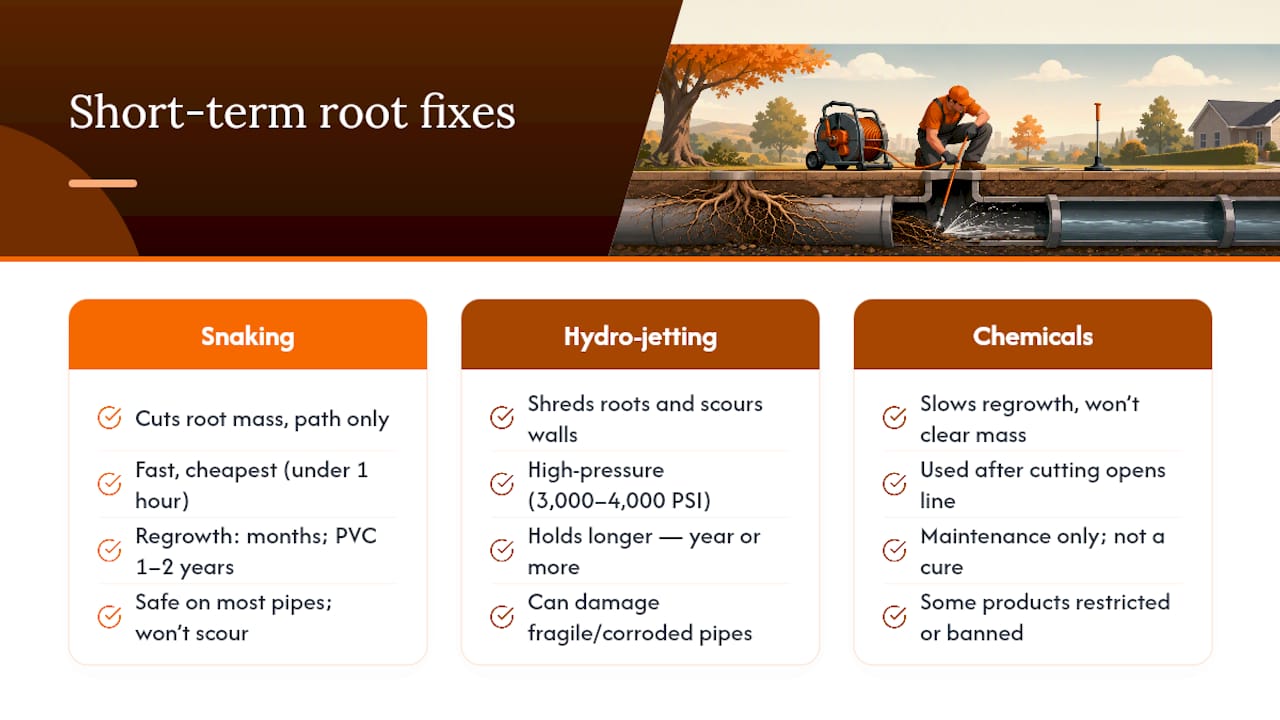
Mechanical snaking or augering uses a rotating cable with a cutting head to chew through the root mass and pull debris back out. It’s the fastest and cheapest option, often finishing in under an hour for a straightforward blockage, and most plumbers carry the equipment on the truck. The catch is that it only clears a path through the roots. It doesn’t scour the pipe walls, and regrowth in an older clay or Orangeburg line can show up again within months. In newer PVC with a small crack, you might get a year or two before it’s an issue again.
Hydro jetting does more thorough work. A hose delivers a concentrated stream, typically in the 3,000 to 4,000 PSI range, that shreds root masses and scours grease, scale, and sludge off the pipe wall at the same time. That combination is why hydro jetting tends to hold up longer than a simple auger pass, often keeping a line clear for a year or more. It’s not universally safe, though. A pipe that’s already fragile, badly corroded, or severely offset can be damaged by high pressure, which is why a reputable contractor runs a camera first to confirm the pipe can take it.
Foaming root killers and chemical treatments have a narrower job than the packaging suggests. These products, often copper sulfate or dichlobenil based, work as a maintenance measure after mechanical cutting has already opened the line, slowing regrowth rather than clearing an existing mass. Some are restricted or banned in certain municipalities because of groundwater and pet safety concerns, so check local rules before pouring anything down a cleanout, according to Perry Plumbing’s guidance.
Pro Tip: If you’re renting a drain snake from a hardware store to handle a slow drain yourself, stop the moment you feel resistance and hear grinding. That’s usually roots or a pipe joint, not a soft clog, and pushing harder risks puncturing pipe you can’t see. Call a professional at that point rather than turning a hundred-dollar problem into a several-thousand-dollar one.
What Permanent Sewer Line Repairs Actually Fix
Cleaning buys you time. Only a structural repair closes the entry point for good, which means roots stop coming back because there’s nowhere left for them to get in.
CIPP relining (cured-in-place pipe) involves threading a resin-saturated liner through the damaged section and curing it in place, creating a new seamless pipe inside the old one. It seals every joint and crack along the run in a single pass, and a properly installed liner typically holds up for decades. The appeal is that it requires only small access points rather than trenching the whole yard, which keeps landscaping and driveways intact.
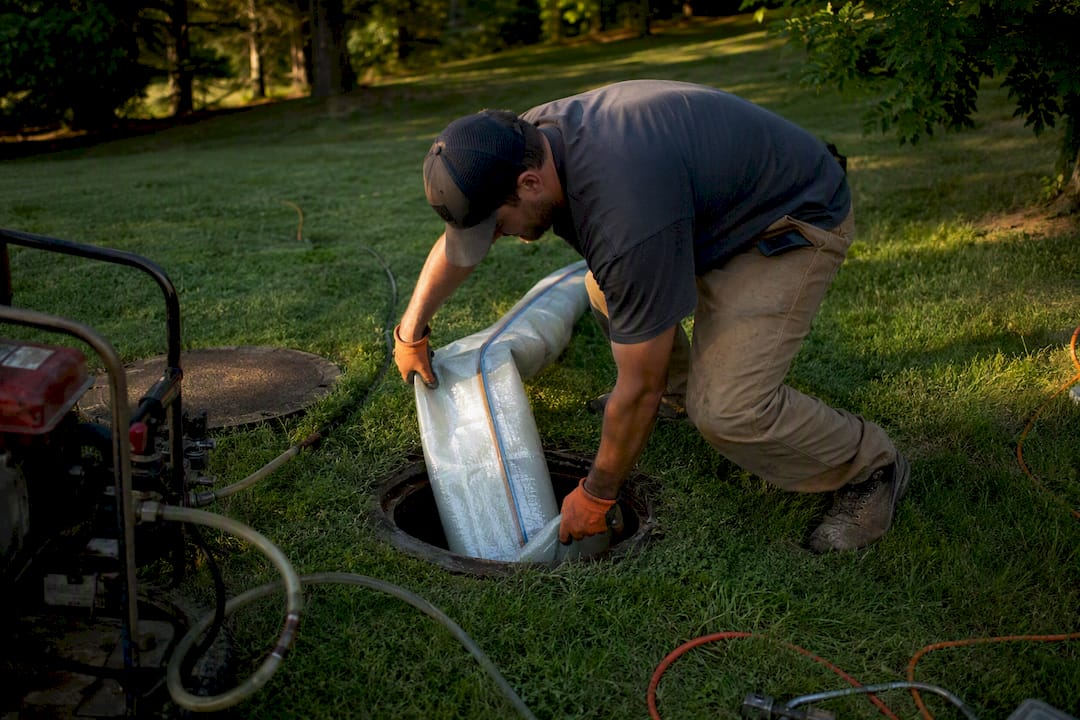
Trenchless pipe bursting replaces the pipe entirely rather than lining it. A bursting head is pulled through the old pipe, fracturing it outward while simultaneously pulling new pipe into place behind it. It works well when the existing line has enough room around it and reasonably straight runs, but it needs adequate ground access at both ends and isn’t always feasible under a slab or in a tightly congested yard.
Open excavation is the option nobody wants but sometimes can’t avoid. Severe pipe collapse, a run that passes directly under a slab foundation, or a section so surrounded by root mass that trenchless methods can’t get through all point toward digging. Access difficulty is usually what drives the price up here, not the pipe itself.
How do you know which one you need? A few signals tend to settle it:
- The line clogs again within a year of a professional cleaning, more than once.
- The camera shows visible ovalling, sagging, or misalignment in the pipe, not just root intrusion.
- The pipe is decades-old clay, cast iron, or Orangeburg nearing the end of its service life anyway.
- Excavation reveals roots have fully encircled the pipe from the outside, something a camera can miss even when the interior looks manageable on video, according to Total UC’s field observations.
How to Prevent Roots From Coming Back
Prevention starts before you ever plant a tree, and it stays relevant for as long as you own the property.
- Map your sewer line’s route before adding any tree or large shrub, and choose slower-rooting species such as dogwood or crape myrtle over aggressive spreaders like willow, silver maple, or sweetgum near that path.
- Treat distance guidelines as a starting point, not a guarantee. Roots have been documented traveling well beyond a tree’s canopy in search of moisture, so a “safe” planting distance doesn’t rule out future intrusion.
- Install a physical root barrier, a vertical panel buried alongside the pipe, when you’re planting new trees near a known sewer route or renovating landscaping around an existing line. Barriers work best installed proactively, before roots have already found their way in.
- Schedule a preventive camera inspection every 2 to 3 years if your line is older or your property has several mature trees, and repair any leaking joint or crack promptly, since that’s the moisture roots are drawn to in the first place, per Traverse City’s guidance.
Pro Tip: If you’re regrading or replacing a driveway near your sewer line anyway, that’s the cheapest window you’ll get to install a root barrier or repair a cracked joint without paying for a separate excavation later.
When Should You Call a Sewer Repair Professional?
Some situations don’t leave room for a wait-and-see approach. Sewage backing up into a tub or floor drain, a sinkhole opening in the yard, or three or more fixtures failing at once all mean it’s time to call someone today, not next week.
When you do call, ask these questions before you agree to anything:
- Do you start with a camera inspection, and will I get to see the video?
- Based on what the camera shows, are you recommending cleaning, relining, or replacement, and why that one?
- What warranty comes with the repair, and does it cover root regrowth specifically?
- What’s the timeline, and can you break the estimate down by labor, materials, and access work?
A contractor who can’t answer the first question clearly is skipping the step that actually tells you what’s wrong.
The gap between a quick cleaning and a lasting fix almost always comes down to whether someone actually looked inside the pipe first. Guessing at root damage from the surface is how homeowners end up paying for the same clog three times in two years.
Expect a solid inspection and repair job to include video documentation, a written estimate with repair options laid out, and an honest conversation about pros and cons for each path, including hydro jetting as a maintenance step versus a structural fix as the permanent one.
What Does Removing Roots From a Sewer Line Cost?
Budget expectations here hinge on one tradeoff: cleaning is cheap per visit, but it’s not a one-time cost if the pipe stays cracked.
A single mechanical snaking or hydro jetting visit is a modest expense compared to full pipe replacement. Research summarized by the U.S. Forest Service puts routine root removal at a fraction of what replacement runs, which is exactly why so many homeowners default to cleaning it out year after year rather than fixing the underlying crack. The math changes when you’re paying for that cleaning every 8 to 12 months for a decade. At that point, the fraction adds up past what a permanent relining or replacement would have cost up front.
What actually drives your final number:
- Access difficulty. A line under a driveway or slab costs more to reach than one running through open lawn.
- Length and location of the damaged section, since a short spot fix costs far less than a full run.
- Pipe material and age. Old clay or Orangeburg pipe often needs full replacement where PVC might only need a spot repair.
- Whether trenchless methods are even feasible for your specific layout.
On insurance, don’t expect much help. Most homeowner policies treat root intrusion as gradual damage, something that happened slowly over years rather than a sudden covered event, and exclude it accordingly, according to municipal guidance from Pomona, California. Homeowners are typically responsible for the lateral line running from the house to the public main; the municipality’s responsibility generally starts at the main itself. Get camera footage and a written estimate before you file any claim anyway, since some policies do carve out exceptions for sudden pipe failure, and ask your contractor directly about financing options or workmanship warranties before you sign anything.
A Technician’s View on Recurring Root Problems
Repeated cleanings feel like the cheap option because each visit is cheap. What gets missed is the total. A homeowner who calls for the same blockage every year for five years has usually spent more than a proper relining job would have cost, without ever fixing the actual crack.
Permanent repair earns its cost back once you’re cleaning more than once a year or the camera shows real structural damage. Before that point, cleaning is a legitimate strategy, not a stopgap you should feel bad about.
— Jason
Get a Camera Inspection Before Roots Cost You More
Snaking and jetting solve the symptom. Neither one repairs a cracked line or a loose joint, which means the roots come back until that entry point gets sealed. Jmseptic runs camera-first inspections for homeowners across Alamance County, so you know whether you’re looking at a routine cleaning or a pipe that needs relining or replacement, before any work starts.

We handle the full range: video inspection, hydro jetting for immediate blockages, CIPP relining, trenchless and full replacement when a line is too far gone to save, and emergency repair when a backup won’t wait. If you’re in Mebane, Burlington, Graham, Elon, Whitsett, or McLeansville, every inspection comes with video documentation and a written estimate laying out your actual options, not just a quote for another cleaning. Start with our sewer line cleaning guide to see what’s involved, or call to get an inspection scheduled this week.
Key Takeaways
Tree roots cause more than half of sewer blockages, and a camera inspection is the only reliable way to know whether your line needs cleaning or structural repair.
| Point | Details |
|---|---|
| Confirm the cause first | Get a camera inspection before paying for any cleaning or repair, since it shows entry points and pipe condition directly. |
| Cleaning is temporary | Snaking and hydro jetting restore flow but don’t seal cracks or joints, so roots can return within months to years. |
| Permanent fixes stop recurrence | CIPP relining or trenchless replacement seal the entry point that roots are exploiting in the first place. |
| Budget for the long run | Repeated cleanings can cost more over several years than a single permanent repair, per U.S. Forest Service research. |
| Insurance rarely helps | Root damage is typically treated as gradual wear, leaving homeowners responsible for the lateral line up to the main. |
| Work with a camera-first provider | Jmseptic diagnoses with video inspection before recommending hydro jetting, relining, or replacement for Alamance County homes. |
Sources
- Tree root intrusion in sewer systems: A review of extent and costs | US Forest Service Research and Development
- Tree root FAQ — Traverse City sewer & water
- Tree Roots in Sewer Line: Symptoms, Removal, and Prevention – Perry Plumbing & Pipelining