
The Septic Permitting Process Explained for NC Homeowners
Navigate the septic permitting process explained for NC homeowners. Learn essential steps, avoid delays, and protect your property today!

Most North Carolina homeowners assume getting a septic permit is a quick formality. Fill out a form, wait a week, done. The reality is that the septic permitting process explained properly looks nothing like that. It involves licensed professionals, multiple inspections, county health departments, and a legal framework that carries real penalties for anyone who cuts corners. Skip a step or submit the wrong document, and you can set your project back by weeks. Get it right, and your system is protected for decades.
Table of Contents
- Key takeaways
- The septic permitting process explained: NC regulations and requirements
- Step-by-step breakdown of the NC septic permitting process
- Common mistakes that derail the permitting process
- Advanced septic systems and how their permitting differs
- Practical tips for navigating your septic installation smoothly
- My honest take after years in North Carolina septic work
- Let Jmseptic handle the hard parts for you
- FAQ
Key takeaways
| Point | Details |
|---|---|
| Permits are legally required | North Carolina law mandates a permit before any excavation or septic installation begins on your property. |
| Three inspections are required | You must pass a soil evaluation, a pre-construction review, and a final inspection before your system can be used. |
| Administrative errors cause most delays | Missing signatures and incorrect setback measurements are the top reasons applications get sent back. |
| Licensed professionals increase approval odds | Homeowners who submit without professional help face significantly higher rejection rates due to local code nuances. |
| Advanced systems need extra permitting time | Alternative systems like mound or aerobic setups can add one to three weeks to the standard review timeline. |
The septic permitting process explained: NC regulations and requirements
In North Carolina, septic system permits are regulated under 15A NCAC 02H regulations, with the NC Department of Health and Human Services (DHHS) setting the standards and individual county health departments handling the day-to-day permit review and approval. This means your county health department is your primary point of contact, and their staff will evaluate your application, conduct inspections, and issue your final permit.
The law is clear: no excavation, no construction, and no modification of a septic system is allowed before a permit is issued. This is not optional.
Homeowners who skip the permit process face serious consequences:
- Fines up to $500 per day for unpermitted septic work, per DHHS enforcement rules
- Orders to demolish the installed system at the homeowner’s expense
- Property sale complications, since unpermitted systems can block real estate transactions
- Health and liability risks if a non-compliant system fails and contaminates groundwater
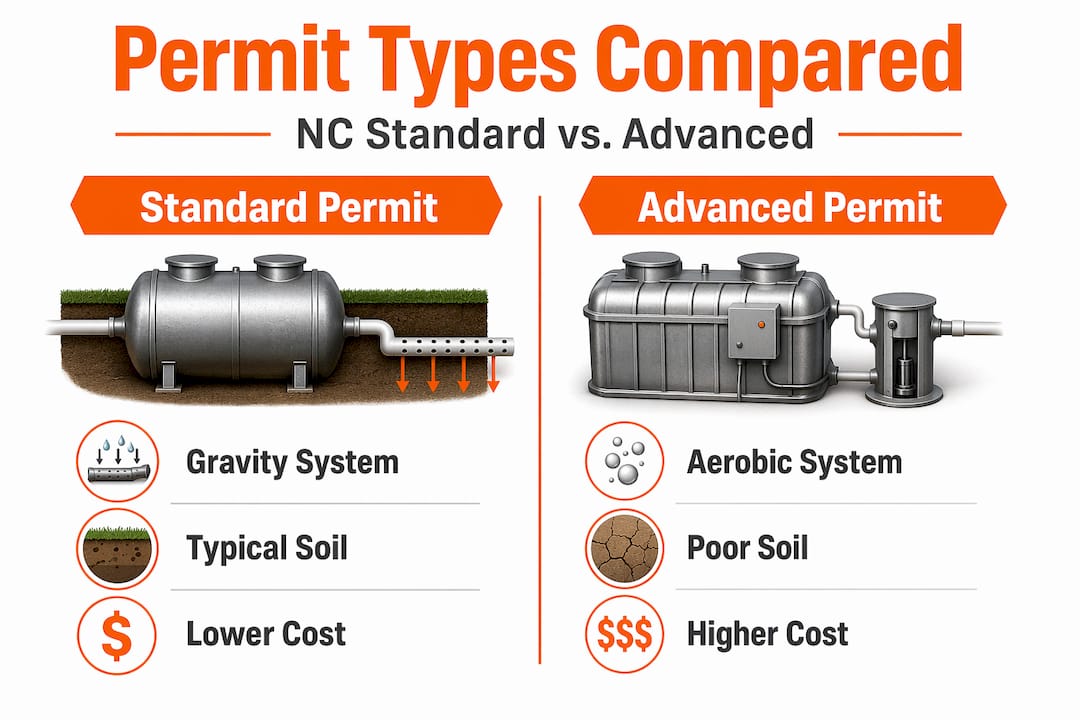
North Carolina also distinguishes between two permit types. A standard permit covers conventional gravity-fed systems on suitable soil. A performance-based permit applies when a site has specific conditions requiring an engineered design and ongoing monitoring. Knowing which one applies to your property is part of why professional involvement matters from day one.
Step-by-step breakdown of the NC septic permitting process
Understanding the septic installation process explained in sequence makes it far less intimidating. Here is what you are actually working through, in order.
-
Hire a licensed soil scientist. Before anything else, your soil has to be evaluated. A licensed professional tests soil absorption rates and identifies the water table depth. DIY soil tests are rejected by county health departments without exception. This is both a regulatory requirement and a practical safeguard, since improperly matched soil and system design leads to failures even after installation is complete.
-
Obtain a certified site plan and system design. Based on the soil report, a licensed engineer or designer produces a site plan showing your proposed system’s location relative to property lines, wells, and any water sources. This document has to meet setback requirements, and errors here are one of the most common reasons for permit denial.
-
Submit a complete permit application package. A complete NC septic permit application runs 6 to 8 pages and includes the soil evaluation report, the certified site plan, the system design, and all required signatures. Missing a single signature or using an outdated form sends your application to the back of the pile.
-
Wait for county review. Standard permit review takes 2 to 4 weeks on average. During this period, health department staff check your documents against local regulations. Common causes of delay include incomplete paperwork, incorrect setbacks, or site plans that do not match the soil report. Calling your county office mid-review to check status is completely acceptable and sometimes helpful.
-
Pass required inspections. North Carolina requires three distinct inspections: the soil evaluation, a pre-construction site review before excavation begins, and a final system inspection once installation is complete. Each one must be scheduled and passed before you move to the next stage.
-
Receive your operational permit. Once the final inspection is approved, the county issues an operational permit. That is the document that legally authorizes system use. Until you hold it, the system cannot be placed into service.
Pro Tip: Request confirmation of your inspection scheduling in writing from the county health department. Verbal confirmations sometimes fall through the cracks during busy periods, and a missed inspection can delay your project by days.
Common mistakes that derail the permitting process
The septic system approval process is precise, and a surprising number of homeowners run into problems that are entirely preventable. Understanding where things go wrong is the fastest way to avoid those pitfalls.
The most frequent problems include:
- Incomplete application documents. Submitting an incomplete application is the single most common cause of delay. Missing pages, unsigned forms, or outdated versions of required documents all trigger rejections.
- Incorrect setback measurements. Your site plan must accurately show distances between the proposed system and all wells, property lines, and water features. An error of even a few feet can mean a denial.
- DIY or unqualified soil evaluations. Some homeowners try to save money by conducting their own percolation tests. County health departments do not accept these. You need a licensed soil scientist, period.
- Design and soil mismatch. If the proposed system type does not match the absorption capacity your soil report documents, the application will be denied. The permit functions as a site-specific blueprint, and matching design to soil conditions is non-negotiable.
- Missing or wrong professional certifications. Designs must be certified by a licensed professional. If the credential is expired or not recognized in North Carolina, the package comes back rejected.
Pro Tip: Before you submit anything, have your licensed installer or engineer do a final document review. This single step catches the most common errors and costs nothing compared to the weeks lost to a rejection and resubmission cycle.
Professional involvement is not just convenient. Homeowner-submitted permits without professional support face significantly higher rejection rates because local county codes contain nuances that are not obvious to first-time applicants.
Advanced septic systems and how their permitting differs
Not every property in North Carolina qualifies for a standard gravity-fed system. When soil quality is poor, the lot size is constrained, or the site is near an environmentally sensitive area, the county may require an advanced system instead.
| Feature | Conventional System | Advanced System (Aerobic, Mound, Sand Filter) |
|---|---|---|
| Typical soil requirement | Well-draining, suitable absorption rate | Poor drainage, high water table, or sensitive site |
| Permitting timeline | 2 to 4 weeks | 3 to 7 weeks depending on complexity |
| Design requirements | Standard site plan and soil report | Engineered design with additional specifications |
| Ongoing monitoring | None required | Often required, with periodic inspection reports |
| Cost range | Lower upfront | Higher upfront, but reduces long-term failure risk |
Advanced systems like aerobic or mound setups are becoming more common across North Carolina, particularly in the Piedmont Triad region where soil conditions vary significantly between lots. Their permitting process is more detailed, but the tradeoff is a system better adapted to real site conditions. If you are dealing with a property where standard options do not qualify, exploring alternative septic system options early in the process saves significant time later.
Advanced technologies, while more complex to permit, offer better adaptability to difficult soil and long-term reliability that conventional systems cannot match on challenging sites.
Practical tips for navigating your septic installation smoothly
With the stages of septic installation laid out, the practical question becomes: how do you move through them without unnecessary setbacks? These steps reflect what actually works for homeowners in Alamance County and the surrounding Piedmont Triad area.
- Hire your licensed soil scientist before you do anything else. This determines every downstream decision, from system type to design to permit category. Starting without this data wastes time and money.
- Verify your installer’s credentials before signing anything. North Carolina requires licensed contractors for septic installation. Confirm your installer holds a current license and has experience with your county’s specific requirements.
- Build in realistic timelines. Plan for at least 4 to 6 weeks from initial soil evaluation to permit in hand for a standard system. If your site may require an advanced system, extend that estimate by several weeks and budget accordingly.
- Communicate regularly with your county health department. Staff at the county level often flag issues informally before a formal denial, which gives you a chance to correct problems without restarting the clock.
- Schedule inspections early and prepare your site. Inspections require site access and, in some cases, specific site conditions. Confirm requirements in advance so you are not scrambling at the last minute.
Pro Tip: Check the Alamance County health department’s website before submitting your application to confirm you are using the most current forms. County form versions change, and submitting an outdated version is a surprisingly easy mistake to make.
For a detailed walkthrough tailored specifically to your area, the Alamance County septic workflow guide walks through the county-specific steps that general guides often skip.
My honest take after years in North Carolina septic work
I have worked with homeowners across Alamance County and the Piedmont Triad long enough to see the same mistakes repeat themselves. The most common one is treating the permit as a checkbox rather than a real process that shapes how your system performs for the next 20 to 30 years.
In my experience, the homeowners who end up with the smoothest projects are the ones who respect the soil evaluation stage. That report is not bureaucratic red tape. It directly determines your system size, type, and placement. When the design does not match what the soil can actually handle, the system will fail. Not maybe. It will fail, usually within the first few years, and often expensively.
I have also seen projects go sideways because a homeowner submitted their own application to save a few hundred dollars on professional fees. When the application comes back rejected three weeks later with five correction requests, those savings are gone. What took a professional one day to prepare right the first time has now become a six-week delay on a project that was already planned around a moving deadline.
The inspection stages matter just as much as the paperwork. The pre-construction review exists to catch problems before concrete is poured and dirt is moved. The final inspection is your legal clearance. Both deserve your full attention, not a rushed phone call to get through them.
My honest advice: work with people who know the specific county they are operating in, because every county in North Carolina has small regulatory habits that are not written down anywhere. That local knowledge is worth more than most homeowners realize until they need it.
— Jason
Let Jmseptic handle the hard parts for you
Getting through the septic permitting process is manageable when you have experienced professionals in your corner from the start. At Jmseptic, we have guided homeowners across Burlington, Mebane, Elon, Graham, Whitsett, and McLeansville through every stage of the septic installation process, from soil evaluation coordination to final inspection.

We design and install custom septic systems built to your property’s specific soil conditions and county requirements. Our team understands the local regulatory nuances that make a difference between a first-time approval and a frustrating resubmission cycle. Whether you need a new installation, a system upgrade to meet current code, or support with a complex alternative system, Jmseptic delivers honest work with long-term results. We also handle septic repairs and ongoing maintenance so your system keeps working the way it was designed to. Call Jmseptic today and get your project started the right way.
FAQ
How long does the NC septic permit process take?
Most standard septic permits in North Carolina take 2 to 4 weeks from application submission to approval. Alternative or advanced systems can add one to three weeks depending on site complexity.
What documents are needed for a NC septic permit application?
A complete application includes a soil evaluation report, a certified site plan showing setbacks from wells and property lines, a professional system design, and all required signatures. The full package typically runs 6 to 8 pages.
Can a homeowner submit their own septic permit in North Carolina?
Yes, but homeowners who submit without licensed professional support face significantly higher rejection rates. Local code nuances and design requirements are difficult to navigate without experience in your specific county.
What happens if you install a septic system without a permit in NC?
Unpermitted septic work can result in fines up to $500 per day and a legal order requiring system demolition at the homeowner’s expense. It also creates complications when selling the property.
When is an advanced septic system required in North Carolina?
An advanced system is typically required when site conditions include poor soil drainage, a high water table, small lot size, or proximity to environmentally sensitive areas. These systems follow a more detailed permitting process but offer better long-term reliability for challenging sites.