
Sewer Lateral Repair: What Every Homeowner Should Know
Discover what is a sewer lateral repair and how it can save you money. Learn when to act to prevent costly sewer backups into your home.

A sewer lateral repair is the targeted fix of a specific defect in the underground pipe connecting your home’s plumbing to the public sewer main, restoring flow without replacing the entire line. The industry term for this pipe is the “sewer lateral,” and it runs 50–80 feet from your foundation to the city’s main sewer. Under most municipal rules, you own and are responsible for every inch of that pipe, even the section running under public sidewalks or streets. Catching a problem early and repairing it correctly can save you thousands of dollars and prevent raw sewage from backing up into your home.
What is a sewer lateral repair, and when does it apply?
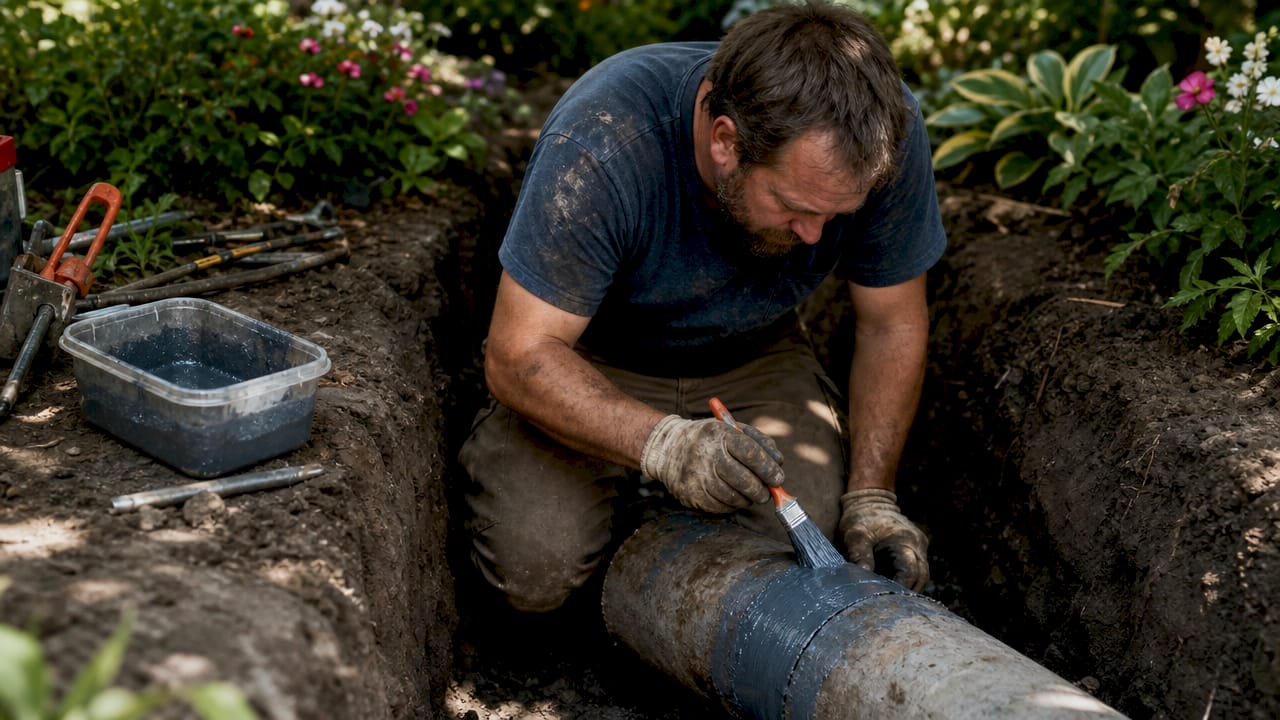
A sewer lateral repair addresses an isolated defect in the pipe rather than replacing the whole line. Think of it like patching a single bad section of a garden hose instead of buying a new one. The repair restores structural integrity and flow at the damaged spot while leaving the rest of the pipe untouched.
Repair is the right call when the damage is limited. Isolated defects like a single crack, a separated joint, or a localized root intrusion qualify as repairable conditions. The surrounding pipe must still be structurally sound for a repair to hold long term.
Replacement becomes necessary when the damage is widespread. Pipe collapse, severe corrosion along multiple sections, or a line made from end-of-life materials like clay or Orangeburg pipe all point toward full replacement. Clay pipe can last 50–100 years but becomes brittle with age. Orangeburg, a fiber-based pipe used through the mid-20th century, is notorious for deforming and collapsing under soil pressure.
Pro Tip: Get a camera inspection before agreeing to any repair or replacement quote. A contractor who skips this step is guessing at the problem, and you will pay for that guess.
The distinction between repair and replacement also comes down to economics. Repairs are cost-effective when damage is limited and the pipe is otherwise sound, buying you years of service before a full replacement is needed. If repair costs approach 60–70% of replacement costs, most plumbing professionals recommend replacing the line outright.

How much does sewer lateral repair cost?
Sewer lateral repair costs range widely based on the method used, the extent of damage, and how difficult the pipe is to access. Spot repairs start around $600–$1,050, while larger or more complex repairs can exceed $15,000. Full replacements can push past $20,000 once excavation and surface restoration are factored in.
Before any repair begins, a diagnostic camera inspection costs roughly $200–$400. That fee is not optional. It is the only reliable way to confirm what you are dealing with before committing to a repair method.
Surface restoration is often the hidden cost that surprises homeowners. Driveway repair alone runs $11–$18 per square foot. If your lateral runs under a concrete driveway or landscaped yard, open-cut excavation can double the total project cost. Trenchless methods avoid most of that expense.
| Repair method | Typical cost range | Best for | Key trade-off |
|---|---|---|---|
| Spot repair | $600–$1,050 | Single crack or joint failure | Only works on isolated damage |
| CIPP pipe lining | $3,000–$8,000 | Moderate deterioration, intact pipe shape | Pipe must not be collapsed |
| Pipe bursting | $4,000–$10,000 | Full-length replacement without trenching | Requires access pits at each end |
| Open-cut excavation | $5,000–$15,000+ | Collapsed pipe or severe damage | High restoration costs |
Pro Tip: Always ask for a line-item quote that separates labor, materials, and restoration costs. A bundled price makes it impossible to compare bids fairly.
Access difficulty also drives cost. A lateral buried 6 feet deep under a finished basement floor costs far more to reach than one near the surface in an open yard. Pipe material matters too. PVC is easier and cheaper to repair than cast iron or clay.
Why is sewer lateral inspection critical before any repair?
A CCTV camera inspection is the industry standard for diagnosing sewer lateral condition. A technician feeds a waterproof camera through a cleanout access point, and the footage reveals exactly what is wrong and where. Without this step, any repair is a guess.
The inspection distinguishes between two very different problems. A blockage from grease or debris is a functional issue that sewer line cleaning can resolve. A structural failure like a crack, root intrusion, or collapsed section requires physical repair. Treating one as the other wastes money and leaves the real problem in place.
A proper inspection produces a written report graded under the NASSCO-PACP standard, which scores defects by severity. That report serves two purposes. First, it prevents upselling by giving you an objective baseline of the pipe’s condition. Second, it documents the line’s state before work begins, which matters if a dispute arises with a contractor or municipality.
Here is what to expect during a sewer lateral inspection appointment:
- A technician locates the cleanout access point, usually near the foundation or in the yard.
- The camera is inserted and pushed through the full length of the lateral.
- The technician records footage and notes the location of any defects.
- You receive a video file and a written condition report.
- The report identifies whether the problem is a blockage, a structural defect, or both.
Most inspections take 45–90 minutes. Request the video file for your records. If a contractor refuses to provide one, that is a red flag.
What are the main sewer lateral repair methods?
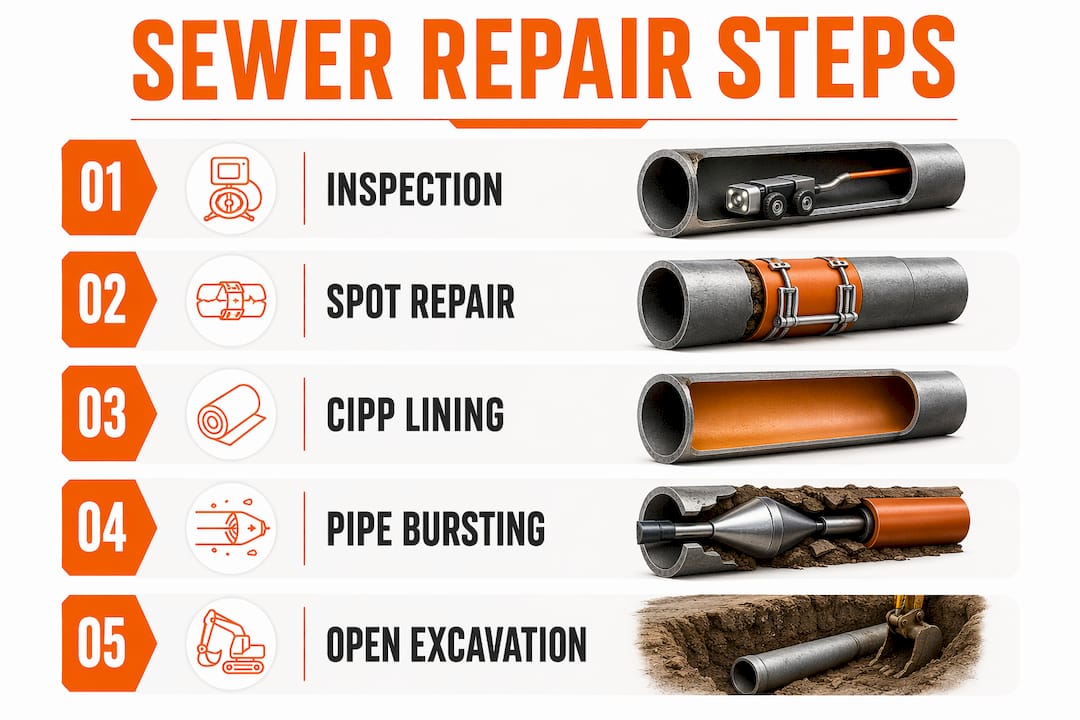
Four repair methods cover the vast majority of residential sewer lateral situations. The right choice depends on the type of damage, pipe material, depth, and how much surface disruption you can tolerate.
Spot repair targets a single damaged section. A technician excavates a small area directly above the defect, cuts out the bad pipe, and replaces it with a matching section. This is the simplest and least expensive option when damage is truly isolated. A crack in the sewer line at one joint is a textbook spot repair candidate.
CIPP lining (Cured-In-Place Pipe) is a trenchless method that inserts a resin-saturated liner into the existing pipe and cures it in place, creating a new pipe within the old one. It works well for pipes with moderate deterioration that still hold their shape. Trenchless methods like CIPP eliminate extensive digging and save significantly on landscape and driveway restoration. The finished liner is smooth, resistant to root intrusion, and rated for decades of service.
Pipe bursting is another trenchless option for full-length replacement without open trenching. A bursting head is pulled through the old pipe, fracturing it outward while simultaneously pulling a new PVC pipe into place. This method works even when the old pipe is badly deteriorated, as long as it has not fully collapsed and blocked passage of the equipment.
Open-cut excavation is the traditional approach. Workers dig a trench along the pipe’s path, remove the damaged section, and install new pipe. It is the only option when the pipe has collapsed completely or when trenchless equipment cannot navigate the line. The trade-off is significant surface disruption and restoration costs.
One point that cannot be overstated: DIY sewer lateral excavation is unsafe and often illegal. Underground work carries risks including toxic sewer gases, unmarked utility lines, and trench collapse. Most municipalities require a licensed contractor and a permit for any lateral repair. Attempting this work without a license can void your homeowner’s insurance and create liability if something goes wrong. For homeowners dealing with related plumbing questions, a qualified residential plumbing professional can also help assess whether surface plumbing issues are connected to a deeper lateral problem.
Understanding local easement rules is equally important. Most municipalities hold homeowners responsible for the entire lateral, including the section running under public property. Knowing where your responsibility ends prevents disputes and clarifies who pays for what.
Key Takeaways
A sewer lateral repair is the most cost-effective solution when damage is isolated, the pipe is structurally sound, and a camera inspection confirms the defect’s exact location and severity.
| Point | Details |
|---|---|
| Homeowner responsibility | You own the full sewer lateral, typically 50–80 feet, even under public property. |
| Repair vs. replacement | Repair isolated defects; replace pipes with widespread damage, collapse, or end-of-life materials. |
| Inspection first | A CCTV camera inspection costing $200–$400 is required before any repair decision. |
| Cost range | Spot repairs start at $600–$1,050; complex repairs or replacements can exceed $15,000. |
| Trenchless advantage | CIPP lining and pipe bursting reduce surface restoration costs and repair timelines significantly. |
What I’ve learned after years of sewer lateral calls
The most expensive sewer lateral repairs I see are not the ones with the worst pipe damage. They are the ones where a homeowner waited too long, or worse, hired someone who skipped the camera inspection and guessed wrong.
Slow drains throughout the house and gurgling pipes are not minor annoyances. They are the pipe telling you something is wrong. By the time sewage backs up into a shower or a yard smells like a treatment plant, the repair window has often closed and replacement is the only option left.
The second mistake I see constantly is homeowners comparing quotes without understanding what is actually included. One contractor quotes $4,500 for CIPP lining. Another quotes $3,200 for a spot repair. Those are not comparable bids. They may be addressing completely different problems, or one contractor may have excluded restoration costs entirely. Always ask for a written scope of work before signing anything.
Property line responsibility also catches homeowners off guard. Municipal ownership rules vary, but in most cases you are responsible for the lateral from your foundation all the way to the public main. That can mean paying for repairs under a sidewalk or street. Knowing this before a problem develops lets you budget and plan rather than scramble.
The best preventive step is simple: schedule a camera inspection every 5–7 years, especially if your home is more than 30 years old or has mature trees near the lateral path. Root intrusion is the leading cause of lateral damage, and catching it early turns a $700 spot repair into a non-event instead of a $12,000 emergency.
— Jason
Jmseptic serves Alamance County homeowners with expert lateral repair
Sewer lateral problems do not fix themselves, and the longer they sit, the more they cost. Jmseptic provides professional inspection, repair, and replacement services for homeowners across Burlington, Mebane, Graham, Elon, Whitsett, and McLeansville.

The Jmseptic team handles everything from camera diagnostics to full lateral replacement, with honest assessments and no upselling. If you are seeing slow drains, gurgling pipes, or standing water in your yard, those are signs that urgent repairs protect your home and your budget. For homeowners planning ahead, the NC homeowner septic guide covers installation, repair options, and what to expect from a professional service visit. Call Jmseptic before a small defect becomes a full replacement.
FAQ
What is a sewer lateral repair?
A sewer lateral repair fixes a specific defect in the underground pipe connecting your home’s plumbing to the public sewer main. It restores flow and structural integrity without replacing the entire line.
Who is responsible for sewer lateral repairs?
Homeowners are responsible for the full length of their sewer lateral, typically 50–80 feet, including sections that run under public sidewalks or streets per local easement rules.
How do I know if I need a repair or full replacement?
A CCTV camera inspection determines whether damage is isolated, which favors repair, or widespread with collapse or end-of-life pipe materials, which requires replacement.
How much does a sewer lateral repair cost?
Spot repairs start at $600–$1,050, while more complex repairs using trenchless methods or open-cut excavation can range from $3,000 to over $15,000 depending on access and pipe condition.
Can I repair a sewer lateral myself?
DIY sewer lateral excavation is unsafe and often illegal due to toxic gas exposure, utility strike risks, and permit requirements. Licensed professional service is required in most municipalities.