
Sewer Camera Inspection Cost: What You’ll Pay in 2026
Discover the costs of sewer camera inspections in 2026. Learn what factors influence your price and how to save on your inspection today.

Most homeowners pay a moderate amount for a sewer camera inspection when the house already has a cleanout the technician can access directly. That’s the baseline. Add a toilet entry and you’re looking at a higher total cost. Need a brand new cleanout installed just to get the camera in the line? Plan for $700 to $2,000 or more. On the far end, complex or commercial jobs can push past $2,000, sometimes toward $6,000 in rare cases involving long runs or excavation.
The single biggest factor isn’t pipe length or camera quality. It’s whether a cleanout already exists.
- Cleanout present: $100 to $300 typical, sometimes $100 to $250 when bundled with a home inspection
- Toilet-entry access: add $50 to $175 for removal and reinstall
- New cleanout required: add $500 to $1,500 or more
Quick fact: Angi’s aggregated data puts the average sewer camera inspection near $996 when factoring in every job type, including the expensive access-installation cases that pull the average up.
Keep in mind, this fee covers diagnosis only. Any repairs the camera uncovers get quoted and billed as a separate job.
Key Takeaways
Access type, not pipe length or camera model, is the single factor that decides whether your sewer camera inspection costs $150 or $1,500.
| Point | Details |
|---|---|
| Know your access tier | Existing cleanout, toilet entry, and new cleanout each carry a distinct price band, from $100 to $2,000-plus. |
| Ask about pricing model | Confirm flat fee versus per-foot or per-hour before booking, especially on longer lines. |
| Separate diagnosis from repair | The inspection fee only covers the camera run and report; any fix is a separate quote. |
| Budget for add-ons | Snaking, jetting, and locating each carry their own $50 to $800 fee ranges when needed. |
| Choose a qualified local pro | Jmseptic serves Alamance County homeowners with documented inspections and follow-up repair capability if the scope finds a problem. |
Primary Sources Used for This Guide
- Sewer Line Inspection Cost: 2026 Breakdown — iBuyer
- Sewer camera inspection cost — Angi
- Sewer inspection cost — HomeAdvisor
- What is a sewer scope inspection? — Rocket Mortgage
- Sewer line camera inspection cost — CurrentCost
Table of Contents
- Average Sewer Camera Inspection Cost by Job Type
- Why Pipe Length, Materials, and Camera Type Change Your Quote
- What’s Included in the Base Fee, and What Costs Extra
- How to Get a Quote You Can Actually Compare
- When You Actually Need One, and What the Visit Looks Like
- Why the Right Contractor Matters More Than the Camera
- Sewer Camera Inspection Cost: What to Prioritize First
- Get a Straight Answer on Your Sewer Line from Jmseptic
- Sources
Average Sewer Camera Inspection Cost by Job Type
Pricing for a sewer scope breaks into three practical tiers, and knowing which one applies to your house before you call around saves you from sticker shock.
- Tier 1: Existing cleanout, scope only. This is the cheapest and fastest scenario. A technician threads the camera through an access point that’s already in the yard or basement, records the footage, and hands you a report. Expect $100 to $300, or as low as $100 to $250 if it’s bundled into a scheduled home inspection where the crew is already on-site.
- Tier 2: Toilet entry. No cleanout, so the technician pulls a toilet to feed the camera into the line. That adds $50 to $175 for removal and reinstall on top of the base scope fee, bringing the realistic total to $185 to $450 depending on the home’s plumbing layout and how far the camera has to travel.
- Tier 3: New cleanout installation. If there’s no reasonable access point at all, some contractors will cut in a new cleanout before running the camera. That’s a bigger job, adding $500 to $1,500 or more, which puts the full inspection between $700 and $2,000-plus.
Picture three real scenarios: a buyer ordering a pre-listing scope on a house with a visible cleanout pays near the low end, around $150 to $250. A homeowner doing routine maintenance on an older home without a cleanout, requiring toilet removal, lands closer to $300. And a homeowner with a long, twisting lateral line under mature trees who needs a new cleanout cut in could see a bill north of $1,200 once labor and materials are added.
Why Pipe Length, Materials, and Camera Type Change Your Quote
Two houses on the same street can get wildly different quotes, and it usually comes down to four variables working together rather than any single one.
- Length and pricing model. Short residential runs are typically flat-fee. Longer or commercial lines often shift to per-foot or per-hour pricing, and some contractors report totals climbing toward $6,000 on extreme commercial jobs.
- Camera type. A basic push camera handles most residential scopes fine. Pan-and-tilt or self-leveling cameras cost more to deploy but give a clearer view at lateral junctions, which matters when a technician suspects a structural crack rather than a simple clog.
- Pipe material and age. Clay and cast iron lines from older homes tend to have more root intrusion and offset joints, which slows the run and can require extra diagnostic time.
- Regional labor rates. HomeAdvisor’s city-level data shows inspection costs swinging widely by metro, with some areas running well above the national norm simply because of local labor pricing.
Pro Tip: Ask upfront whether the quote is flat or per-foot. A “starting at” price on a per-foot job can balloon fast on a 150-foot lateral, and you want that math done before the truck shows up, not after.
What’s Included in the Base Fee, and What Costs Extra
A standard sewer camera inspection includes the camera run itself, a recorded video file you can keep, a basic written report describing what the technician saw, and the technician’s time on-site, usually 30 to 120 minutes depending on access.
Anything beyond that diagnostic scope is billed as an add-on:
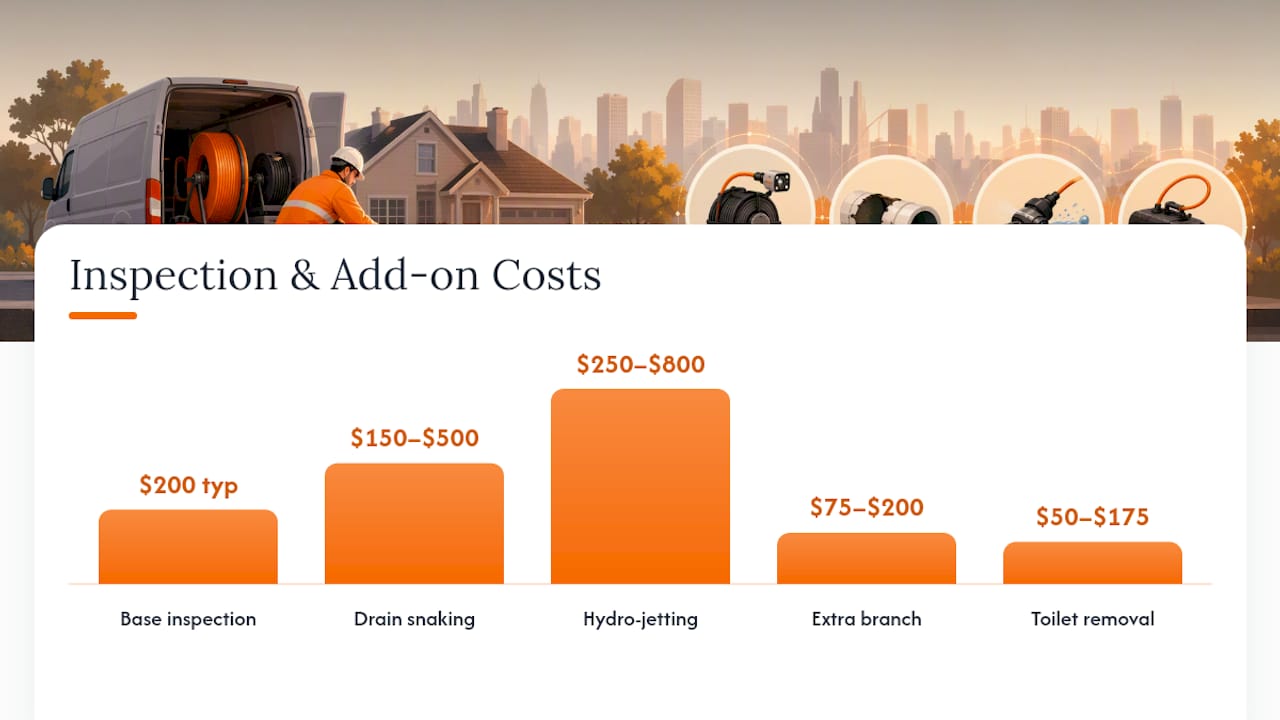
- Drain snaking: $150 to $500, needed if the camera can’t pass a blockage
- Hydro-jetting: $250 to $800, used to clear heavy grease or root buildup before or after the scope
- Line locating and mapping: $50 to $200, useful when you need to know exactly where the pipe runs underground
- Extra branch inspections: $75 to $200 per branch, common on homes with multiple bathroom stacks
- Emergency or after-hours service: typically a flat premium on top of standard rates
Quick fact: Toilet removal alone runs $50 to $175, which is why that single access issue shows up so often as the swing factor between a $200 quote and a $400 one.
You’ll usually need one of these add-ons when the line is fully blocked, when there are multiple branches feeding into the main lateral, or when something got flushed and needs retrieval before the camera can even get a clear picture.
How to Get a Quote You Can Actually Compare
Every provider prices sewer scopes a little differently, so the only way to compare quotes fairly is to ask the same questions every time.
- Do you have an existing cleanout, or will access require a toilet pull or new installation?
- Is this a flat fee, or priced per foot or per hour?
- Does the price include a recorded video and a written report I keep?
- What’s the toilet removal and reinstall fee if that’s needed?
- What would a new cleanout installation cost on this property?
- Are there travel or dispatch fees added to the quoted price?
- Are you licensed and insured for this work?
Before the technician arrives, snap a few photos of any visible cleanout, note your home’s approximate age, and have your address ready so the provider can check for known line issues in your neighborhood.
Pro Tip: Walk away from any quote written as “up to $X” with no conditions attached. A real quote names the access type it assumes. If the provider won’t commit to that detail over the phone, the number on the invoice will likely be higher than what you were told.
When You Actually Need One, and What the Visit Looks Like
Recurring backups, gurgling drains, or slow flow throughout the house are the clearest signs it’s time to schedule a scope. Buying or selling a home with pipes older than 20 years is another common trigger, and so is a mystery wet spot or smell in the yard that won’t go away.
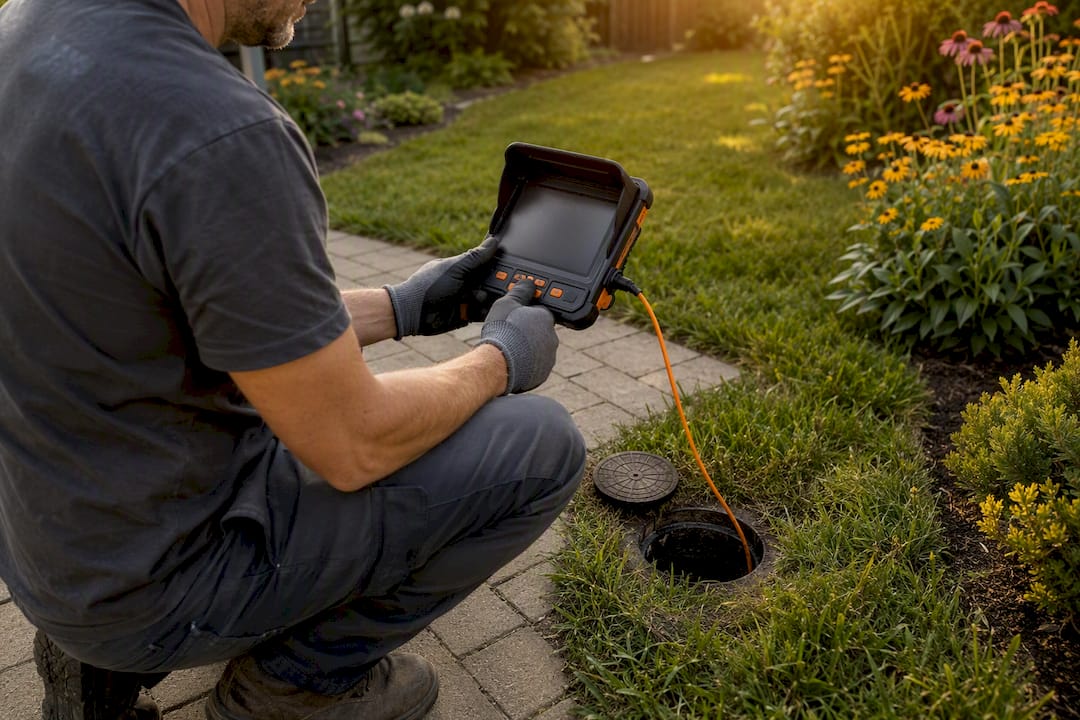
On-site time runs anywhere from 30 minutes for a straightforward scope-only job to 2 or 3 hours when the crew also has to remove a toilet, cut in a cleanout, or work through a partial blockage before the camera can move freely.
The footage itself does double duty. It gives you an immediate answer on what’s wrong, and it becomes documentation you hand to a repair contractor, or use as leverage in home sale negotiations when a buyer’s inspector flags an aging lateral line.
Why the Right Contractor Matters More Than the Camera
The camera is only as useful as the person reading the footage. Angi and other industry sources note that interpreting sewer video takes trained judgment, distinguishing harmless debris from a genuine structural crack isn’t obvious to an untrained eye, which is one reason a one-off DIY camera rental rarely pays off.
Jmseptic, operating as J&M Septic Installation & Repair out of Mebane, works this exact territory across Alamance County and the Piedmont Triad, including Burlington, Elon, Graham, Whitsett, and McLeansville. That local footprint matters when a scope turns up a problem that needs a follow-up repair crew who already knows the soil conditions in your area.
Before hiring anyone for a sewer scope, confirm a few basics:
- Active licensing and liability insurance
- A documented video file and written report you keep, not just a verbal summary
- Clear reinstatement of any landscaping if a new cleanout gets cut in
- A warranty or follow-up policy if the same problem recurs shortly after
| What to verify | Why it matters |
|---|---|
| License and insurance | Protects you if something goes wrong during access work |
| Written report | Gives you documentation for repairs or negotiations |
| Cleanout/landscaping plan | Prevents surprise yard damage on new-cleanout jobs |
| Follow-up policy | Confirms the provider stands behind the diagnosis |
Sewer Camera Inspection Cost: What to Prioritize First
The conventional advice on this topic treats sewer scope pricing like a single number you can shop around for, and that’s backward. The real question isn’t “what does an inspection cost,” it’s “what access tier am I in,” because that answer determines which price range even applies to you.
I’d argue most homeowners overweight camera quality and underweight access. A pan-and-tilt camera sounds impressive, but if your real problem is that nobody can find a cleanout, the camera spec is irrelevant to your bill. Ask about access first, camera type second.
The other gap I see: people treat the inspection report as the end of the process instead of the start of one. A video file sitting on your phone doesn’t fix a cracked lateral. The report only has value once it’s in the hands of someone who can quote the repair and stand behind it afterward. Prioritize a provider who can do both, not just the one with the lowest scope fee.
— Jason
Get a Straight Answer on Your Sewer Line from Jmseptic
If a camera inspection turns up root intrusion, a cracked joint, or a failing lateral, you don’t want to start a second search for a repair contractor from scratch. Jmseptic handles the full path, from diagnostics through hydro jetting, line repair, and septic system work, for homeowners across Alamance County and the Piedmont Triad, including Burlington, Mebane, Elon, Graham, Whitsett, and McLeansville.

That matters because inspection findings and repair work are two different skill sets, and switching contractors between them usually means paying for a second diagnostic visit. Jmseptic’s crews already know the soil, the pipe materials common to the area, and the local permitting quirks that slow down out-of-town contractors. If your inspection points to a failing line or an aging tank that needs attention, check the cost factors for septic installation in North Carolina and call for a quote on the actual repair, not just another scope.
Sources
- Sewer Line Inspection Cost: 2026 Breakdown — iBuyer
- Sewer camera inspection cost — Angi
- Sewer inspection cost — HomeAdvisor
- Sewer line camera inspection cost — CurrentCost