
Save Money: Skip Septic Tank Additives and Pump Every 3 to 5 Years
Homeowners: EPA and university studies show septic tank additives rarely help and can harm. Save money: inspect and pump every 3 to 5 years.

Routine septic tank additives are not recommended. The EPA has not approved any additive for septic systems, field studies show no measurable benefit, and some chemical formulas actively damage tanks and drainfields. Skip the monthly bottle and put that money toward scheduled pump-outs and a professional inspection instead.
TL;DR:
- Septic tank additives do not reduce sludge buildup or improve system performance according to independent studies and extensive research.
- Use of chemical or enzyme products can actively damage tanks and drainfields by disrupting biological processes or causing soil and microbial harm.
- Routine use of additives has no proven benefit and can be more costly than scheduled pump-outs and inspections.
- Only in specific cases, like starting up an aerobic treatment unit or after long periods of vacancy, might a biological additive be marginally useful.
- Proper maintenance, including regular pumping and responsible waste disposal, is more effective and economical than relying on additives.
Table of Contents
- What Are Septic Tank Additives, and What Do They Claim to Do?
- Do Septic Additives Actually Reduce Sludge or Improve Performance?
- Can Septic Additives Damage Your Tank or Contaminate Groundwater?
- When Might a Septic Additive Actually Make Sense?
- What Should You Do Instead of Buying Septic Additives?
- A Septic Professional’s Take on Additive Marketing
- Is Spending Money on Additives Worth It?
- Skip the Bottle, Schedule the Service
- Sources
What Are Septic Tank Additives, and What Do They Claim to Do?
Septic tank additives fall into a few distinct categories, and knowing which one you’re looking at on a store shelf matters more than the brand name printed on the label.
Biological or enzyme products contain live bacteria, yeast, or enzyme concentrates. Marketers claim these “boost” the tank’s natural bacteria population and speed up waste breakdown. Your tank already produces these microbes on its own every time you flush.
Inorganic acids and alkalis include products built around sulfuric acid or strong caustic compounds. They’re marketed as drain openers or grease dissolvers, but they can strip the biological film that actually does the digesting inside your tank.
Organic solvents show up in degreasers and some “septic shock” treatments. These don’t break down quickly in soil, and Purdue and Kansas State extension research flags their tendency to migrate through soil rather than stay put.
Odor-control and phosphorus-removal products typically rely on masking agents or chemical binders. They may reduce smell temporarily but do nothing to address why the odor exists in the first place.
A handful of states, including Washington, maintain lists of additives judged unlikely to cause harm. That’s a low bar. Being on an approved list means a product probably won’t hurt your system; it says nothing about whether it works.
Do Septic Additives Actually Reduce Sludge or Improve Performance?
No credible independent study has shown that septic tank additives improve system performance under normal conditions. That’s the short version. Here’s the evidence behind it.
The 48-tank field study
A controlled field study tracked 48 septic tanks over 12 months, comparing bacterial additive use against untreated tanks. Sludge levels showed no measurable difference between the two groups. Tanks getting a monthly dose of bacteria performed exactly the same as tanks getting nothing.
What agencies and extensions conclude
- The EPA states plainly that additives can be ineffective or harmful, and it does not endorse routine use.
- University extension programs, including Washington State University, conclude a properly functioning system doesn’t need additives at all.
- Extension bulletins from Kansas State reach the same conclusion: a well-maintained tank handles waste breakdown on its own.
The research does leave a narrow opening. Some technical reviews note a brief, limited benefit from biological reseeding in specific scenarios, like right after a full pump-out. But natural reseeding from incoming wastewater typically restores bacterial populations within days, making a purchased additive redundant in most cases.
The math on cost
A basic biological additive program runs somewhere in the range of a bottle a month, adding up over a year. A professional pump-out every three to five years costs more per visit but far less over the same stretch of years, and it’s the only maintenance step with actual evidence behind it.
Can Septic Additives Damage Your Tank or Contaminate Groundwater?
Some additives don’t just fail to help. They actively hurt your system, and the mechanisms are worth understanding before you buy anything.
- Scum breakup and resuspension: Harsh chemicals can break apart the scum layer that normally floats and separates from liquid, sending solids downstream into your drainfield where they clog soil pores.
- Soil structure damage: Hydrogen peroxide and similar oxidizers can degrade the physical structure of drainfield soil, reducing its ability to filter wastewater long after the chemical itself is gone.
- Microbial kill-off: Strong acids, alkalis, and solvents can wipe out the very bacteria that digest waste, undoing the one process your tank does need.
- Groundwater mobility: Solvent-based products don’t biodegrade quickly in soil and can travel with groundwater, carrying contaminants well beyond your property line.
Watch for these red flags on a label: concentrated peroxides, sulfuric acid, strong industrial solvents, and formaldehyde. Any of these can lead to costly drainfield damage if soil degradation occurs.
Pro Tip: If a product promises to “dissolve” solids or “instantly clear” a clogged system, treat that as a warning sign, not a selling point. Real septic problems get fixed with equipment and diagnostics, not a pour-and-wait bottle.
When Might a Septic Additive Actually Make Sense?
There are a few narrow situations where an additive has a real, defensible use case. Outside of these, skip it.
- Aerobic treatment unit (ATU) startup. Some ATUs need a specific bacterial strain to establish their aerobic process, and the manufacturer’s own startup product is the right call here, not a generic grocery-store additive.
- Restarting after long vacancy. A vacation home sitting empty for months can benefit from a light reseed, though this is a minor convenience, not a necessity.
- Brief reseeding after a pump-out or heavy antibiotic use. Antibiotics can temporarily suppress tank bacteria, and a single low-cost biological dose may shorten the recovery window slightly.
If you fall into one of these categories, stick to a simple biological starter product, follow the label’s dosing instructions exactly, and never combine it with acids or solvents. One dose is usually plenty. Before treating anything you suspect is a failing drainfield, call a licensed septic professional first. Adding chemicals to a system that’s already struggling tends to make the underlying problem worse, not better.
What Should You Do Instead of Buying Septic Additives?
Pumping and inspection are the two maintenance actions with real evidence behind them, and neither requires a subscription to a monthly product.
- Pump on schedule. Most households need pumping every three to five years, though household size, water use, and garbage disposal habits can shift that window shorter.
- Watch what goes down the drain. Grease, excessive bleach, and antibacterial soap loads all stress the bacterial balance your tank depends on.
- Conserve water. Spreading laundry loads across the week instead of running them back to back gives your tank time to process waste properly.
- Dispose of medications properly. Flushing pills sends compounds into your tank that can suppress the same bacteria you’re trying to protect.
- Call a professional when something’s off. A pro can inspect, pump, hydrojet clogged lines, and catch small problems before they become drainfield replacements.
The economics favor prevention every time. A pump-out and inspection every few years costs far less over the life of your system than years of additive purchases that multiple extension studies say deliver no measurable benefit. For homeowners looking to tighten up habits around the house, a general plumbing maintenance checklist is a useful companion to septic-specific care.
A Septic Professional’s Take on Additive Marketing
Jason has spent years walking Alamance County properties where a “miracle” additive masked a problem instead of solving it. The pattern repeats: clearer-looking water for a few weeks, then a bigger bill later.
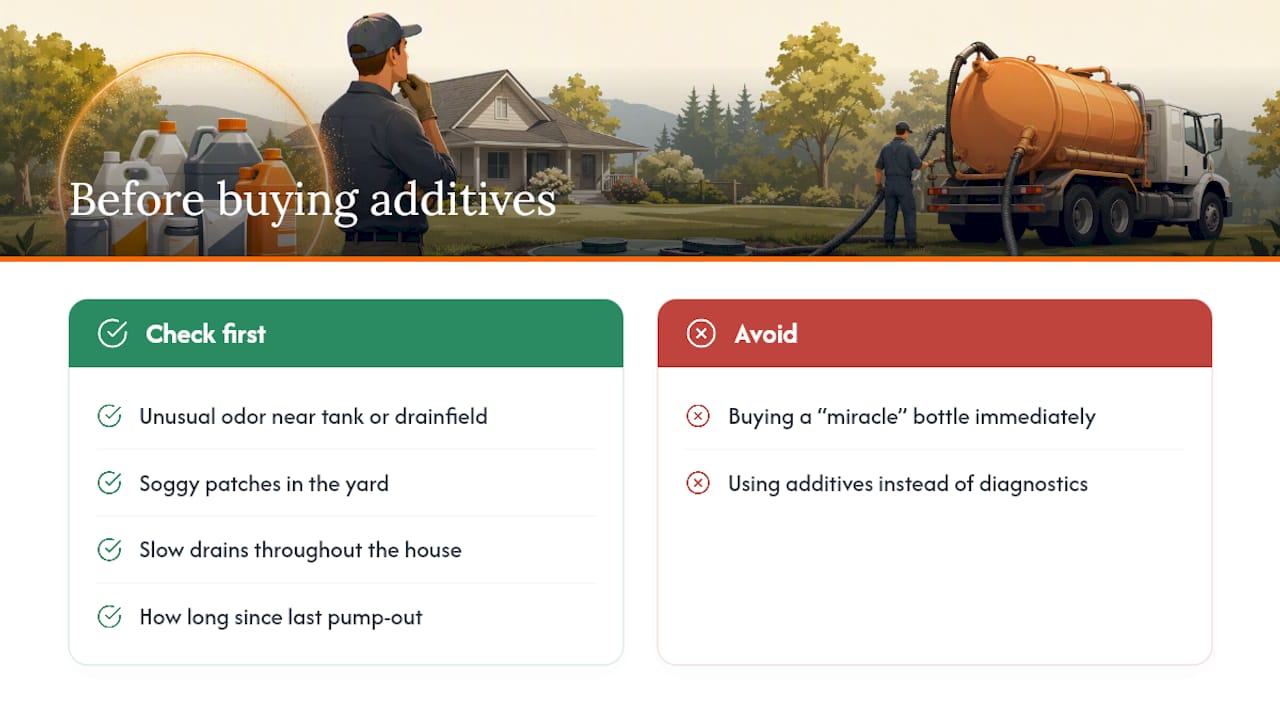
Before buying anything, check four things: unusual odor near the tank or drainfield, soggy patches in the yard, slow drains throughout the house, and how long it’s been since your last pump-out. If any of those show up, that’s a sign to call a professional for diagnostics, not a sign to reach for a bottle.
Is Spending Money on Additives Worth It?
Skip the additives. The evidence doesn’t support routine use, and some products carry real risk to your tank and drainfield. Put that budget toward scheduled pumping and inspection instead. When something seems off with your system, a licensed septic professional will diagnose it faster and safer than any product on a store shelf.
— Jason
Skip the Bottle, Schedule the Service
If you’ve been eyeing a jug of additive at the hardware store, save your money. Jmseptic offers what actually protects a septic system: real inspection, real diagnostics, and pump-outs done right the first time, for homeowners across Alamance County and the Piedmont Triad.

Our technicians check for the warning signs that additive marketing tries to paper over, soggy yard patches, slow drains, lingering odors, and tell you plainly whether you need a routine pump-out or something more involved. We also handle hydrojetting for clogged lines, diagnostics, and full repairs when a system’s past the point where maintenance alone will fix it.
If it’s been three years or more since your last pump-out, or you’re noticing any of the warning signs above, schedule a septic tank pump service with Jmseptic today. It’s the one maintenance step the evidence actually backs.
Sources
- McKenzie et al., study on septic tank additives (PubMed entry)
- EPA Septic tank additives fact sheet
- Septic Tank Additives | Washington State University Extension