
Septic System Installation Guide for NC Homeowners
Discover the ultimate septic system installation guide for NC homeowners. Learn how to ensure a long-lasting, efficient system on your property.

A septic system is defined as an underground wastewater treatment structure that collects, treats, and disperses household sewage on your property without connecting to a municipal sewer line. For North Carolina homeowners in Alamance County and the Piedmont Triad, following a proper septic system installation guide is the difference between a system that lasts 30 years and one that fails in five. Every installation involves four core components: the septic tank (typically concrete or fiberglass), the distribution box, the drain field, and the connecting pipes. The total project timeline runs 3–6 weeks from permitting to final inspection, though the physical installation itself takes only 3–5 days. Understanding each phase before breaking ground protects your property, your wallet, and your neighbors’ groundwater.
What are the prerequisites for septic system installation?
Pre-installation soil percolation testing and permitting are the phases most homeowners underestimate in both timeline and importance. Before any excavator touches your yard, North Carolina’s county health departments require a soil percolation test, commonly called a “perc test.” This test measures how fast water drains through your soil, which directly determines the size and design of your drain field.
Soil percolation rates vary significantly by soil type. Sandy soil drains at 5–15 minutes per inch, loam drains at 15–45 minutes per inch, and clay drains far slower. Clay-heavy soil may require a modified or alternative system design entirely.

| Soil Type | Perc Rate | Septic Suitability |
|---|---|---|
| Sandy | 5–15 min/inch | Excellent, smaller drain field |
| Loam | 15–45 min/inch | Good, standard drain field |
| Clay | 60+ min/inch | Poor, alternative system needed |
| Rocky | Varies | Requires engineered design |
Beyond the perc test, you need a construction permit from your local health department. North Carolina mandates setback distances from wells, property lines, buildings, and water bodies to protect groundwater. These setbacks are not suggestions. Violating them can result in forced system removal. You will also need to locate all underground utilities before excavation begins. Call 811, North Carolina’s free utility locating service, at least three business days before any digging.
The tools and equipment involved at this stage include soil augers for perc testing, site survey stakes, and the permit application itself. Explore the NC permitting process in detail before you schedule your contractor.
Pro Tip: Submit your permit application the same week you schedule your perc test. Health departments in Alamance County can take two to four weeks to process permits, and waiting costs you the entire project window.
How do you execute the step-by-step installation process?
A code-compliant installation follows a 5-step workflow: site preparation, excavation and tank placement, drain field construction, pre-backfill water testing, and layered backfilling. Skipping or rushing any step creates problems that are expensive to fix after the fact.
-
Site Preparation. Mark the tank location and drain field boundaries based on your approved permit design. Clear vegetation and confirm utility locations one final time.
-
Excavation and Tank Placement. An excavator digs the tank pit to the specified depth. The tank, whether concrete or fiberglass, is lowered into position and leveled precisely. An unlevel tank causes uneven effluent flow and accelerates wear on the inlet and outlet baffles.
-
Drain Field Construction. Trenches are dug to the depth specified in your permit. A gravel bed is laid first, then perforated pipes are placed on top. The distribution box, which splits flow evenly across all drain field lines, must be perfectly level. Even a slight tilt sends all flow to one line and starves the others, causing premature failure.
-
Pre-Backfill Water Testing. Before covering anything, the tank is filled with water to check for leaks and confirm structural integrity. This is your last chance to catch problems without digging everything back up.
-
Layered Backfilling. Proper backfilling requires adding soil in incremental layers while simultaneously filling the tank with water. This balances the pressure on the tank walls and prevents structural collapse or pipe damage.
| Phase | Key Task | Typical Duration |
|---|---|---|
| Site Prep | Staking, clearing, utility marking | Half day |
| Excavation and Placement | Digging, leveling tank | 1 day |
| Drain Field Build | Trenching, gravel, pipe, distribution box | 1–2 days |
| Water Testing | Fill tank, inspect for leaks | Half day |
| Backfill and Inspection | Layered fill, final county inspection | 1 day |
Pro Tip: Never allow backfill to be dumped in one large load over the tank or pipes. Layered compaction in 6-inch lifts prevents settling that can crack pipes and void your county inspection.
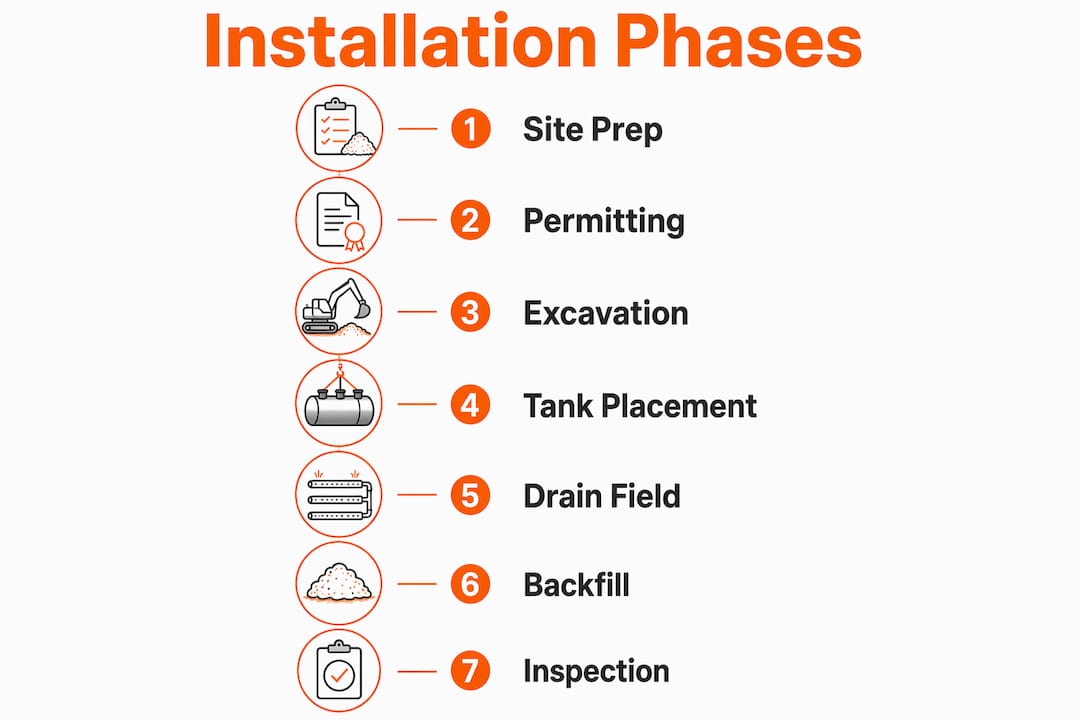
The Alamance County homeowner workflow outlines the specific inspection checkpoints your county inspector will review before signing off on the installation.
What mistakes cause septic system installation failures?
The drain field is the most expensive component to replace, and most installation failures trace back to decisions made during the first 48 hours of the project. Many homeowners mistakenly believe the tank is the entire system. The drain field is where actual filtration happens, and it requires as much care as the tank itself.
The most common installation mistakes include:
- Ignoring soil drainage capacity. Installing a standard gravity system in clay-heavy soil without a modified design leads to surface ponding within months.
- Skipping utility location. Cutting a gas or water line during excavation creates safety hazards and legal liability.
- Improper backfill compaction. Dumping fill in one pass crushes perforated pipes and shifts the tank off level.
- Incorrect pipe slope. Septic pipes require a consistent downhill grade of roughly 1/8 to 1/4 inch per foot. Too steep and solids race past the tank. Too flat and solids back up into the house.
- Violating setback distances. Installing too close to a well or property line triggers permit violations and potential system removal.
“Systems overloaded with water fail rapidly, causing raw sewage to surface and plumbing to back up throughout the home.” — UF/IFAS Septic Systems Program
The consequences of these errors are serious. Surface ponding signals drain field saturation. Sewage backups inside the home indicate hydraulic overloading or a blocked outlet baffle. Groundwater contamination from a poorly sited system can affect neighboring wells. Review common septic problems before installation so you recognize warning signs early.
How do you maintain a new septic system for long-term performance?
A new septic system requires active protection from day one. The drain field is a living system that depends on healthy soil biology to filter effluent. Compaction, surface water intrusion, and overloading all destroy that biology faster than any mechanical failure.
Follow these practices from the moment your system is installed:
- Pump the tank every 3–5 years. Solids accumulate in the tank and eventually overflow into the drain field if not removed. A clogged drain field costs far more to replace than a routine pump service.
- Never drive or park over the tank or drain field. Vehicle weight compacts the soil and can crack the tank lid or crush perforated pipes.
- Divert surface water away from the drain field. Roof downspouts, French drains, and grading should direct rainwater away from the drain field area. Saturated soil cannot absorb effluent.
- Spread water use throughout the day. Running the dishwasher, washing machine, and multiple showers simultaneously floods the system. Hydraulic overloading is a leading cause of premature system failure.
- Avoid flushing non-biodegradable items. Wipes, paper towels, and grease clog the inlet baffle and accelerate solids buildup.
Pro Tip: Plant only shallow-rooted grass over your drain field. Deep-rooted plants and trees send roots into perforated pipes, causing blockages that require full line replacement.
North Carolina does not currently require routine septic inspections for existing systems, but Alamance County health departments do require a permit renewal and inspection if you expand your home’s bedroom count. Any addition that increases wastewater load requires a system evaluation. Learn more about factors affecting system lifespan to plan ahead.
Signs that your system needs professional attention include slow drains throughout the house, gurgling pipes, standing water over the drain field, and strong odors near the tank or yard. Call a licensed contractor before these symptoms escalate.
Key takeaways
A successful septic installation in North Carolina depends on completing soil testing, securing permits, and following a precise 5-step installation workflow before a single shovel of dirt goes back in the ground.
| Point | Details |
|---|---|
| Perc test determines design | Soil drainage rate sets drain field size; clay soil requires an alternative system design. |
| Permits protect you legally | North Carolina mandates setback distances from wells and property lines before any work begins. |
| Drain field needs equal care | The distribution box must be level and the gravel bed correct to prevent premature field failure. |
| Layered backfill prevents damage | Fill soil in 6-inch lifts while watering the tank to avoid pipe crush and structural settling. |
| Pump every 3–5 years | Regular pumping prevents solids from overflowing into the drain field and causing costly replacement. |
What i’ve learned installing septic systems across alamance county
After years of installing and repairing systems across Burlington, Mebane, Graham, and the surrounding Piedmont Triad, the single biggest mistake I see homeowners make is treating the permitting phase as a formality. It is not. The perc test result shapes every other decision on the project. I have watched homeowners push contractors to start digging before permits were approved, only to have the county require them to expose and relocate the entire drain field. That mistake costs more than the original installation.
The second thing I tell every homeowner: stay involved during construction. You do not need to stand over the crew all day, but you should be present when the distribution box is set and when backfilling begins. Those are the two moments where shortcuts are most tempting and most damaging. A distribution box that is off by even half an inch will send 80% of your effluent to one drain line and starve the rest.
Keep every document from your installation: the permit, the perc test results, the as-built drawing, and the inspection sign-off. North Carolina health departments can require these records if you ever sell the property or apply for a building permit. Homeowners who cannot produce them face delays and sometimes full re-inspections. A manila folder in a filing cabinet has saved more than one of my clients a significant headache.
Proactive maintenance is cheaper than emergency repair every single time. A pump service every three to five years costs a fraction of what drain field replacement runs. Treat your system like the infrastructure it is, and it will serve your home for decades.
— Jason
Get expert septic installation help in alamance county
If you are planning a new installation or replacing a failing system in Burlington, Mebane, Elon, or the surrounding area, Jmseptic builds custom systems designed for your specific soil conditions and property layout.

Start by reviewing the cost factors for NC installation so you know what to budget before your first contractor conversation. If you are weighing system types, the guides on conventional septic tanks and anaerobic septic systems break down your options clearly. Jmseptic handles everything from the initial site evaluation through final county inspection, with honest pricing and no shortcuts. Call us to schedule your consultation.
FAQ
What is a septic system and how does it work?
A septic system is an underground wastewater treatment structure consisting of a tank, distribution box, and drain field. Household waste flows into the tank where solids settle, and liquid effluent flows to the drain field for natural soil filtration.
How long does septic system installation take in north carolina?
The total project duration runs 3–6 weeks when you include soil testing and permitting. The physical installation itself takes 3–5 days for a standard gravity system.
What is a perc test and why is it required?
A perc test measures how fast water drains through your soil and determines the size and design of your drain field. North Carolina health departments require it before issuing a construction permit.
How often should a new septic system be pumped?
Pump your septic tank every 3–5 years to prevent solids from overflowing into the drain field. Skipping pumps is the most common cause of premature drain field failure.
What should you never do over a drain field?
Never drive, park, or build structures over a drain field. Vehicle weight compacts the soil and can crush perforated pipes, destroying the system’s ability to filter effluent.