
$150–$30,000: Septic Repair Cost in NC by County
County price bands for septic repairs in North Carolina, from small fixes to $30,000 drain field jobs, plus the checklist of questions to demand on any quote.

Expect routine septic repairs in North Carolina to run $150 to $3,500, while drain field problems or full replacement can climb to $5,000 to $30,000 or more. The gap comes down to soil, access, and whether the drain field itself has failed. Diagnostic fees typically run $200 to $400, and permitting through your county health department adds its own cost and timeline. Local contractors see this range play out across Alamance County every month.
TL;DR:
- Soil type and site conditions significantly impact repair costs, with clay soils and difficult access in Piedmont raising expenses compared to sandy or rocky terrains.
- Partial drain field repairs typically cost between $3,000 and $8,000, while full replacements can reach $8,000 to $15,000 or more, especially on engineered sites.
- Getting an itemized diagnostic before repairs can prevent overestimating costs, as problems like filters or baffles are often mistaken for major failures.
- Permitting adds $200 to $2,500 depending on complexity, with permits taking one to three weeks in most counties.
Table of Contents
- How Much Is Septic Repair Cost in NC by Region?
- What Do Common Septic Repairs Cost in NC?
- What Drives Septic Repair Costs Up in NC?
- Should You Repair or Replace Your Septic System?
- How Long Do Septic Permits and Repairs Take in NC?
- How Do You Get a Fair Septic Repair Quote in NC?
- How J&M Septic Handles Diagnostics and Estimates
- What Most Septic Advice Gets Wrong About Cost
- Get a Straight Answer on Your Septic Repair Cost
- Where These Cost Figures Come From
- Sources
- FAQ
How Much Is Septic Repair Cost in NC by Region?
Where you live in North Carolina changes your repair bill more than almost anything else. Soil type dictates what a drain field repair or replacement actually requires, and that’s the single biggest cost swing in the state.
In the Piedmont (Raleigh, Greensboro, Alamance County, and the surrounding Piedmont Triad), heavy clay soils are the norm. Clay drains slowly, so failing drain fields here often need engineered fixes rather than a simple pipe swap, and the soil conditions in this region push repair costs higher than in sandier parts of the state. Tight lots and mature trees in older Piedmont neighborhoods also mean more excavation labor per job.
The Coastal Plain (Eastern NC) deals with a different problem: a high water table. Standard drain fields often can’t be installed below grade, which is why mound systems are common there. Mounds cost more upfront but sidestep the flooding issues that plague conventional fields near the coast.
Mountain and Western NC counties bring rock and bedrock closer to the surface, along with steep, hard-to-access sites. Equipment has to be smaller and more maneuverable, and that drives labor costs up even for straightforward repairs.
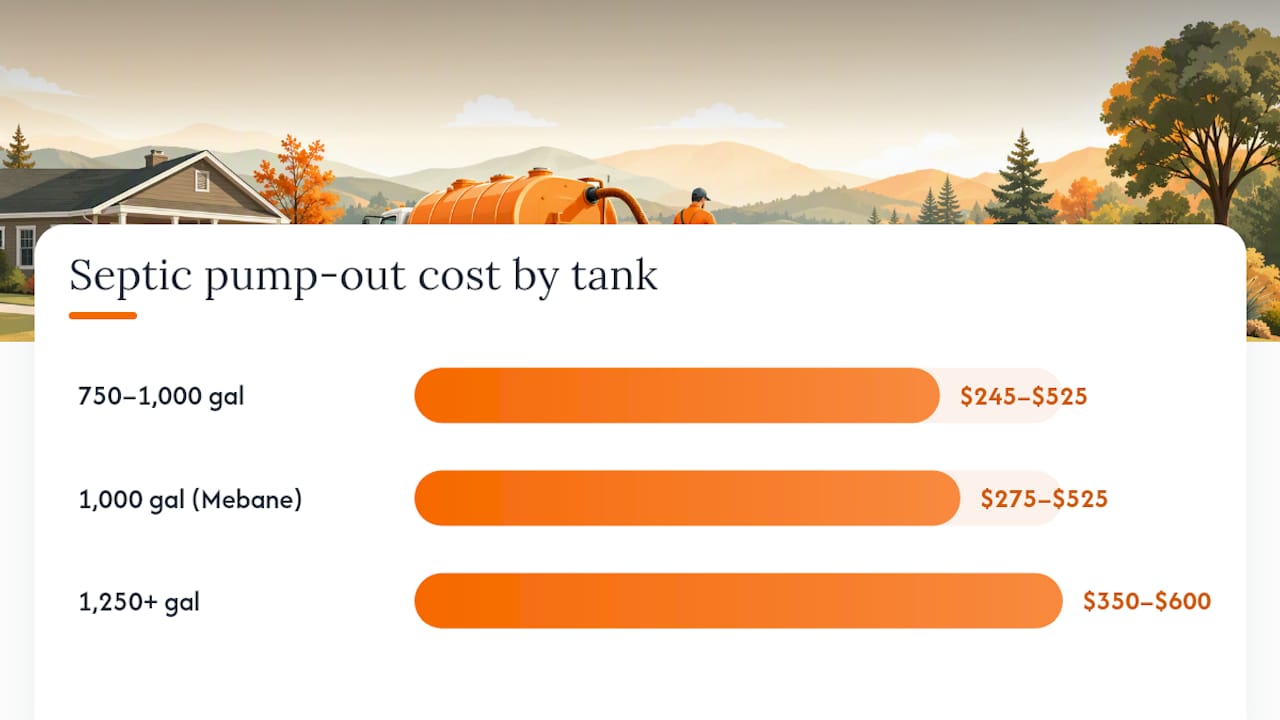
Pumping costs shift with tank size and access across all three regions:
- 750 to 1,000 gallon tanks: commonly $245 to $525, with Raleigh-area pricing landing near the middle of that band
- 1,000 gallon tanks in Mebane and Alamance County: typically $275 to $525 for a standard pump-out
- 1,250 gallon and larger tanks: often $350 to $600, more if a truck can’t get close to the tank lid
What Do Common Septic Repairs Cost in NC?
Most septic calls aren’t drain field emergencies. They’re smaller, fixable problems that get misdiagnosed as something worse.
Effluent filter cleaning or replacement is the cheapest fix on this list, often under $200, but a clogged filter causes slow drains and gurgling that homeowners mistake for drain field failure. Checking the filter first can save thousands in unnecessary diagnostics.
Baffle replacement and riser or tank access work typically costs a few hundred to around a thousand dollars. Broken baffles let solids escape into the drain field, so this repair is cheap on parts but labor intensive since it usually means digging to expose the tank.
Pump and float switch replacement for systems with a pump tank generally costs several hundred to over a thousand dollars, depending on the complexity of the work.
Distribution box and lateral pipe repairs usually cost from a few hundred to a couple thousand dollars for localized problems, with higher costs if more extensive damage has occurred.
Partial drain field rehab versus full replacement is where the real money lives:
- Partial drain field repair: $3,000 to $8,000
- Full drain field replacement: $8,000 to $15,000, sometimes higher
- Advanced engineered systems on difficult sites: can exceed $30,000
Statistic to know: Local Mebane pricing data puts general septic repair between $500 and $3,000, and drain field repair between $2,000 and $15,000, which tracks closely with what J&M Septic sees on Alamance County service calls.
What Drives Septic Repair Costs Up in NC?
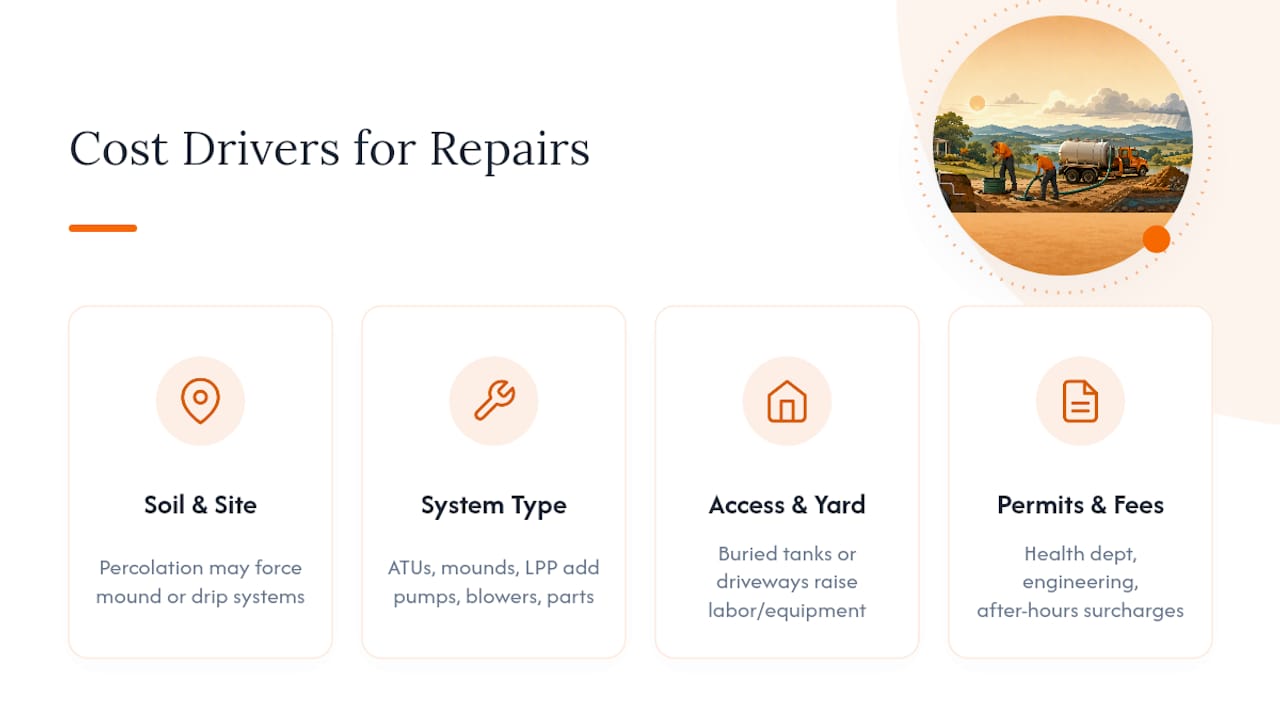
Two identical-sounding problems can carry wildly different price tags, and the reason almost always traces back to four variables.
Soil and site suitability. A percolation test tells a contractor whether your soil can support a conventional drain field or needs an alternative system. Clay-heavy Piedmont lots often need soil-specific solutions like mound or drip line systems, and those cost more in materials and design than a standard trench field.
System type and age. Conventional gravity systems are the cheapest to repair. Aerobic treatment units (ATUs), mound systems, and low-pressure pipe (LPP) systems have pumps, blowers, and electrical components that add both parts and diagnostic time.
Access and landscaping. A tank buried under a deck, a driveway poured over a drain field, or a septic system behind a locked gate all add equipment and labor hours before any actual repair starts.
Permits, engineering, and surcharges. County health department involvement, engineering for complex sites, and after-hours dispatch fees can each add hundreds to a job.
Pro Tip: Before calling anyone, find your septic permit or as-built site plan. Knowing your tank size and drain field layout up front can shave real time off diagnostics, and time is what you’re paying for.
Should You Repair or Replace Your Septic System?
Not every failing system needs replacement, and not every cheap repair is the right call. Run through this checklist before deciding:
- System age. Systems under 15 years old with an isolated problem are usually worth repairing. Past 20 to 25 years, repeated failures point toward replacement.
- Frequency of failures. One issue in five years is normal wear. Three service calls in two years signals a system that’s failing structurally, not just aging.
- Extent of drain field compromise. A localized wet spot is often fixable. Standing sewage across the whole field usually means the field is done.
- Soil suitability for a new field. If your lot barely passed its original perc test, replacement may require an engineered system, which changes the math significantly.
- Repair history and cost stacking. Two repairs at $2,000 each in eighteen months often add up to more than one $10,000 replacement with a warranty attached.
The comparative math is straightforward: partial drain field rehab in the $3,000 to $8,000 range can buy several more years of service, while full replacement at $8,000 to $15,000 (more on difficult sites) resets the clock entirely. Full replacement also takes longer, often two to four weeks from permit to final inspection, versus a few days for a partial repair.
How Long Do Septic Permits and Repairs Take in NC?
Not every septic job needs a permit, but the ones that touch the drain field, relocate a tank, or involve a new system almost always do. The North Carolina DHHS On-Site Water Protection Branch sets the statewide framework, while your county health department issues the actual permit and inspects the work.
- Simple repairs (filter cleaning, baffle swap, pump replacement): usually no permit required
- Drain field repair or relocation: county permit required, commonly $200 to $800
- Complex or engineered systems: add $500 to $2,500 for site evaluation and engineering
- Typical permit turnaround: one to three weeks, longer if the county requires a new soil evaluation
Some contractors offer prepaid maintenance plans that bundle annual inspections with reduced emergency rates, which can blunt the impact of surprise repair bills over time.
How Do You Get a Fair Septic Repair Quote in NC?
A written, itemized estimate is non-negotiable. It should name the specific failure, the exact repair, and separate line items for labor, parts, and any permit fees. Verbal quotes over the phone before anyone has seen your system are a guess, not an estimate.
Ask these questions before you sign anything:
- Who pulls the permit, and is that cost included in the quote?
- Is the diagnostic fee waived if I approve the recommended repair?
- What’s the warranty on parts and labor, and how long is it?
- Can you provide references or proof of insurance?
- What’s the realistic timeline from approval to completion?
Red flags worth walking away from: a contractor who refuses to put anything in writing, anyone pressuring you to sign the same day, and especially anyone recommending full replacement before running a proper diagnostic. Many failures that look catastrophic turn out to be a baffle, a filter, or a single bad lateral line, not a dead drain field. A sewer camera inspection before excavation can confirm exactly where the problem sits and prevent you from paying for work you don’t need.
Pro Tip: If a contractor quotes full replacement without ever putting a camera down your line or opening the tank, get a second opinion before you agree to anything.
How J&M Septic Handles Diagnostics and Estimates
Jason and the J&M Septic team run every service call the same way: diagnose first, quote second, never the other way around. That means checking the effluent filter, inspecting the baffles, and pressure testing lines before anyone talks about drain field replacement.
Services that cover the repairs homeowners call about most often include:
- Pump and float switch replacement
- Hydro jetting for clogged or root-choked lines
- Effluent filter cleaning and replacement
- Riser installation for easier future access
- Partial drain field rehab when full replacement isn’t necessary
If you’ve got your original permit or site plan, pull it out before the truck arrives. It tells the technician tank size, drain field layout, and system age in seconds, and that alone cuts real time off the diagnostic visit.
What Most Septic Advice Gets Wrong About Cost
Most articles on septic repair cost treat North Carolina like one market. It isn’t. A drain field repair that runs $3,500 in sandy soil near the coast can run $10,000 for the same square footage in Piedmont clay, and no flat statewide number captures that. If you’re budgeting off a generic “average cost” figure without checking what your specific soil and county require, you’re planning against the wrong number.
The bigger issue I see is homeowners skipping the diagnostic step entirely. Someone hears “gurgling pipes” or “slow drains,” assumes the worst, and calls around for drain field replacement quotes before anyone has actually opened the tank. Half the time it’s a filter or a baffle. That’s a $200 to $1,200 problem being priced like an $10,000 one.
My advice: get the itemized diagnostic first, always. Ask what specifically failed before you accept any number. And factor your region into your mental math from the start, because clay, sand, and rock don’t care what a national cost guide says the average should be.
— Jason
Get a Straight Answer on Your Septic Repair Cost
If you’re staring at slow drains, a soggy yard, or a septic odor and trying to figure out what it’s actually going to cost, A local septic service provider based in Mebane, serves homeowners throughout Alamance County and the surrounding Piedmont Triad, including Burlington, Elon, Graham, Whitsett, and McLeansville.

Here’s what happens when you call: we diagnose the actual failure first, whether that’s a bad baffle, a failing pump, or a compromised drain field, and hand you a written, itemized estimate before any work starts. If your situation needs a county permit, we handle that directly so you’re not chasing paperwork on top of a septic problem. Core services include emergency septic repair, tank replacement, hydro jetting, and certified inspections and pumping.
If your system is backing up right now or you just want an honest read on what a repair will actually cost, Jmseptic and get a real diagnosis instead of a guess.
Where These Cost Figures Come From
Price ranges in this article draw from regional NC septic pricing guides and local service listings, plus the standard state permitting rules that apply to drain field work.
- NC Septic System Costs: Installation & Repair Pricing
- Drain Field Repair Cost NC: Regional Pricing
- Emergency Septic Repair: 24/7 Service North Carolina
- Septic Tank Services in Mebane, North Carolina
Sources
- North Carolina Septic System Costs: Installation & Repair Pricing | NC Septic Guide
- Drain Field Repair Cost NC: 2026 Regional Pricing | Septic & Well Pro
- Emergency Septic Repair | 24/7 Service North Carolina | NC Septic Guide
- Septic Tank Services in Mebane, North Carolina — Free Quotes (2026) | SepticFind
FAQ
What Is the Average Cost to Pump a Septic Tank in North Carolina?
Pumping a standard 1,000 gallon tank in NC typically costs $245 to $525, with Mebane-area pricing running $275 to $525 depending on access and tank condition.
How Much Does It Cost to Fix a Septic Issue in NC?
Routine repairs like filter cleaning, baffle replacement, or pump swaps generally run $150 to $3,500, while drain field problems or full replacement can reach $5,000 to $30,000 or more depending on soil and system type.
What’s the Average Lifespan of a Septic Tank?
A well-maintained septic tank typically lasts 20 to 30 years, though drain fields in difficult soil or systems that skip regular pumping often need repair or replacement sooner.
How Deep Are Septic Lines Buried in NC?
Septic lines are commonly buried 12 to 24 inches deep in North Carolina, though depth varies by soil type, frost considerations, and county-specific installation requirements.
Does J&M Septic Charge a Diagnostic Fee?
Current pricing for diagnostics and services is listed directly on the J&M Septic website, where you can also request a written estimate for your specific repair.