
Homeowners Keep Septic Working After Outage: Run 2–5 Min, Wait 4–6 Hr
Homeowners' quick septic outage protocol: conserve water, cycle the pump 2–5 minutes, wait 4–6 hours between runs. Call a pro if the alarm persists 24 hours.

Turn off the septic pump breaker the moment power fails, and cut water use to almost nothing until the lights come back. When electricity is restored, don’t just flip the breaker and walk away. Manually cycle the pump in short bursts, one of the on-off intervals extension offices recommend. until it resumes normal timing on its own. If a high-water alarm won’t quit after an extended period, stop troubleshooting and call a septic professional.
TL;DR:
- Water conservation is essential during a power outage, as wastewater continues to arrive in the tank but cannot be moved, risking backups within a day.
- Manually cycling the septic pump in short bursts after power returns prevents overload and helps the system resume normal operation gradually over several cycles.
- If a high-water alarm persists beyond 24 hours after power restoration, immediate professional inspection is necessary to prevent damage or failure.
- Never open the septic tank or pump chamber to inspect, as toxic gases and low oxygen levels pose severe safety hazards.
- Regular maintenance, including inspections and timely pumping, significantly reduces the risk of emergencies during outages by ensuring tank capacity and system readiness.
Table of Contents
- Septic Pump Power Outage: What to Do While the Power Is Off
- Restarting Your Pump Once the Power Comes Back
- Safety Rules That Are Not Optional
- Maintenance That Keeps the Next Outage From Becoming an Emergency
- A Note From Jason at J&M Septic
- What Homeowners Get Wrong About Outage Protocols
- When Your System Needs Professional Attention After an Outage
- Sources
- FAQ
Septic Pump Power Outage: What to Do While the Power Is Off
A septic pump power outage doesn’t stop wastewater from arriving at your tank, it just stops the pump from moving it anywhere. If your system runs on gravity alone, you’re fine. But if it uses a pump or a mechanical component, effluent starts stacking up the second the lights go out, and it doesn’t stop stacking up until power returns, according to the EPA.
That’s why water conservation matters more than almost anything else during an outage. A typical tank holds roughly a day’s worth of household waste in reserve, and once that cushion is gone, wastewater has nowhere to go but back up your drains, per Oklahoma State Extension. Slow drains are your early warning sign that the reserve is nearly full.
Here’s what to do in the first hour:
- Skip laundry, dishwashing, and long showers entirely until power returns.
- Flush only when necessary, and never flush liquid waste “just because it’s there.”
- Locate your pump’s breaker (usually labeled in the panel) and switch it off, or unplug the pump if it’s accessible above ground.
- Leave any high-water alarm alone. It’s telling you the truth about tank levels, not malfunctioning.
- If the outage stretches past a day, set up a temporary toilet, either a rented porta-potty or a sealed, lined bucket system, and store waste for proper disposal rather than adding it to an already-full tank, a method public health guides from NEHA confirm is safe for short-term use.
Cutting power at the breaker isn’t just about saving your pump from a surge when electricity kicks back on, though that matters too. It also keeps you from accidentally running a pump against a system that’s already backed up, which can burn out the motor.
Pro Tip: Keep a battery-powered lantern near your electrical panel. Fumbling for a breaker switch in the dark with a phone flashlight wastes time you don’t have during a storm.
Restarting Your Pump Once the Power Comes Back
Not every septic pump restarts the same way, and that difference decides how careful you need to be. On-demand systems use a float switch, so they’ll try to catch up on the entire backlog the instant power returns, sometimes moving a large volume in one shot. Timer-controlled systems run on a schedule, and after an outage that schedule is behind, meaning it may take an extra day or more before dosing catches up on its own, notes King County’s guidance.
For a float-controlled pump, don’t just let it run wild. Manually manage the process:
- Turn the breaker back on and watch the pump start.
- Let it run for 2 to 5 minutes, then shut it off at the breaker.
- Wait 4 to 6 hours before running it again, per guidance from a local county health department.
- Repeat this cycle until the pump resumes normal automatic operation.
Think of yourself as a temporary timer. Dosing the drainfield in small, spaced-out amounts prevents a single large surge from flooding soil that’s had no chance to absorb anything for hours.
A high-water alarm still sounding after power returns is your clearest signal something’s wrong. If it clears within a few hours as the pump catches up, that’s normal recovery. But if the alarm stays active for more than 24 hours, Louisiana’s Department of Health advises calling a service professional immediately. A pump that won’t stop running, drains that stay sluggish, or effluent surfacing in the yard all point to the same thing: the outage may have caused damage that manual dosing alone won’t fix.

Safety Rules That Are Not Optional
The single most dangerous mistake homeowners make during septic troubleshooting is opening the tank or pump chamber to “take a look.” Never do it. The gases trapped inside septic components are toxic, and oxygen levels can drop low enough to be fatal within minutes, warns South Carolina’s Department of Environmental Services. No visual inspection is worth that risk.
Before touching any control panel, cords, or wiring near the pump, cut power at the breaker first, then unplug the unit. Wet ground, standing water, and electrical components are a dangerous combination even after the storm has passed.
Call a licensed professional right away if you notice:
- Sewage backing up inside the house, even a small amount.
- Effluent pooling or surfacing anywhere in the yard.
- Exposed, chewed, or damaged wiring near the pump or panel.
- A pump that keeps running nonstop, or an alarm that won’t clear after 24 hours.
A professional walks in with a checklist you don’t have: electrical connections, float switches, the effluent filter, sludge depth, and drainfield saturation. Skipping that inspection after a rough outage is how a minor scare turns into a five-figure repair.
Maintenance That Keeps the Next Outage From Becoming an Emergency
The homeowners who sail through a septic pump power outage without drama are almost always the ones who were already ahead on maintenance. The EPA recommends inspecting your system every 1 to 3 years and pumping the tank every 3 to 5 years, though a full house or heavy water use can shorten both intervals considerably, according to the EPA’s guidance.
A tank that’s already near capacity has almost no reserve left when the power goes out. A tank that was pumped a few months ago has room to spare, which buys you hours during an outage instead of minutes.
A short prep list worth doing this weekend, before any storm shows up:
- Label the pump breaker clearly so anyone in the house can find it in the dark.
- Keep your last pumping date and system diagram somewhere accessible, not buried in an email from three years ago.
- Test your high-water alarm and silence switch so you recognize the sound before it matters.
- Ask a professional about a generator hookup if your property loses power often.
Regular pumping schedules, covered in more detail in our guide to how often you should pump your septic tank, are the cheapest insurance policy you’ll ever buy against outage-related backups.
A Note From Jason at J&M Septic
I’ve watched plenty of Alamance County homeowners handle outages calmly right up until the alarm won’t stop, then panic. That’s usually the moment a pump’s been overworked for days, not hours. J&M Septic has walked into a few of these calls to find a float switch stuck from sediment buildup, not the outage itself, just exposed by it. If your alarm outlasts the storm, don’t wait it out. Call someone.
What Homeowners Get Wrong About Outage Protocols
Most outage advice online treats every septic system the same, and that’s the biggest gap in the conventional wisdom. A gravity system and a pump system face completely different risks the moment power drops, yet plenty of checklists never mention the distinction. That’s a real problem when the fix for one system (do nothing) is useless for the other (act immediately).
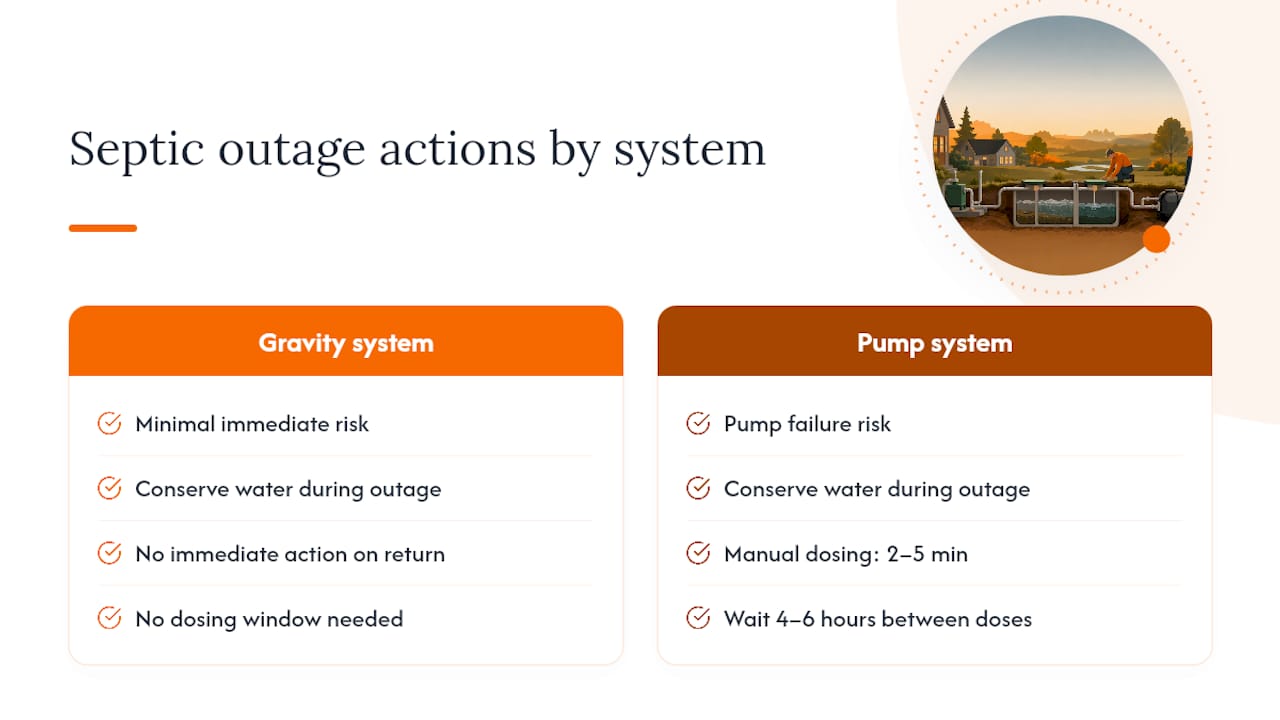
The second miss is timing. Homeowners either flood the pump the instant power returns, or they forget about it entirely once the lights are back on. Neither works. The manual dosing window, a few minutes on, several hours off, exists because drainfields need recovery time between doses, not because anyone enjoys babysitting a breaker panel.
If you take one thing from this article, make it this: conserve water aggressively during the outage, then be patient and deliberate for the first 24 hours after. That single habit prevents more emergency calls than any amount of after-the-fact repair work ever will.
— Jason
When Your System Needs Professional Attention After an Outage
Sometimes conservation and manual dosing aren’t enough, especially if the outage ran long or your system was already stressed before the storm hit. If you’re seeing slow drains that won’t clear, effluent surfacing in the yard, or an alarm that’s still going off a day later, that’s your cue to stop troubleshooting solo.

Professional septic companies handle emergency pump-outs, pump repair and replacement, effluent filter cleaning, and drainfield assessments in local service areas. Before you call, jot down what your system did during the outage: how long the alarm sounded, whether the pump ran continuously, and any backup you noticed indoors. That information cuts diagnostic time significantly. If your pump needs a closer look before the next storm season, our septic tank pump service guide covers what a checkup involves, and if things have already gone sideways, our emergency septic repair page is the fastest way to get someone out to your property.
Sources
- Septic systems: what to do after severe weather — Oklahoma State Extension
- Guidance for septic systems before, during, and after a power outage — NEHA
- Power outage guidance — Louisiana Department of Health (LDH)
FAQ
Do septic systems work when the power is out?
Gravity-fed systems keep working normally, but pump-based systems stop moving effluent until electricity returns, which is why water conservation is critical during any outage.
My septic pump isn’t getting power. What could be the problem?
Check the breaker first since it may have tripped or been shut off intentionally during an outage; if power is confirmed at the panel and the pump still won’t run, the float switch, wiring, or the pump itself may have failed and needs a professional look.
How long can my system go without power before it backs up?
There’s no fixed number since it depends on household water use and tank reserve capacity, but a full tank can start backing up in about a day once incoming reserve capacity is used up.
How long can I go without pumping my septic tank?
Most tanks need pumping every 3 to 5 years, with inspections recommended every 1 to 3 years, though heavy household use can shorten both intervals.
What should I do if my high-water alarm won’t stop after power returns?
Let manual dosing run its course for a few hours, but if the alarm is still sounding after 24 hours, call a septic professional since that usually points to pump failure or other damage.