
Call County First: How North Carolina Homeowners Get Septic Financing
Call your county environmental health office first to get a verification inspection that often unlocks CWSRF Helene, USDA, SERCAP, Water Well Trust, or...

The fastest path to paying for a septic repair or replacement in North Carolina starts with a phone call, not a loan application: contact your county environmental health office for a verification inspection. That single step often unlocks referrals to the state’s CWSRF Helene program, USDA’s Water & Waste Disposal Loan & Grant Program, and nonprofit lenders like SERCAP and Water Well Trust, all of which offer better terms than a credit card or personal loan. If you’re outside a designated disaster county or need faster cash, home equity or contractor financing fills the gap. Eligibility and paperwork vary by program, so the details below matter.
TL;DR:
- Public and nonprofit septic funding programs in North Carolina prioritize homeowners who cannot obtain reasonable private credit, with eligibility mainly for rural, owner-occupied, and low-income residences.
- The NC DEQ’s CWSRF Helene program offers up to 100% forgiveness in certain counties, but work may not start until early 2027, requiring early application.
- USDA loans provide low-interest, long-term financing for rural homeowners outside Helene-affected areas, with rates as low as 2.875% and terms up to 40 years.
- Private financing options like home equity loans or contractor payment plans often fund repairs faster but come with higher interest and costs; timing can be days to weeks depending on the route.
- Gathering documentation and completing a county inspection early can significantly speed up approvals and prevent delays in applying for public or nonprofit septic repair funds.
Table of Contents
- Public and Nonprofit Septic Financing Options in NC
- Who Qualifies for NC Septic Financing and What You’ll Need
- Private Financing and Contractor Payment Plans: When to Use Them
- How Long Does Septic Financing Take in North Carolina?
- Step-by-Step: How to Apply for Septic Financing in NC
- What Local Contractors Wish Homeowners Knew About Financing
- Get a Local Estimate and Financing Guidance From J&M Septic
- Where to Apply: Official Program Pages and County Contacts
- Sources
- FAQ
Public and Nonprofit Septic Financing Options in NC
North Carolina homeowners have more funding routes than most realize, but each one comes with its own eligibility map and funding cycle. Knowing which door to knock on first saves weeks.
NC DEQ’s CWSRF Helene program is the newest and most generous option for homeowners in the right zip code. The state received $22.5 million for decentralized wastewater repair through this fund, targeted at 39 counties designated under DR-4827-NC after Hurricane Helene. Nonprofits and local government units pass the money through to property owners, and some awards under the related pilot program can carry zero-percent interest with principal forgiveness up to 100% for qualifying applicants. Work tied to this round may not start until early 2027, so applying now matters even if repairs feel urgent.
USDA’s Water & Waste Disposal Loan & Grant Program covers a wider swath of rural North Carolina, not just Helene-affected counties. The interest bands effective through September 2026 run from 2.875% for poverty-level applicants to 3.750% for intermediate income and 4.750% for market-rate borrowers, with payback stretched out as long as 40 years. Grants can sometimes combine with a loan to lower the monthly payment further.
SERCAP and Water Well Trust run individual household well and septic loan programs that fill the gap for homeowners who don’t fit USDA’s rural-area rules. Loan caps often run up to $15,000 with rates as low as 1% on repair-focused loans, and terms can stretch to 10 years.
- NC DEQ CWSRF Helene: pass-through funding for 39 designated counties, possible zero-interest and forgiveness
- USDA Rural Development: fixed-rate loans and grants, 40-year terms, rural-area rule
- SERCAP and Water Well Trust: smaller loans up to $15,000, 1% rates possible, broader service area
- Regional councils like WPCOG have run no-interest revolving loan funds for failing systems in their coverage area
That last point is worth chasing on your own. Regional councils of government sometimes run small revolving funds that never show up in a statewide search, so it’s worth calling your local council directly.
Who Qualifies for NC Septic Financing and What You’ll Need
Most of these programs share a common gatekeeping logic: they exist for people who genuinely can’t get a reasonable loan anywhere else. USDA and NC DEQ materials are explicit that funding is reserved for applicants who cannot obtain commercial credit on reasonable terms, so a homeowner with strong credit and equity may get steered toward private financing instead.
Common eligibility rules across programs include:
- Property sits in an eligible rural area, often defined as a town or area under 50,000 in population
- You own and occupy the home (renters and investment property owners typically don’t qualify)
- Household income falls under program-specific thresholds
- The system is failing or malfunctioning, not simply old
- Funds go toward septic repair or replacement, never toward connecting to an existing public sewer line or building a new dwelling
Gather your paperwork before you apply, because most delays come from missing documents rather than denied eligibility. You’ll typically need a deed or proof of ownership, a government-issued ID, Social Security or benefit award letters, recent pay stubs, bank statements, proof of current property tax payment, and homeowners insurance documentation. Some programs also charge a small credit-report or application fee.
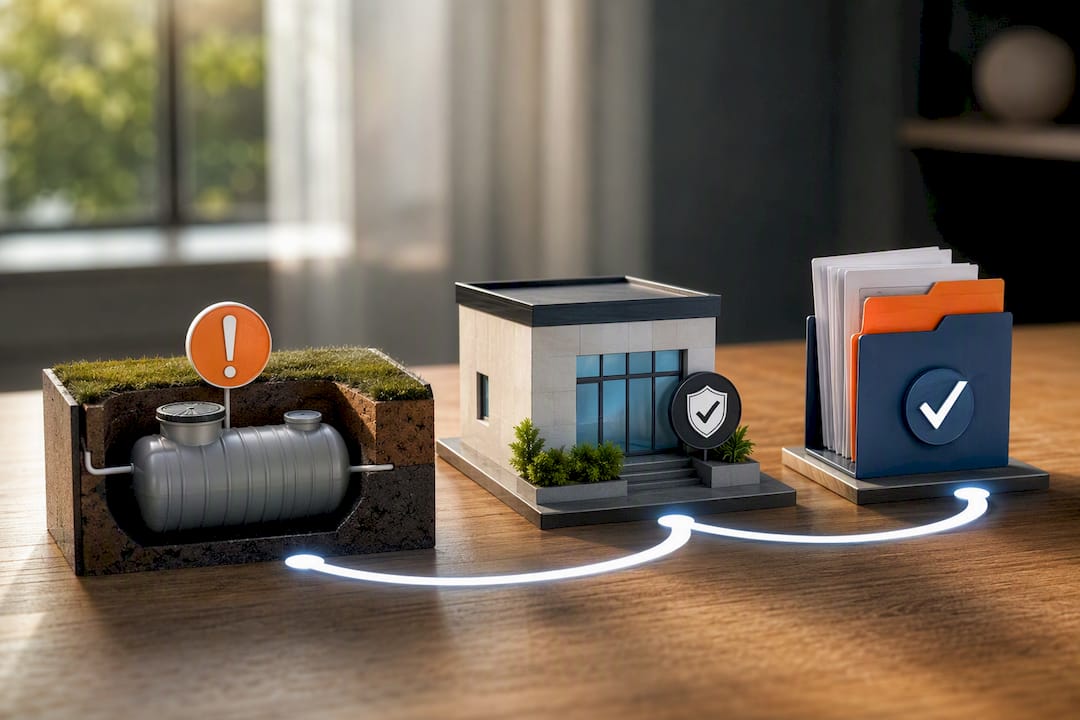
County environmental health verification is frequently the gateway that everything else depends on. Skip it, and nonprofit administrators often can’t move your file forward, since most require an official inspection finding before they’ll process an award.
Private Financing and Contractor Payment Plans: When to Use Them
Public and nonprofit programs move on their own schedule, and that schedule doesn’t always match a system that’s actively backing up into your yard. Private financing exists for exactly that mismatch.
- Home equity (HELOC or cash-out refinance): usually the lowest rate among private options, but it uses your house as collateral and comes with closing costs and appraisal delays
- Unsecured personal loans or credit cards: funded in days, not weeks, but APRs run well above any government or nonprofit program
- Contractor payment plans or third-party financing: convenient, but read the fine print on interest and confirm the plan covers the entire job, including tank, drainfield, and permit fees, not just labor
Pro Tip: Ask any contractor offering a payment plan for a written breakdown of what’s financed versus what’s billed separately. A quote that excludes permit fees or drainfield work can leave you short mid-project.
The math usually favors taking on faster, more expensive private financing over letting a failing system sit for months waiting on a public award. Sewage backup damage to flooring, plumbing, and even the foundation almost always costs more than the interest difference between a personal loan and a USDA loan.
How Long Does Septic Financing Take in North Carolina?
Timing depends heavily on which funding route you take, and stacking routes in parallel is smart. County verification typically takes days to a couple of weeks, depending on office backlog. From there, public and nonprofit program review can run anywhere from a few weeks to several months, since pass-through funds get distributed in limited rounds rather than continuously.
Permitting and construction scheduling add more weeks once funding clears, particularly if soil evaluation or percolation testing is required for a new drainfield design. System type also drives both cost and schedule: a standard gravity system moves faster through permitting than an alternative system required for tight soil or a high water table. Contractor availability in your area adds its own delay on top of all of it.
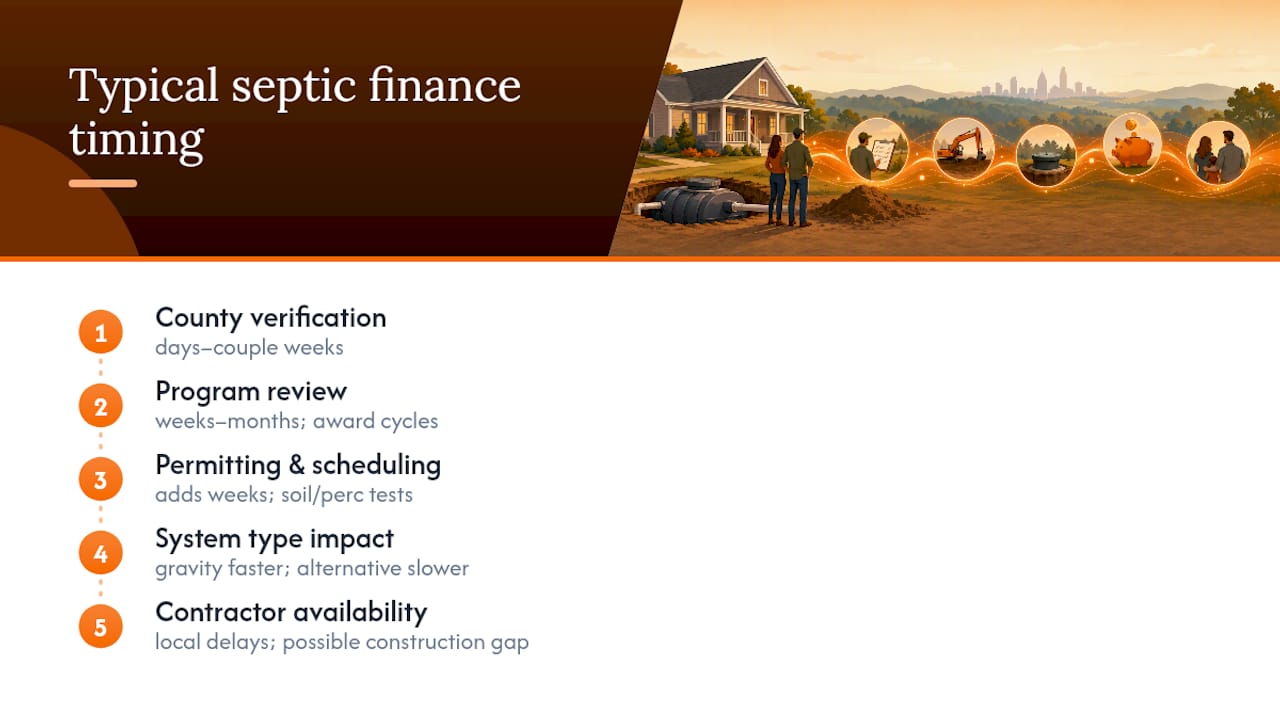
Because pass-through funding for programs like CWSRF Helene arrives in limited award cycles, some homeowners face a real gap between approval and construction start. If your system is actively failing, ask your contractor about staged or temporary repairs to buy time while a larger funding award works through the pipeline.
Step-by-Step: How to Apply for Septic Financing in NC
- Document the problem now. Take photos, note dates of backups or odors, and cut back on water use to reduce strain on a failing system.
- Call your county environmental health office and request a verification inspection. This is the step that unlocks most program referrals.
- While you wait for that inspection, assemble your documents: deed, ID, pay stubs, bank statements, insurance proof, and tax payment records.
- Reach out to SERCAP, Water Well Trust, or the nonprofit administrator listed on the NC DEQ Helene page for application help.
- If your system can’t wait for a funding decision, line up a contractor first for a short-term repair while keeping your full-replacement application active.
What Local Contractors Wish Homeowners Knew About Financing
Homeowners waste time when they wait for a contractor’s estimate before calling county environmental health. That inspection should happen first. It documents the failure, and it’s usually the piece nonprofit lenders ask for before approving anything.
Phased repairs tend to work better than most people expect. A temporary fix on a failing line while a full-replacement application moves through USDA or CWSRF Helene review keeps a household functioning without draining savings on a rushed, undersized repair.
Local septic contractors familiar with Alamance County’s permit and inspection processes can help homeowners avoid paperwork mismatches that stall funding applications.
— Jason
Get a Local Estimate and Financing Guidance From J&M Septic
Septic financing programs move faster when your documentation is already in order, and that’s exactly where a local contractor earns its keep. A local contractor can assist with inspections, custom system design, and repair estimates that you can present directly to lenders or nonprofit administrators, helping to prevent delays from missing details in your funding application.

Whether you’re waiting on a CWSRF Helene award, applying through SERCAP, or covering the gap with private financing, you need a firm number and a realistic scope before anyone signs off. Contractors typically evaluate your system, advise whether repair or full replacement makes sense, and provide that assessment in writing. If your drainfield needs replacement work or your tank needs pumping before an inspection, call us or request an estimate through Jmseptic and get a documented plan you can bring to any lender.
Where to Apply: Official Program Pages and County Contacts
Start with the USDA Water & Waste Disposal program page and the NC DEQ CWSRF Helene program page for eligibility and applications. SERCAP’s household loan page and the Henderson County USDA guidance PDF outline documentation. Wake County’s program list shows how one county structures referrals.
This article is general information, not a substitute for advice from a qualified financial advisor. Consult a qualified financial professional about your own circumstances before acting on anything here.
Sources
- CWSRF Helene Decentralized Wastewater Treatment Systems (Septic Systems) Program | NC DEQ
- Water & Waste Disposal Loan & Grant Program | Rural Development
- USDA-Funded Well-Septic Repair On-Line Loan Application Information (Henderson County)
- Programs to help with your septic repairs, well repairs, water treatment & well testing | Wake County
FAQ
Can I use these programs to connect to public sewer instead of fixing my septic system?
No. Programs like USDA’s Water & Waste Disposal Loan & Grant Program and SERCAP’s household loans are restricted to septic repair or replacement, not connecting to an existing public sewer line or funding new construction.
Do I have to be denied by a bank before applying for USDA or nonprofit septic loans?
Not always formally denied, but these programs are built for homeowners who cannot obtain reasonable commercial credit, so applicants with strong credit and available home equity may be directed toward private financing instead.
How fast can I get septic financing in North Carolina?
Private financing like a personal loan or contractor payment plan can fund in days. Public and nonprofit programs typically take weeks to months because pass-through awards move in limited funding cycles rather than continuously.
What does J&M Septic charge for an inspection or estimate?
Pricing for inspections, tank pumping, and repair estimates isn’t published online, so current rates are available directly through Jmseptic or by calling our team for your property specifics.
Who should I call first if my septic system is failing?
Call your county environmental health office first. The verification inspection they perform is usually the document that unlocks referrals to state, federal, and nonprofit funding partners.