
Septic Blue Services: Pumping, Repairs, and Local Booking
Discover Septic Blue for reliable septic pumping, repairs, and easy online booking. Protect your system and avoid costly repairs today!

Septic Blue is a national network of local septic service franchises offering pumping, cleaning, inspection, repair, and installation — and you can book service online or by phone directly through your city’s location page. The EPA recommends inspecting a typical household septic system at least every 3 years and pumping every 3–5 years; routine maintenance runs roughly $250–$300, while skipping it can push emergency repair costs to $3,000–$7,000. If you’re in Alamance County or the Piedmont Triad area of North Carolina, Jmseptic (J&M Septic Installation & Repair) is a licensed local alternative with the same full-service menu.
Quick booking options:
- Call the Septic Blue location page for your city directly
- Use the online booking form on the brand’s city-specific page
- For emergency or same-day service, call the local number listed under “emergency service” on your location page
- Alamance County homeowners: contact Jmseptic for local, licensed service in Burlington, Mebane, Elon, Graham, Whitsett, and McLeansville
Table of Contents
- What services does Septic Blue offer?
- Where does Septic Blue operate, and how do you check coverage?
- What does Septic Blue typically charge, and are there promotions?
- What happens during a typical service visit?
- How often should you inspect and pump your septic system?
- Signs you need to call a septic pro right now
- How do you evaluate a septic contractor’s credibility?
- Key Takeaways
- What most homeowners get wrong about septic maintenance
- Jmseptic: local septic service for Alamance County homeowners
- Useful sources
What services does Septic Blue offer?
Septic Blue location pages consistently advertise the following core services:
- Septic pumping and cleaning: Removes accumulated solids and scum from the tank. This is the foundation of any maintenance visit and the service most homeowners call about first.
- Full system inspections: Technicians check scum and sludge layer depths, inspect inlet and outlet baffles, look for cracks or root intrusion, and assess overall tank condition.
- Repairs: Covers baffle replacement, lid repair or replacement, tank crack sealing, and line repairs. Scope and cost vary by damage type.
- New system installation and replacement: Full installs for new construction or complete system replacements when repair is no longer viable.
- Hydro-jetting and sewer line cleaning: High-pressure water clears grease buildup, root intrusion, and stubborn blockages in lines. See Jmseptic’s sewer line cleaning guide for what this process involves.
- Drainfield repairs: Addresses saturated or failing leach fields before full replacement becomes necessary.
- Emergency and after-hours service: Most Septic Blue locations advertise 24/7 availability for backups and active failures.
Add-on tasks often billed separately: locating buried lids, deep excavation to access lids, camera inspections, and dye tests. Ask for an itemized estimate before the technician arrives so there are no surprises on the invoice.
Septic Blue location pages also mention service contracts and annual maintenance plans. These typically bundle a pump-out with a written inspection report and priority scheduling, which can be worth the cost if your system hasn’t been serviced in several years.
Where does Septic Blue operate, and how do you check coverage?
Septic Blue operates on a franchise model, meaning each city or metro area has its own independently operated location page with its own phone number, hours, and service radius. You’ll find pages for markets like Atlanta, Raleigh, Charlotte, and Orlando, but the list is not exhaustive, and coverage boundaries vary by franchise.
To confirm service at your address:
- Search “Septic Blue” plus your city name (e.g., “Septic Blue Raleigh” or “Septic Blue Charlotte”) to land on the correct location page
- Enter your ZIP code in the service-area tool on the brand site if one is available
- Call the local number listed on your city’s page and ask directly whether your address falls within their service radius
- Check the location page for listed hours and whether emergency service is available in your area
When you call, have your property address ready, the nearest cross street, your tank size if you know it (1,000 or 1,500 gallons is most common), and whether your lids are exposed or buried. That last detail matters more than most homeowners expect.
What does Septic Blue typically charge, and are there promotions?

Price depends on several factors, and no single number covers every situation.
What drives the cost up or down:
- Tank size (1,000 vs. 1,500+ gallons)
- Whether lids are exposed or buried (locating and digging for buried lids adds labor charges)
- Distance from the service depot
- Soil conditions and access difficulty
- Whether repairs are needed on the same visit
- Emergency vs. scheduled appointment
The EPA puts routine maintenance at roughly $250–$300 every 3–5 years. Emergency repairs, when a system has been neglected, can run $3,000–$7,000. That gap is the clearest financial argument for staying on schedule.
| Service | Typical Cost Range | Notes |
|---|---|---|
| Routine pump-out and cleaning | typical cost varies depending on tank size and lid access | |
| Full inspection | Often bundled with pump-out | May be separate if standalone |
| Emergency repair | costs can be substantial depending on the scope of damage, with repairs often significantly more expensive than routine maintenance. | |
| Lid location (professional) | $100–$900 | Per Angi’s cost data; method-dependent |
Septic Blue location pages commonly advertise promotions like discounted pump-outs, free inspections with service, or financing options through third-party lenders. Terms change, so verify the current offer directly on your city’s page before booking. Financing availability and approval depend on the lender’s criteria, not the franchise itself.
Pro Tip: Know where your lids are before the technician arrives. Customers who have exposed or marked lids avoid additional excavation fees and get faster service completion.
What happens during a typical service visit?
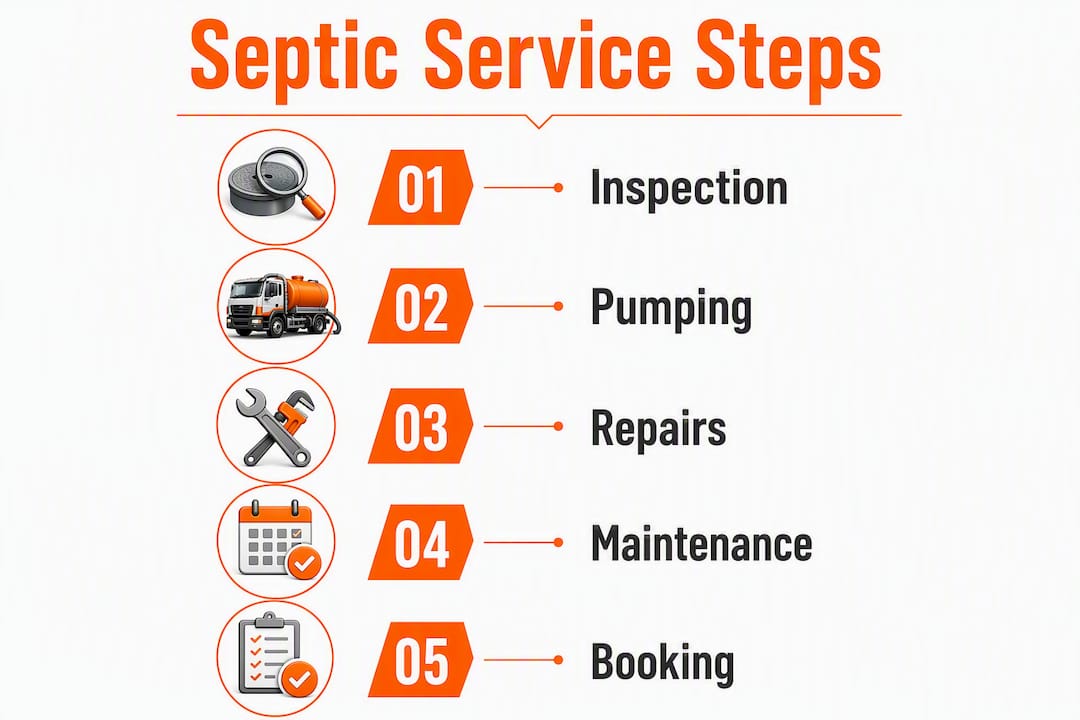
Here’s what a standard Septic Blue pumping and cleaning appointment looks like from start to finish:
- Arrival and safety check. The technician confirms the service address, reviews the work order, and asks about recent heavy water use, prior repairs, or known system issues. Clear the driveway for the vacuum truck.
- Locating and opening lids. If lids are buried, the technician uses probing rods or a locator device to find them. This step is billed separately if excavation is required.
- Inspection of baffles and layers. Before pumping, the tech measures scum depth at the top and sludge depth at the bottom. They inspect inlet and outlet baffles for damage or displacement.
- Pumping. The vacuum truck removes all liquid and solid waste. A thorough job includes backwashing to break up solids and ensure the tank is fully cleared.
- Optional camera inspection or hydro-jetting. If the technician spots signs of line blockage or root intrusion, a camera scope or high-pressure jetting may be recommended. These are typically add-on charges.
- Post-service report. You should receive written notes on tank condition, baffle status, recommended pump interval, and any repairs flagged. Ask for photos if the technician documented anything unusual.
- Invoice and next steps. A written estimate for any recommended repairs should accompany the invoice. If a warranty applies to parts replaced, get it in writing before the truck leaves.
Keep pets secured and make sure someone is home who can answer questions about the system’s history. If you’ve had recent sewage backups or added a garbage disposal, mention it — both affect how the technician interprets what they find.
How often should you inspect and pump your septic system?
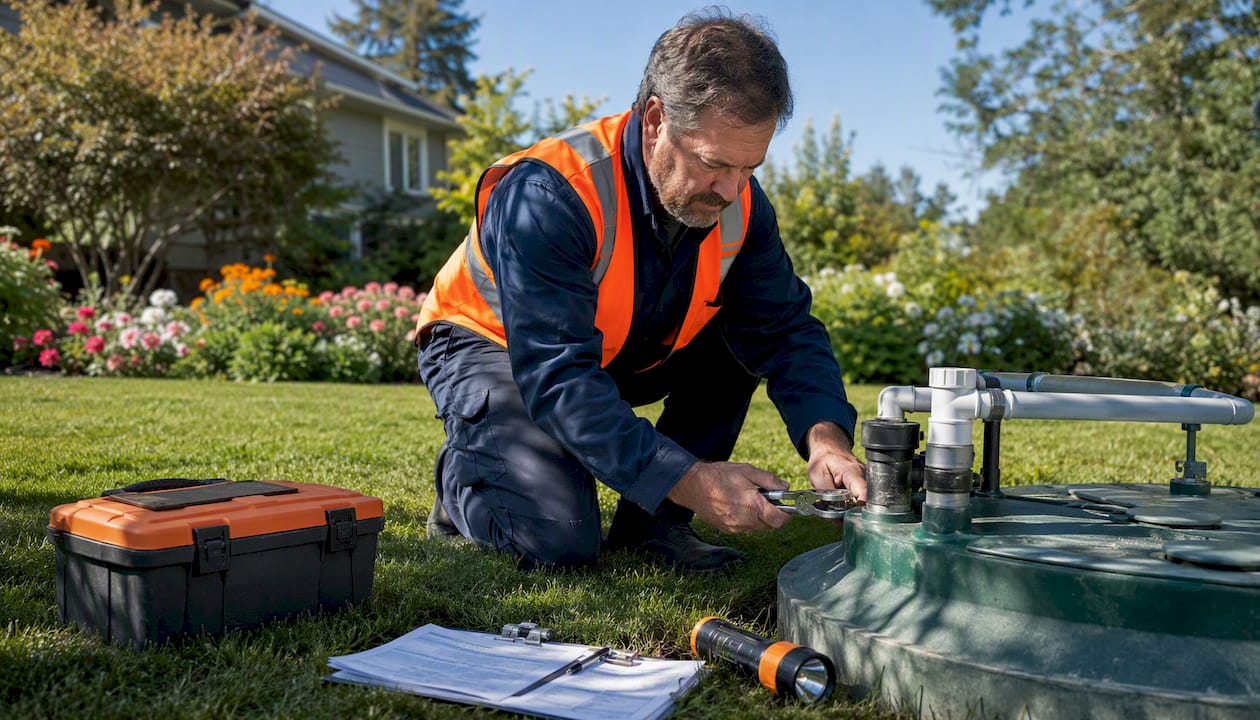
The EPA’s guidance is clear: inspect at least every 3 years, pump every 3–5 years for a typical household. Systems with mechanical or electrical components — pumps, float switches, aerators — need annual inspections because a failed pump can cause a backup within days.
| System Type | Inspection Frequency | Pumping Frequency |
|---|---|---|
| Standard gravity system | Every 3 years | Every 3–5 years |
| Alternative system with pumps/floats | Annually | Every 3–5 years (or per technician guidance) |
Consistent pumping on that schedule is what prevents premature drainfield failure. Homeowners who skip pump-outs for 8–10 years often find solids have migrated into the leach field, and drainfield repair or replacement costs far more than a decade of routine service.
What to keep out of your system entirely, per EPA guidance and Purdue Extension’s “Dirty Dozen” list:
- Cooking fats, oils, and grease (coat pipes and kill beneficial bacteria)
- Chemical drain cleaners (destroy the bacterial population that breaks down waste)
- “Flushable” wipes (they do not break down and are a leading cause of pump-outs and mechanical failures)
- Feminine products, diapers, and paper towels
- Medications and solvents
- Large volumes of bleach or antibacterial cleaners
Garbage disposals deserve a specific mention. Disposals can significantly increase the solids load entering your tank, which means more frequent pumping. Use one sparingly or skip it altogether if your system is older or undersized.
Excessive clear-water inputs are a less obvious threat. Sump pumps, gutter drains, and water softener backwash routed to the septic system can hydraulically overload it, pushing solids into the drainfield before they’ve settled. Redirect those flows away from the system.
Homeowners who pump consistently every 3–5 years generally avoid the catastrophic drainfield replacements that can cost tens of thousands of dollars. The math is straightforward: a few hundred dollars every few years versus a potential five-figure repair.
Pro Tip: Spread laundry loads across the week instead of running multiple loads in a single day. A sudden surge of water can flush solids out of the tank before they settle.
For a deeper look at scheduling and what a professional pump service includes, Jmseptic’s septic tank pump service guide covers the full process.
Signs you need to call a septic pro right now
Some of these are emergencies. Others give you a day or two. None of them should be ignored.
Call immediately (emergency service):
- Raw sewage backing up into sinks, toilets, or tubs
- Sewage surfacing on the ground above the tank or drainfield
- Strong sewage odor inside the house
Schedule within the next day or two:
- Soggy, spongy, or unusually green grass over the drainfield area
- Slow drains across multiple fixtures simultaneously
- Gurgling sounds from toilets or drains after flushing
- Persistent sewage odor outdoors near the tank
Delaying on any of these risks contaminating your soil and groundwater, which creates health hazards and can trigger county health department involvement. A drainfield bog or active backup is not a “wait and see” situation. For a full breakdown of failure modes and what they mean for repair timelines, Jmseptic’s guide to common septic system problems is worth reading before you call.
How do you evaluate a septic contractor’s credibility?
Not every location page tells the full story. Here’s what to look for before you book.
Reviews: Volume and recency both matter. A contractor with 200 reviews from the past 18 months is more informative than one with 50 reviews spread over 8 years. Look for reviews that mention specific technician names, describe the job in detail, or include before-and-after notes. Generic five-star reviews with no detail are less useful. Also check how the company responds to negative reviews — a professional, non-defensive reply is a good sign.
Licensing and insurance: In North Carolina and most states, septic contractors must hold a state-issued license and carry general liability insurance. Ask for the license number and verify it with your state’s licensing board before work begins. An unlicensed contractor leaves you liable for permit violations and any property damage.
Written estimates and warranties: A credible contractor provides a written estimate before starting work, not after. Any parts replaced — baffles, lids, risers — should come with a documented warranty. If a company resists putting terms in writing, that’s a clear signal to look elsewhere.
Financing terms advertised on brand pages are typically managed through a third-party lender. Read the financing agreement carefully, including the interest rate and term length, before signing. “Up to 36 months” financing is a common offer, but approval and rate depend on the lender’s criteria.
Key Takeaways
Septic Blue is a franchise network of local septic contractors; for Alamance County homeowners, Jmseptic provides the same full-service menu with licensed, local technicians.
| Point | Details |
|---|---|
| EPA maintenance cadence | Inspect every 3 years; pump every 3–5 years; annual inspections for systems with pumps or floats. |
| Cost signals | Routine pump-outs run $250–$300; emergency repairs can reach $3,000–$7,000 when maintenance is skipped. |
| Warning signs | Backups, sewage odors, soggy yard, and slow drains across multiple fixtures all require prompt professional service. |
| What to avoid | Never flush wipes, grease, chemicals, or medications; limit garbage disposal use to reduce solids loading. |
| Local alternative | Jmseptic serves Burlington, Mebane, Elon, Graham, Whitsett, and McLeansville with licensed installation, repair, and maintenance. |
What most homeowners get wrong about septic maintenance
The biggest mistake I see consistently is homeowners treating their septic system like a municipal sewer connection — something that just works until it doesn’t. A septic system is private infrastructure. The EPA is direct about this: the homeowner bears full responsibility for maintenance, permits, and repairs. Nobody is monitoring it for you.
The second most common mistake is trusting the “flushable” label. Practitioners see these products accumulate in tanks and cause mechanical failures that a simple pump-out won’t fix. The marketing term “biodegradable” does not mean “safe for septic” — it means the product will eventually break down, possibly over years, not the weeks your tank needs.
Hidden lids are a real cost driver that surprises people. If you don’t know where your lids are, find out now and mark them. It saves money on every future service call and speeds up emergency response when you need it most.
Jmseptic serves Alamance County homeowners in Burlington, Mebane, Elon, Graham, Whitsett, and McLeansville. If you’re in the area and haven’t had a professional inspection in the past three years, that’s the first call to make.
Jmseptic: local septic service for Alamance County homeowners
If you’re in Alamance County or the surrounding Piedmont Triad area, Jmseptic gives you a licensed, locally owned alternative to national franchise chains. Every job comes with a written estimate, transparent pricing, and technicians who know the soil conditions, permit requirements, and county regulations specific to this area.

Jmseptic handles the full range: new installations, tank replacements, repairs, hydro-jetting, and emergency service for active backups. For urgent situations, the emergency septic repair page covers same-day response details. For routine pump-outs and scheduled maintenance, the septic tank pump service guide explains exactly what to expect and how to prepare your property.
Service towns: Burlington, Mebane, Elon, Graham, Whitsett, and McLeansville, North Carolina. Call or book online to schedule an inspection, get a written estimate, or request emergency service today.
Useful sources
The following authoritative sources informed this article. Consult them directly for official maintenance guidance, do-not-flush lists, and homeowner troubleshooting.
- How to Care for Your Septic System | US EPA — Primary source for inspection and pumping frequency, cost signals, and items to keep out of your system. Start here for maintenance planning.
- Do Your Part — Be SepticSmart! (EPA Homeowner Guide) — Detailed EPA homeowner guide covering system basics, maintenance responsibilities, and environmental impact.
- Frequent Questions on Septic Systems | US EPA — Covers regulations, inspections, failing systems, and compliance questions in a searchable Q&A format.
- Keep the “Dirty Dozen” Out of Your Onsite Sewage System | Purdue Extension — Academic extension publication listing the twelve categories of items that cause system failures; useful for homeowner education.
- How Much Does It Cost to Locate a Septic Tank? | Angi — Current cost data for professional lid location services, ranging from $100 to $900 depending on method.