
Sagging Sewer Line Repair: What Homeowners Must Know
Learn essential steps for sagging sewer line repair. Prevent clogs and protect your home with expert tips and immediate actions to take.

A sagging or bellied sewer line is a low spot in the pipe where wastewater pools and solids collect instead of flowing to the main. Snaking it out buys you a few weeks at best. The slope is broken, and until someone corrects it, the clogs come back.
Here is what to do right now:
- Stop heavy water use. Hold off on laundry, dishwasher cycles, and long showers until you know what you are dealing with.
- Skip the chemical drain cleaners. They will not fix a grade problem and can damage older pipe materials.
- Locate your cleanout. It is usually a capped pipe near the foundation or in the yard. Note whether sewage is backing up there.
- Document everything. Take photos and short videos of slow drains, gurgling fixtures, wet yard patches, or any sewage odor.
- Call a licensed plumber or sewer contractor and request a camera inspection before anyone recommends a repair.
Quick triage:
- Emergency (act today): Raw sewage backing up into tubs, toilets, or floor drains. Stop using all fixtures and call immediately.
- Urgent (within days): Recurring clogs at the same fixture, gurgling after every flush, persistent sewage smell.
- Monitor: A single slow drain with no odor or backup and no history of repeat clogs. Still worth a camera look within the next few weeks.
Pro Tip: Before you call anyone, write down which fixtures drain slowly, how long the problem has been happening, and whether you have had the line snaked before. That information cuts diagnostic time and helps you spot a contractor who is guessing versus one who is diagnosing.
Key Takeaways
A pipe belly traps wastewater and solids in a low spot and requires slope correction, not just cleaning, for a durable repair.
| Point | Details |
|---|---|
| What a belly is | A low spot in the lateral where wastewater pools; snaking clears it temporarily but does not fix the grade. |
| First steps | Stop heavy water use, document symptoms, locate the cleanout, and call a licensed contractor for a camera inspection. |
| Diagnosis must-haves | Request recorded camera footage with distance markers and a slope readout before approving any repair. |
| Repair methods that fix grade | Open excavation with compacted bedding, spot replacement, or directional bore; CIPP lining does not correct slope. |
| Responsibility and insurance | Homeowners own the lateral from house to property line; most standard policies exclude gradual settlement damage. |
| Prevention schedule | Camera inspection every 8–10 years (every 2–3 years near large trees); hydro-jetting every 2–5 years. |
| Jmseptic | Serves Alamance County and the Piedmont Triad with camera inspection, hydro-jetting, excavation, and lateral replacement. |
Table of Contents
- What is a sagging sewer line, and how is it different from a crack or collapse?
- What causes a sewer line to sag in the first place?
- What are the signs of a sagging sewer line?
- How do professionals diagnose a sewer belly?
- Which repair method actually fixes a sewer belly?
- How much does sagging sewer line repair cost?
- Who is responsible for sewer lateral repairs, and what does insurance cover?
- How to prevent future sewer line bellies
- How do you choose the right sewer contractor?
- Septic vs. municipal sewer: when should you call a septic company?
- What a local septic contractor actually sees in the field
- What to expect when Jmseptic inspects your lateral
- Sources
What is a sagging sewer line, and how is it different from a crack or collapse?
The industry term is a pipe belly. A section of the sewer lateral drops below its designed slope, creating a low point where gravity can no longer push wastewater forward. Instead of draining cleanly, water sits in that dip. Grease, sediment, and toilet paper accumulate on top of the standing water, and eventually the line clogs.
Slope is everything in a gravity-fed sewer. Residential laterals are typically designed to fall at least 1/4 inch per foot. When a section settles even an inch or two below that grade, the hydraulics change completely.
A belly is not the same as these other common pipe problems:
- Cracks or pinholes: The pipe structure is compromised and leaking, but the slope may still be intact. Trenchless lining often works well here.
- Root intrusion: Roots grow through joints or cracks and restrict flow, but the pipe geometry may be fine. Cutting and lining can address this.
- Offset joints: Pipe sections have shifted laterally at a joint, creating a partial obstruction. May or may not affect slope.
- Collapsed pipe: The pipe wall has failed and the line is fully or partially blocked. This is a structural emergency requiring excavation.
A belly is a geometry problem. The pipe is structurally intact, but it is in the wrong position. That distinction matters because it rules out certain repairs. You cannot line your way out of a belly, and you cannot snake your way out of one permanently. The fix has to restore the slope.
What causes a sewer line to sag in the first place?
Pipe bellies rarely happen overnight. Most develop over years as the soil around and beneath the pipe shifts. Understanding the cause helps you ask the right questions and assess whether your property has ongoing risk factors.
Common causes:
- Poor initial bedding or compaction: If the pipe was not laid on a stable, compacted bed of sand or gravel, it will settle unevenly as the surrounding soil consolidates. This is the most common cause in newer homes.
- Soil settlement and erosion: Natural soil compaction over time, especially in clay-heavy soils common in the Piedmont region, can cause gradual pipe movement. Erosion from water running alongside the pipe accelerates this.
- Groundwater fluctuation: Repeated wet and dry cycles cause soil to expand and contract. Over years, this movement can shift pipe sections out of alignment.
- Heavy surface loads: Vehicles, heavy equipment, or construction activity over the pipe route compress the soil and can push sections downward. Driveways built over lateral lines are a frequent culprit.
- Tree root voids: Roots grow toward the pipe seeking moisture, then die back or are cut, leaving voids in the soil. The pipe drops into those voids.
- Adjacent excavation: Digging near the lateral for utilities, landscaping, or additions disturbs the bedding and can cause settlement.
- Pipe age and material: Older clay tile and cast-iron sections have more joints and are more susceptible to joint separation and movement than modern PVC. A 50-year-old clay lateral has had decades of settlement risk.
The location of the belly often points to the cause. A sag near a large oak or maple? Likely root-related voids. A belly under the driveway? Heavy load compaction. A sag in the middle of the yard with no obvious surface cause? Probably original bedding failure or long-term soil settlement.
For more on what drives sewer blockages at the root level, this homeowner’s guide to sewer blockage causes breaks down root and grease factors in plain language.
What are the signs of a sagging sewer line?
The symptoms of a pipe belly overlap with other sewer problems, but a few patterns are specific enough to point toward a grade issue rather than a simple clog.
Watch for these at home:
- Slow drainage at multiple fixtures simultaneously (not just one sink)
- Clogs that recur at the same spot within weeks of being snaked
- Gurgling sounds from toilets or floor drains after water runs elsewhere in the house
- Sewage odors inside the home or near the cleanout
- A patch of unusually green or lush grass in the yard over the lateral route
- Soft spots, depressions, or sinkholes in the yard
- Standing water around the cleanout cap after rain or heavy use
- Sewage backing up into the lowest fixture in the house (floor drain, basement toilet)
The recurring clog pattern is the most telling. A simple blockage clears and stays clear. A belly refills with sediment within weeks because the standing water never leaves. If you have had the line snaked two or three times in the past year and the problem keeps coming back, a belly is a strong possibility.
For more background on what leads to sewage backup and when it signals something structural, that resource covers the full range of causes.
When it is an emergency: Raw sewage backing up into living spaces is a health hazard. Stop using all water-consuming fixtures, keep people and pets away from the affected area, and call a contractor immediately. Do not wait for a scheduled appointment.
When monitoring is acceptable: A single slow drain with no odor, no backup, and no history of repeat clogs may be a minor partial blockage rather than a belly. A camera inspection within the next few weeks will confirm it either way.
How do professionals diagnose a sewer belly?
A camera inspection is the starting point, but a thorough diagnosis goes further than just running a camera through the pipe.
| Inspection Method | What It Reveals | Typical Cost Range |
|---|---|---|
| Video camera inspection | Standing water, U-shaped dip, root intrusion, cracks, offsets | $230–$845 |
| Line locating with sonde | Exact depth and horizontal position of the camera head for targeted excavation | Varies; often bundled with camera |
| Slope/grade measurement | Confirms degree of belly and whether grade correction is needed | Included in thorough inspections |
| Hydrostatic pressure test | Identifies leaks and confirms pipe integrity under pressure | Varies by contractor |
| Smoke test | Locates cracks, bad joints, and cross-connections | Typically used for larger systems |
The camera footage is your most important piece of evidence. A properly run inspection will show standing water sitting in the low point even when no water is flowing through the pipe. That standing water, visible as a reflective pool on the footage, confirms a belly rather than a simple blockage. Camera footage, combined with locator/sonde markers, gives the contractor the exact depth and position needed to plan a targeted excavation rather than guessing.
Distance markers on the footage matter too. They tell you exactly how far from the cleanout the belly sits, which helps you verify that any excavation is happening in the right place.
Pro Tip: Always ask for a copy of the recorded camera video before approving any repair. A contractor who will not provide footage or who cannot show you the belly on screen is a red flag. The video is your documentation for insurance, future sales, and contractor comparison.
For property managers handling multiple units, this pipe inspection guide for landlords covers recordkeeping and inspection scheduling in practical detail.
Which repair method actually fixes a sewer belly?
This is where a lot of homeowners get misled. Not every repair method corrects the underlying grade problem, and some contractors sell trenchless solutions that reinforce the pipe without fixing the slope.
Why trenchless lining usually cannot fix a belly
Trenchless relining methods like CIPP (cured-in-place pipe) install a new liner inside the existing pipe. The liner follows the interior geometry of the old pipe exactly. If the pipe has a belly, the liner has a belly. The structural integrity improves, but the standing water problem remains. Lining a bellied section can leave the dip in place and lead to the same recurring clogs within months.
CIPP is an excellent solution for cracks, root intrusion, and deteriorating pipe walls where the slope is still intact. It is not a belly fix.
Open excavation and slope restoration
This is the standard long-term repair for a true belly. The contractor exposes the affected section, removes compromised or unstable soil, re-establishes the correct slope on a compacted bedding layer, and installs new pipe. Done correctly with proper bedding material and compaction, this approach addresses the root cause rather than masking it.
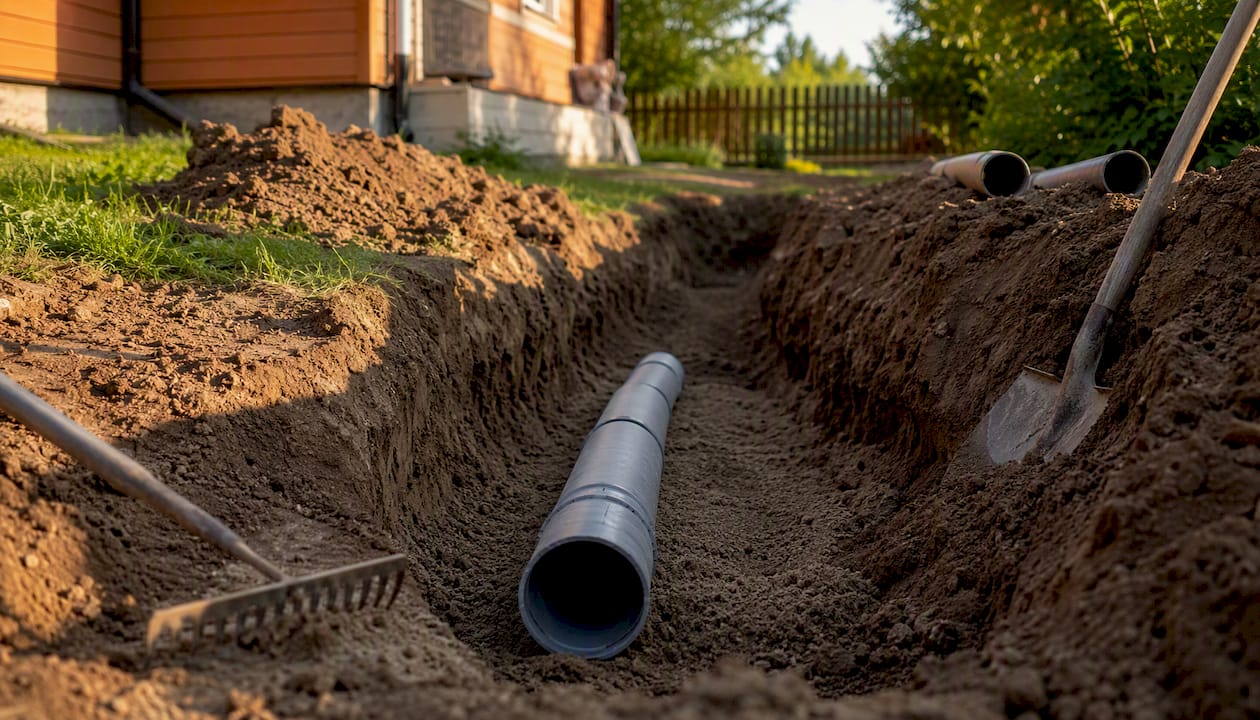
A spot repair targets only the bellied section rather than the full lateral, which keeps costs down when the rest of the pipe is in good condition.
Pipe bursting
Pipe bursting pulls a new pipe through the old one while fracturing the existing pipe outward. It replaces the pipe run but follows the existing path. If the bedding beneath is unstable, the new pipe can settle into the same belly over time. Pipe bursting works best when the old pipe is deteriorated along its full length and the soil conditions are stable.
Directional boring
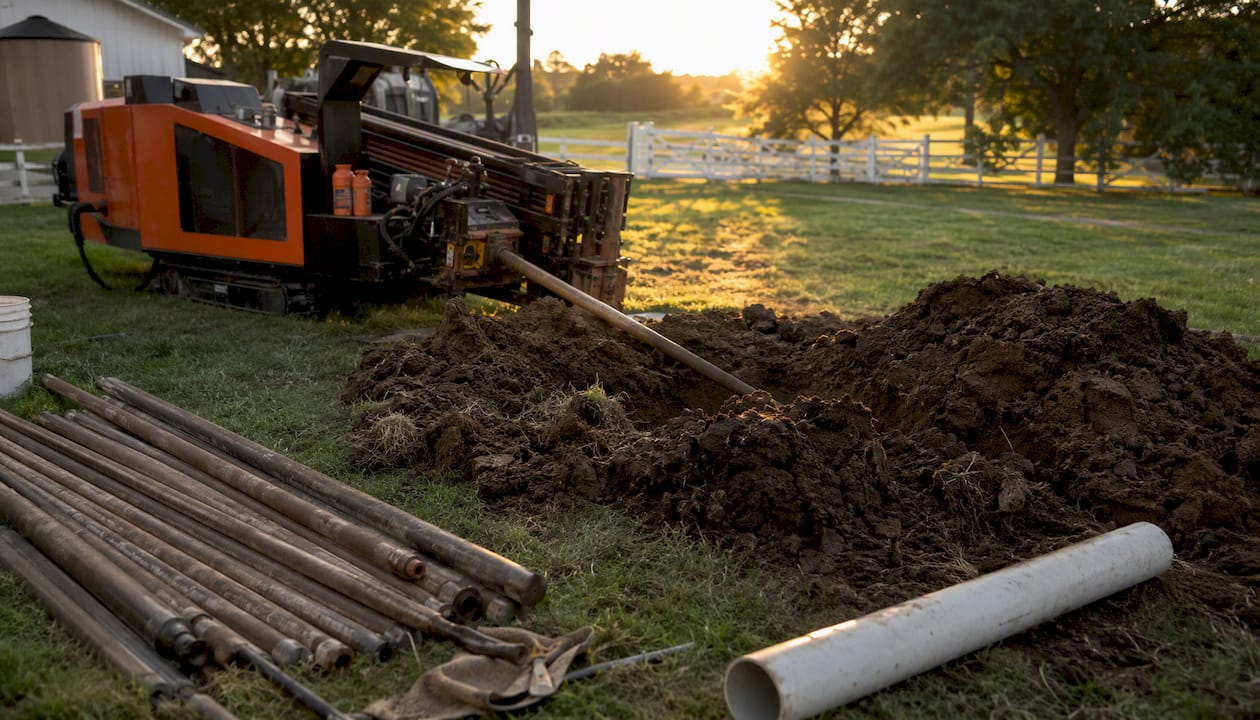
A new pipe run is bored on a corrected grade, bypassing the old pipe entirely. This works well when the old lateral is too deteriorated to burst and surface disruption needs to be minimized. It requires stable soil and enough clearance for the boring equipment.
Repair method comparison:
| Method | Corrects grade? | Surface disruption | Best suited for |
|---|---|---|---|
| Open excavation and replace | Yes | Moderate to high | True belly, any length |
| Spot excavation (targeted dig) | Yes | Localized | Short, isolated belly |
| CIPP trenchless lining | No | Minimal | Cracks, root damage, intact slope |
| Pipe bursting | Partially | Low to moderate | Full-run deterioration, stable soil |
| Directional bore (new run) | Yes | Low to moderate | Severe deterioration, bypass needed |
Short case scenarios:
- Shallow belly, 3–5 feet long, rest of pipe in good shape: Spot excavation and replace on compacted bedding. Fast, targeted, cost-effective.
- Long run sag over 20+ feet with multiple low points: Full section replacement via open trench or directional bore on corrected grade.
- Collapsed section with belly upstream: Emergency excavation to address the collapse first, then evaluate and correct the belly in the same mobilization.
How much does sagging sewer line repair cost?
Costs vary significantly based on depth, access, pipe length, and what is above the line (driveway, tree roots, structure). These ranges give you a realistic starting point for budgeting and comparing quotes.
Timeline expectations:
- Camera inspection: typically scheduled within 1–3 days
- Permit lead time: varies by municipality, often 3–10 business days
- Spot repair on site: 1–2 days for excavation, pipe work, and backfill
- Full lateral replacement: 2–5 days depending on length and conditions
- Landscape restoration (sod, gravel, concrete): 1–4 weeks after backfill settles
Budgeting advice: Always request an itemized written quote that separates labor, materials, excavation, surface restoration, permit fees, and soil disposal. Understanding cost drivers like depth, access, and contaminated soil disposal helps you compare bids on scope rather than just the bottom line number.
Key price drivers to ask about:
- Depth of the pipe (deeper means more excavation cost)
- What is directly above the line: concrete driveway, mature trees, deck or structure
- Soil conditions and whether contaminated soil requires special disposal
- Length of the affected section
- Whether permits are required and who pulls them
Who is responsible for sewer lateral repairs, and what does insurance cover?
The general rule in the U.S. is straightforward: homeowners own and are responsible for the private side sewer from the building to the property line. The utility owns and maintains the sewer main running in the street. That boundary matters because it determines who pays and who you call first.
If you suspect the problem is in the street main: Call your sewer utility before hiring a contractor. Utilities will inspect the main at no charge to confirm whether the blockage or damage is on their side. Attempting unauthorized repairs on the utility-owned portion can result in the cost being charged back to you, so confirm jurisdiction first.
What homeowner insurance typically covers:
Most standard homeowner policies exclude gradual wear, settlement, and deterioration. A belly that developed over years of soil movement is almost always classified as a maintenance issue, not a covered loss. Coverage is more likely when:
- The damage was caused by a sudden, accidental event (a burst pipe, a vehicle striking the line)
- You have a sewer backup endorsement or rider on your policy
- A third party (contractor, utility) caused the damage through negligence
Documentation checklist:
- Request a copy of the camera inspection video and any written contractor report
- Photograph the cleanout, any surface evidence (wet spots, sinkholes), and all affected fixtures
- Note dates: when symptoms started, when each service call occurred, and what was done
- Get at least two written contractor quotes before authorizing major repairs
- Contact your insurance agent before repairs begin to ask whether your policy covers any portion
Quick action steps when you suspect a sewer problem:
- Call the sewer utility to rule out a mainline issue
- Schedule a camera inspection with a licensed contractor
- Get two or more itemized quotes
- Review your homeowner policy for sewer backup endorsements
- Keep all documentation in a folder (digital or physical) for insurance and future property records
How to prevent future sewer line bellies
Prevention is dramatically cheaper than repair. A consistent maintenance schedule catches problems early and reduces the chance of a belly developing in the first place.
Recommended maintenance schedule:
- Camera inspection every 8–10 years for most homes; every 2–3 years if large trees are growing near the lateral.
- Hydro-jetting every 2–5 years to clear grease buildup and debris before it accumulates into a blockage.
- Annual visual check of the cleanout and yard for wet spots, depressions, or odors.
- Pre-purchase inspection before buying any home, especially one with mature trees or a lateral over 20 years old.
- Post-construction inspection after any major landscaping, excavation, or heavy equipment work near the lateral route.
Daily and monthly habits that protect your lateral:
- Follow the Three P’s for toilets: flush only Pee, Poop, and (toilet) Paper. Wipes, even “flushable” ones, do not break down.
- Never pour grease, cooking oil, or fat down the drain. Grease buildup is one of the primary causes of sewer problems, and it accumulates in the low points of a belly faster than anywhere else.
- Use drain screens in kitchen and bathroom sinks to catch debris.
- Run hot water for 30–60 seconds after washing dishes to flush grease further down the line.
- Consider enzyme-based drain treatments monthly to reduce organic buildup, though these are a supplement to professional cleaning, not a replacement.
What not to do:
- Do not park heavy vehicles or place dumpsters over the known lateral route.
- Do not plant fast-rooting trees (willow, poplar, silver maple) within 20 feet of the lateral. Root intrusion is a leading cause of sewer damage, and roots can create the voids that lead to pipe settlement.
- Do not add unpermitted connections or additional fixtures without confirming the lateral can handle the added flow.
Pro Tip: If you are buying a home, make a sewer scope part of your inspection contingency. A camera run costs a few hundred dollars and can reveal a belly, root intrusion, or deteriorated pipe before you own the problem.
For a full sewer line cleaning guide tailored to septic homeowners, that resource covers inspection schedules and cleaning options in detail.
How do you choose the right sewer contractor?
The contractor you hire determines whether the repair actually fixes the grade or just delays the next call. Here is how to vet them before signing anything.
Credentials to verify:
- State contractor license (required in most states for sewer work)
- General liability insurance and workers’ compensation coverage
- Bonding
- Permit-pulling capability and willingness to handle permits on your behalf
- Written warranty terms for both labor and materials
Questions to ask every contractor:
- Can I see the camera footage before you recommend a repair?
- How do you measure slope, and what does your readout show?
- Why are you recommending this specific method over alternatives?
- Is your quote itemized by labor, materials, excavation, restoration, and permits?
- How do you dispose of excavated soil if it is contaminated?
- What does your warranty cover, and for how long?
- Can you provide references or photos from a similar recent job?
Red flags that should stop you from signing:
- Pressure to approve a repair before you have seen camera footage
- Recommending CIPP trenchless lining as a guaranteed cure for a belly without explaining how it corrects slope (it does not)
- Vague warranty language like “we stand behind our work” with no written terms
- Large upfront cash-only payment demands
- No written, itemized quote
Comparing bids: Focus on whether the proposed scope actually corrects the slope, not just clears debris. A quote that includes proper bedding, compaction, and grade verification is worth more than a cheaper quote that skips those steps. Ask each contractor to walk you through what happens if they open the trench and find the problem is larger than expected.
Pro Tip: Ask specifically: “Will you show me the slope readout after the repair is complete?” A contractor confident in their work will say yes without hesitation. One who hedges on that question may not be re-establishing grade properly.
For a deeper look at sewer lateral repair and what to expect from a qualified contractor, that guide covers scope, pricing, and what questions to ask in detail.
Septic vs. municipal sewer: when should you call a septic company?
Not every home connects to a city sewer main. If your property runs on a septic system, the rules and the right contractor are different.
Septic system owners are responsible for all on-site piping, including the lateral from the house to the septic tank, the tank itself, and the drainfield. There is no utility main involved. A belly in the lateral between your house and the tank causes the same pooling and clog problems as a municipal belly, but the diagnosis and repair happen entirely on your property.
A septic specialist handles:
- Camera inspection of the septic lateral
- Hydro-jetting to clear buildup in the lateral and tank inlet
- Septic tank inspection and pumping to rule out tank-related backup
- Excavation and replacement of the lateral on private property
- Grade correction and bedding restoration
- Coordination with local health departments for permits when required
- Drainfield evaluation when a backup may involve the field rather than the lateral
When to call the city utility instead: If your home connects to a municipal sewer (not a septic tank), and you suspect the blockage is in the street main rather than your lateral, call the utility first. They will inspect the main at no charge.
When the line is unclear: A septic specialist can run a camera from your cleanout and confirm whether the problem is in your lateral or further downstream. That inspection is the fastest way to determine jurisdiction and avoid paying for repairs on the wrong section of pipe.
Jmseptic serves homeowners across Alamance County and the surrounding Piedmont Triad area, including Burlington, Mebane, Elon, Graham, Whitsett, and McLeansville. If you are on a septic system and seeing signs of a belly or backup, the team can run a camera inspection, identify the problem, and walk you through repair options with video evidence in hand.
For guidance on clearing septic line blockages safely, that resource covers what homeowners can do before a contractor arrives and when to stop and call for help.
What a local septic contractor actually sees in the field
The most common mistake homeowners make is waiting too long. By the time a belly causes a full sewage backup, the repair is almost always more expensive than it would have been six months earlier when the drain was just slow.
The second most common mistake is accepting a repair that does not address the grade. Snaking a belly feels like a fix for about three weeks. Lining a belly feels like a fix for a year or two. Neither one is. The only durable solution is re-establishing slope on stable, compacted bedding, and the only way to confirm it worked is a post-repair camera run with a slope readout.
When Jmseptic inspects a lateral, the crew shows the homeowner the footage on site, explains what the camera is showing, and provides a written estimate that separates every cost line. No one should approve a major excavation without seeing the belly on video first.
What to expect when Jmseptic inspects your lateral

When the crew arrives, the first step is locating the cleanout and running the camera through the full lateral. You watch the footage in real time. If there is a belly, you will see the standing water in the dip on screen. The team records the footage, notes the distance markers, and provides a slope readout.
From there, you get a written, itemized estimate covering every cost: labor, materials, excavation, surface restoration, permit fees if required, and soil disposal. The estimate includes the recommended repair method and an explanation of why that method corrects the grade rather than just reinforcing the pipe.
If permits are needed, Jmseptic handles the application. Once the repair is complete, a post-repair camera run confirms the slope is restored before the trench is backfilled.
Jmseptic serves Alamance County and the surrounding Piedmont Triad area. For emergency septic repair or a scheduled camera inspection, contact the team directly. If you want to understand the full cost picture before calling, the cost factors guide for North Carolina septic installations covers what drives pricing on local jobs.
Sources
These resources provide additional detail on inspection costs, ownership rules, repair method limitations, and prevention habits:
- Evansville Water and Sewer Utility – sewer maintenance and repairs (municipal guidance)
- Can You Fix a Sagging Pipe with Trenchless Methods?
- Sewer maintenance tips (LPUD)