
Precision Grading for Septic Systems: NC Homeowner Guide
Ensure your septic system thrives with precision grading. This guide empowers NC homeowners with essential tips for proper drainage and installation.

Precision grading is the practice of shaping land surfaces to exact slope tolerances using GPS machine control and 3D digital site models, and it determines whether your septic system drains correctly or fails within years. For homeowners in Alamance County and across the Piedmont Triad, getting the grade right before installation is not optional. A few millimeters of error in slope can cause water pooling, drain field saturation, and groundwater contamination. This guide breaks down the methods, technologies, and hiring decisions that protect your investment from the ground up.
How does precision grading ensure proper drainage on septic sites?
Proper drainage around a septic system depends entirely on controlled slopes. When the ground around a drain field is graded too flat, effluent pools on the surface. When it slopes too steeply, runoff carries contaminants toward wells, streams, or neighboring properties. Precision grading solves both problems by holding slope tolerances within 3 to 5mm, the threshold required to prevent water pooling and maintain consistent soil absorption.
The relationship between slope and septic function is direct. A drain field that receives uneven water distribution across its trenches will overload some sections while underusing others, shortening the entire system’s lifespan. Controlled grading distributes hydraulic load evenly, which is why North Carolina’s septic permitting standards require inspectors to verify surface grades before approving an installation.
Grading accuracy also protects against groundwater contamination. When surface runoff is not directed away from the drain field, it saturates the soil and prevents the aerobic bacterial treatment that makes a septic system safe. Precise slopes channel stormwater away from the absorption area, keeping the soil in the right moisture range for treatment to work.
Key drainage outcomes that precision grading delivers on septic sites:
- Uniform slope across the drain field prevents localized saturation
- Controlled runoff paths keep surface water away from the absorption zone
- Consistent soil moisture levels support bacterial treatment processes
- Reduced erosion around the tank and field protects system components
Pro Tip: Ask your contractor to provide a post-grading survey report showing actual slope measurements across the drain field. Any reputable crew using GPS machine control can produce this document in minutes, and it gives you a paper trail if drainage issues arise later.
What are the modern precision grading techniques used in North Carolina?
The industry standard for site grading has shifted from manual stake checking to real-time machine control guided by GPS and digital terrain models. Two primary technologies define current practice: RTK GPS and total station systems. RTK GPS achieves vertical accuracy within plus or minus 15 to 20mm, while total station systems reach plus or minus 3 to 5mm. For septic drain fields where slope tolerances are tight, total station accuracy is the preferred choice on complex or small sites.
Here is how the modern grading workflow operates on a North Carolina septic project:
- Site survey and 3D model creation. A licensed surveyor maps the existing terrain and the engineer or designer creates a digital 3D model of the finished grade, including all required slopes and elevations.
- Machine control setup. The excavator or motor grader is fitted with GPS or total station receivers that feed real-time position data to an onboard computer.
- Automated blade guidance. The machine’s hydraulic system receives continuous commands to raise or lower the blade, keeping it within the design tolerance at every point across the site.
- Continuous surface verification. GNSS machine control systems measure blade position against the 3D model in real time, removing the need for frequent manual survey checks and reducing material waste.
- Final as-built survey. After grading, the crew produces a surface scan confirming that finished elevations match the design within the required tolerance.
The most advanced equipment now uses model predictive control for hydraulic systems. These controllers maintain grading accuracy within 1.8cm even when soil hardness varies across the site, preventing the blade stall and over-cutting that plague traditional setups in North Carolina’s clay-heavy Piedmont soils.
| Technology | Vertical Accuracy | Best Application |
|---|---|---|
| RTK GPS machine control | ±15 to 20mm | Large open sites, rough grading |
| Total station system | ±3 to 5mm | Small sites, finish grading, tight tolerances |
| Hydraulic model predictive control | ±18mm (1.8cm RMSE) | Variable soil conditions, heavy-duty cuts |
| Traditional stake-based grading | ±25 to 50mm | Low-precision applications only |
GPS machine control improves grading productivity by 25 to 50% and reduces staking costs by 60 to 80%. That efficiency gain translates directly into lower labor costs on your septic project, which matters when you are already managing septic installation expenses across multiple line items.

How does precision grading reduce soil instability and settling risks?
Uneven grading does not just cause drainage problems. It creates differential soil compaction, where some areas of the drain field are packed tighter than others. Over time, that unevenness causes sections of the field to settle at different rates, cracking distribution pipes and disrupting the even flow of effluent. Continuous surface control with GPS guidance reduces this risk by maintaining consistent blade pressure and cut depth across the entire site, producing a more uniform soil density than traditional methods can achieve.
The comparison between traditional and precision grading methods is stark when you look at long-term septic outcomes.
| Factor | Traditional grading | Precision grading |
|---|---|---|
| Slope consistency | Operator-dependent, variable | Data-driven, repeatable within millimeters |
| Soil compaction uniformity | Uneven, risk of differential settling | Consistent across the site |
| Error detection | Discovered after installation | Caught in real time during grading |
| Rework frequency | Higher, costly late corrections | Lower, real-time control reduces late errors |
| Regulatory compliance | Relies on manual checks | Verified continuously against 3D design |
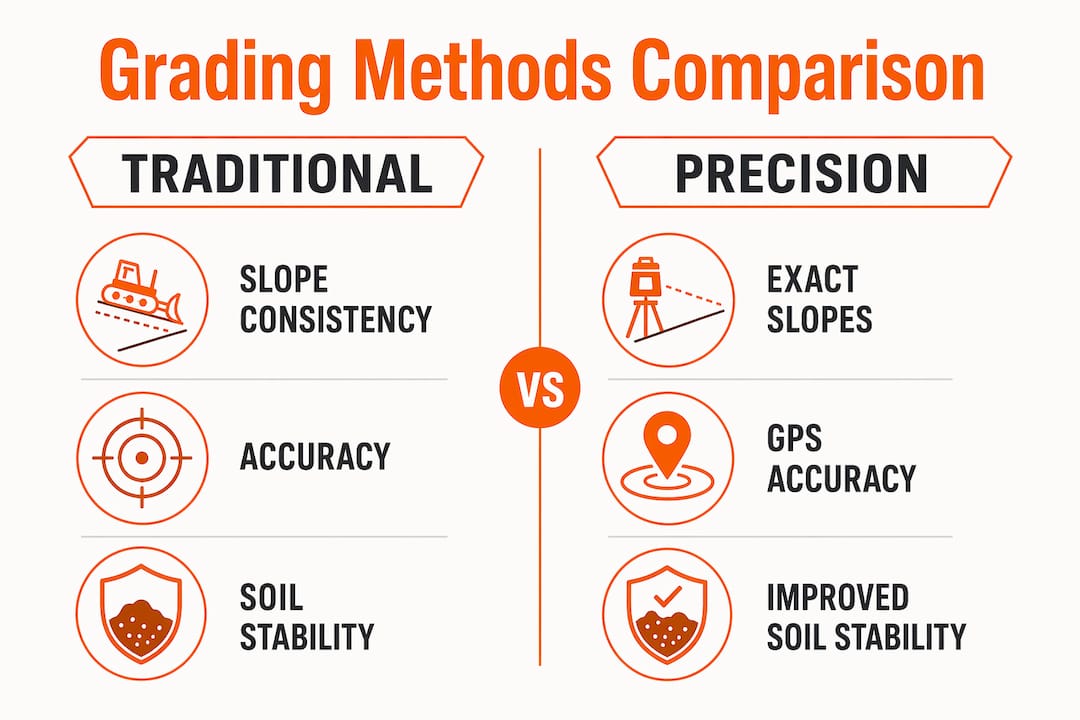
Integrating grading with a 3D site model also makes North Carolina regulatory compliance more straightforward. Precision grading combined with local code compliance reduces long-term system failures by ensuring the finished surface matches the permitted design exactly. Inspectors can review the as-built survey data rather than relying solely on visual checks, which speeds up approvals and reduces the chance of costly corrections after the fact.
Pro Tip: Before any grading begins, request that your contractor load the permitted design file directly into their machine control system. This eliminates the translation errors that happen when operators interpret paper plans manually, and it creates a direct audit trail between the approved permit and the finished grade.
Soil variability is a real challenge in the Piedmont region. North Carolina’s red clay soils shift in density depending on moisture content, and hydraulic-adaptive controllers that compensate for load-dependent soil behavior are the only reliable way to maintain blade accuracy through those transitions. A contractor using older equipment without adaptive hydraulics will struggle to hold tolerances in wet clay conditions, which is exactly when precision matters most.
What should NC homeowners ask when hiring a precision grading contractor?
Hiring the right contractor for a septic grading project comes down to asking specific questions about equipment, experience, and documentation. Most homeowners do not know what to ask, which is how substandard grading gets approved and problems surface two or three years later.
Start with these questions before signing any contract:
- What machine control technology do you use? Acceptable answers include RTK GPS, total station systems, or hydraulic model predictive control. Vague answers about “laser levels” or “experience” are red flags.
- Can you provide an as-built survey after grading? Any contractor using GPS machine control can produce this. If they cannot, they are not using the technology they claim.
- What slope tolerances do you guarantee? The answer should reference specific millimeter tolerances, not general terms like “close enough” or “within an inch.”
- Are you familiar with North Carolina’s drain field material requirements and local soil conditions? Contractors who work regularly in Alamance County and the Piedmont Triad understand the clay soil behavior that affects grading outcomes here.
- Have you worked with the county health department on septic grading approvals? Local experience with inspectors matters. A contractor who knows what Alamance County reviewers look for will deliver a grade that passes the first time.
When comparing quotes, do not evaluate price alone. A lower bid that uses traditional stake-based grading may cost more in the long run if rework, failed inspections, or early system failure follow. The types of septic systems you are installing also affect grading complexity. Conventional gravity systems have different slope requirements than pressure-dosed or mound systems, and your contractor needs to understand those distinctions before the first bucket of soil moves.
Key takeaways
Precision grading is the single most important site preparation step for a septic system, and the difference between GPS machine control and traditional staking is measured in both millimeters and years of system lifespan.
| Point | Details |
|---|---|
| Slope tolerance is critical | Septic drain fields require slopes held within 3 to 5mm to prevent pooling and field failure. |
| RTK GPS vs. total station | Total station systems reach ±3 to 5mm accuracy, making them the better choice for tight septic sites. |
| Soil stability depends on grading | Continuous GPS surface control produces more uniform compaction, reducing differential settling in drain fields. |
| Ask for documentation | Always request an as-built survey after grading to verify the finished surface matches the permitted design. |
| Local knowledge matters | Contractors experienced with Piedmont clay soils and Alamance County permitting deliver more reliable results. |
What I’ve learned after years of septic grading in the Piedmont
I have seen the full range of outcomes on septic projects across Alamance County, from systems that perform flawlessly for decades to fields that fail within five years. The single most consistent factor separating those outcomes is the quality of the grade. Not the tank brand, not the pipe material, not the soil amendment. The grade.
What surprises most homeowners is that the technology to get this right has become genuinely accessible. Machine-agnostic grading controllers that support various hydraulic architectures mean smaller contractors can now run GPS-guided equipment without owning a fleet of specialized machines. That is a real shift. Five years ago, precision grading on a residential septic site was a premium service. Today, it should be the baseline expectation.
My honest recommendation: treat the as-built survey as a non-negotiable deliverable, not a nice-to-have. If a contractor pushes back on providing one, that tells you everything about how they work. The data exists the moment the machine finishes its pass. Withholding it means they do not want you to see the numbers.
The trend I am watching closely is computerized slope enforcement built directly into the design phase, where drainage compliance is verified algorithmically before a single machine starts. That will eventually make grading disputes between homeowners and contractors far easier to resolve, because the design intent and the finished surface will both be fully documented.
— Jason
Get expert septic grading services in Alamance County
If you are planning a new septic installation or dealing with drainage problems around an existing system, the grade is where the conversation starts.

At Jmseptic, we serve Burlington, Mebane, Elon, Graham, Whitsett, and McLeansville with septic installations built on properly graded sites that meet North Carolina’s code requirements. Our team understands Piedmont clay soils, works directly with county health departments, and delivers documentation you can keep. Before you commit to a contractor, review the septic installation cost factors that affect your project so you know exactly what you are paying for and why grading quality belongs at the top of that list. Call Jmseptic to schedule a site consultation.
FAQ
What is precision grading for a septic system?
Precision grading is the process of shaping the soil around a septic system to exact slope tolerances using GPS machine control and 3D design models. It prevents water pooling, uneven soil settling, and drain field failure by holding surface grades within a few millimeters of the permitted design.
What slope tolerance is required for a septic drain field?
Septic drain fields require slope tolerances within 3 to 5mm to prevent water pooling and maintain consistent soil absorption. Tolerances outside this range increase the risk of localized saturation and premature system failure.
How accurate is GPS machine control for septic grading?
RTK GPS machine control achieves vertical accuracy within plus or minus 15 to 20mm, while total station systems reach plus or minus 3 to 5mm. For tight residential septic sites, total station accuracy is the preferred standard.
Why does grading affect soil stability under a drain field?
Uneven grading creates differential soil compaction, which causes sections of the drain field to settle at different rates over time. Continuous GPS surface control produces more uniform compaction, reducing the cracked pipes and uneven effluent distribution that follow from differential settling.
What should I ask a contractor before hiring them for septic grading?
Ask specifically what machine control technology they use, whether they can provide an as-built survey after grading, and what millimeter tolerances they guarantee. Contractors who cannot answer those questions directly are not using precision grading methods.