
North Carolina Septic System Regulations 2026 Guide
Stay compliant with septic system regulations 2026 in North Carolina! Our guide outlines key changes ensuring you avoid costly mistakes.

If you own property in North Carolina with a septic system, septic system regulations 2026 are not something you can afford to ignore. Many homeowners assume there’s a single national rulebook that covers everything. There isn’t. The reality is more complicated, and getting it wrong can cost you thousands of dollars, delay a home sale, or land you a citation from your county health department. This guide breaks down exactly who sets the rules, what’s changing in 2026, how your county’s requirements may differ from your neighbor’s, and what steps to take right now to stay on the right side of the law.
Table of Contents
- Key Takeaways
- Septic system regulations 2026: who’s actually in charge
- Core requirements: permits, inspections, setbacks, and maintenance
- County-level variations you need to know
- Practical steps for compliance in 2026
- My honest take on what 2026 means for NC property owners
- How Jmseptic helps you stay compliant
- FAQ
Key Takeaways
| Point | Details |
|---|---|
| No federal septic rules | All permitting and maintenance requirements are set by state and county agencies, not the EPA. |
| 2026 brings notable updates | North Carolina counties are tightening inspection requirements, especially around point-of-sale rules. |
| Setback distances vary by county | Required distances from wells, water bodies, and buildings differ across the state. |
| Records matter more than ever | Keeping as-built documentation and maintenance logs is now a regulatory expectation in many counties. |
| Act before selling | Point-of-sale septic inspections are a growing requirement that can delay closings if you wait too long. |
Septic system regulations 2026: who’s actually in charge
Here’s the thing most homeowners get wrong. The EPA does not regulate residential septic permitting. There is no federal agency that tells you when to pump your tank or how far your drain field must sit from your well. That authority belongs entirely to state and county health departments, and in North Carolina, that means the rules in Alamance County can look meaningfully different from the rules in Orange County or Forsyth County.
The North Carolina Department of Health and Human Services sets baseline standards through its On-Site Wastewater Section. County environmental health departments then enforce those standards, issue permits, conduct inspections, and sometimes layer on stricter local requirements. This structure means you need to know both the state floor and your county’s ceiling.
For 2026, there are two major themes emerging across the state. First, counties are tightening documentation requirements and moving toward digital recordkeeping. Second, point-of-sale inspection rules are expanding, which directly affects property managers and anyone planning to sell. The trend nationally confirms this: some jurisdictions now mandate that certified professionals inspect septic systems within one year before a property closing, a requirement designed to protect both buyers and the environment.
Key takeaways on the jurisdictional structure:
- State level: NC DHHS sets minimum standards for system design, soil evaluation, setbacks, and installer certification
- County level: Environmental health departments issue permits, approve site plans, schedule inspections, and enforce local ordinances
- Local variances: Some counties have adopted stricter rules based on soil conditions, proximity to water bodies, or watershed protection goals
Pro Tip: Call your county environmental health department at the start of any project or property transaction. The staff there can tell you exactly what your county requires in 2026, which is often more specific than what you’ll find online.
Core requirements: permits, inspections, setbacks, and maintenance
The framework of important septic regulations in North Carolina covers four main areas. Understanding each one helps you see where compliance gaps most commonly appear.

Permits and fees
You need a permit before installing, repairing, or significantly altering a septic system. North Carolina counties typically require a soil and site evaluation before a permit is issued, which involves a licensed soil scientist assessing your land’s ability to treat wastewater. Permit fees vary by county and system size. For comparison, South Carolina issues permits at $150 with a five-year validity period, and North Carolina counties follow similar structures, though exact fees differ. Permits are not lifetime documents. You may need to renew or reapply if your system changes or sits dormant.
Inspection requirements in 2026
Inspections are the area seeing the most change under new septic system guidelines taking shape for 2026. Point-of-sale inspections are becoming standard in regulated areas. These inspections must be performed by certified professionals and often need to occur within 12 months before closing. Lenders are also increasingly requiring them independently of local rules. For homeowners, that means a failing or marginal system discovered at closing is not just a legal problem. It’s a negotiating crisis.
Beyond point-of-sale, routine inspection schedules also matter. Most North Carolina counties recommend or require inspection every three to five years, with pumping typically expected every three to five years depending on household size.
Setback distances
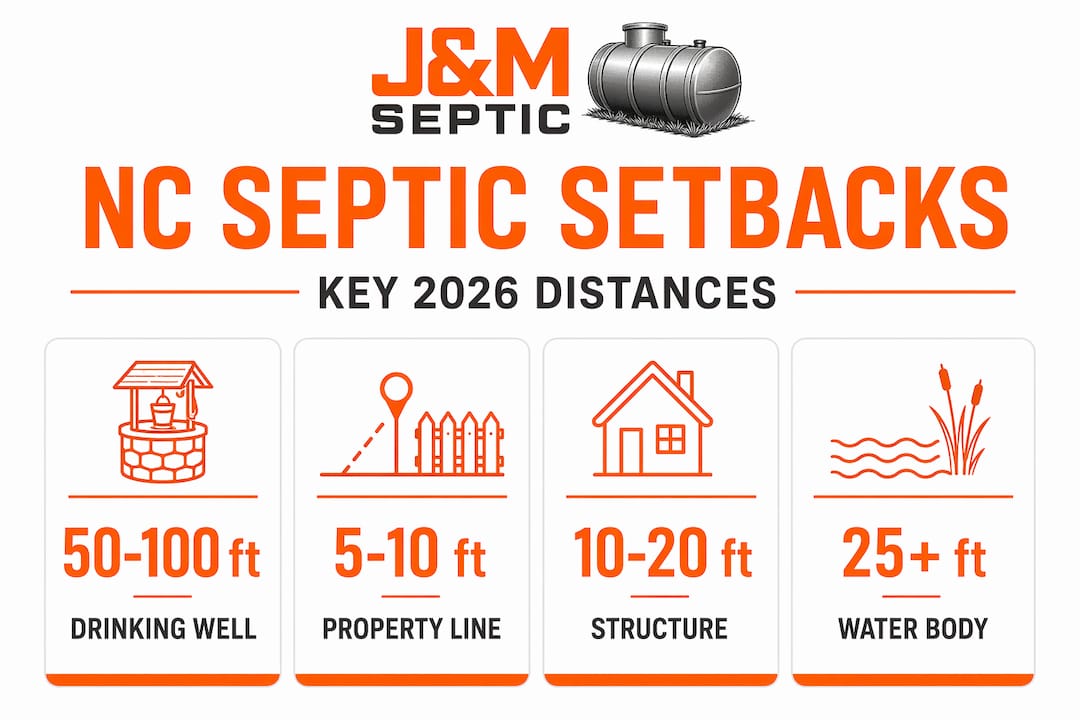
Setback distances define how far your septic components must be from other features on and around your property. These numbers protect drinking water and neighboring land. The table below reflects common minimum ranges applicable across North Carolina jurisdictions for 2026, based on standard setback frameworks.
| Feature | Minimum setback (typical range) |
|---|---|
| Private drinking well | 50 to 100 feet |
| Structure or building foundation | 5 to 20 feet |
| Surface water or stream | 10 to 50 feet |
| Property line | 5 to 10 feet |
Your county may require more than these minimums. Never assume the statewide baseline is what applies to your specific lot.
Mandatory maintenance
Routine maintenance is not optional under 2026 septic system compliance standards. Required activities include:
- Pumping the tank every three to five years by a licensed hauler
- Keeping records of all pumping, repairs, and inspections
- Reporting system failures or significant changes to your county health department
- Following specific rules for alternative or advanced treatment systems, which often carry annual inspection requirements
Pro Tip: Start a simple paper folder or digital file for every receipt, inspection report, and permit related to your septic system. When you sell your property or need a repair, this documentation can save you hundreds in search fees and prove your system has been properly maintained.
County-level variations you need to know
State regulations give you the floor. Counties build on top of it, and the differences can be significant. Here’s a numbered breakdown of how county-level variation plays out in practice across North Carolina.
-
Soil testing protocols differ. Some counties require soil morphology analysis by a licensed soil scientist on every lot, while others accept simplified evaluations for certain system types. In counties near the Haw River or other sensitive watersheds, expect more thorough site evaluations and possibly stricter absorption field designs.
-
Stricter setbacks in sensitive areas. Counties that sit within protected water supply watersheds often enforce setback requirements that exceed state minimums by 25 to 50 percent. If your property is near a reservoir or classified stream, you need to verify your county’s specific rules before designing or modifying a system.
-
Alternative system approvals vary. Not every county approves the same alternative system types. If your property has soil or space constraints that make a conventional system impractical, no-leach-field options may be available, but local approval processes differ. What’s allowed in Guilford County may require additional review in Alamance County.
-
Local permit requirements beyond state minimums. Some counties require a separate operating permit or annual maintenance contract for advanced treatment systems. These are not statewide requirements, but non-compliance with them still triggers county enforcement action.
-
Accessing local resources. Your county environmental health department website is the most reliable source for current forms, fee schedules, and approved installer lists. The NC DHHS On-Site Wastewater Section also maintains a state-level resource page. If you’re in Alamance County, the homeowner septic workflow can help you understand how local permitting steps connect to state requirements.
Practical steps for compliance in 2026
Getting compliant is more manageable when you break it into concrete steps. Here’s how to approach septic system compliance 2026 without guessing.
-
Pull your as-built records. These documents show exactly where your tank, distribution box, and drain field are located. Many homeowners have never seen theirs. Accessing these records can save hundreds of dollars compared to paying a professional to locate your system from scratch. Contact your county health department or check their online portal.
-
Schedule an inspection now if you haven’t in three-plus years. Understanding why regular inspections matter is the difference between catching a problem early and facing a full system replacement. Inspectors check for tank integrity, sludge levels, distribution issues, and drain field performance.
-
Know what inspectors look for. A standard inspection covers the tank lid condition, inlet and outlet baffles, liquid levels, signs of backup into the house, and drain field saturation. If any of these are off, you’ll receive a notice of violation or a required repair order from your county.
-
Plan ahead if you’re selling. Point-of-sale inspections can delay closings significantly if problems are found at the last minute. Schedule your inspection six to twelve months before you plan to list.
-
Check for financial assistance. NC DHHS and some counties offer grant and loan programs for failing septic system replacement, particularly for low-to-moderate income homeowners. The Rural Center and USDA Rural Development also have programs that can offset repair or replacement costs.
Pro Tip: If you notice slow drains, gurgling pipes, or wet spots in your yard near the drain field, do not wait for your next scheduled inspection. These are signs of system stress that can escalate quickly and expensively.
My honest take on what 2026 means for NC property owners
I’ve worked with homeowners in Alamance County and across the Piedmont Triad for years, and the pattern I see repeatedly is that septic problems don’t sneak up on people. They get ignored. Someone notices a slow drain, shrugs it off, and then three years later they’re dealing with a $15,000 system replacement right before closing on a home sale.
What I’ve learned is that the biggest compliance risk in 2026 isn’t the regulations themselves. It’s the gap between what homeowners think is required and what’s actually required in their specific county. I’ve talked to property managers who assumed state rules were the whole picture. They weren’t, and the county violation notices made that clear fast.
The community pushback that stopped a proposed fee increase in Nevada after 1,000 residents voiced concerns proves one thing: these rules are not fixed in stone. Local regulations respond to public pressure and local politics. But you have to be paying attention to participate in that process. Most homeowners aren’t.
My honest advice for 2026 is simple. Get your records, get an inspection, and talk to your county before assuming you know what’s required. The state is moving toward stricter documentation standards and more consistent enforcement. That’s not a threat. It’s an opportunity to get ahead of problems before they become emergencies.
— Jason
How Jmseptic helps you stay compliant
Staying compliant with 2026 septic system laws in North Carolina doesn’t have to feel overwhelming. Jmseptic has been helping homeowners and property managers across Alamance County, Burlington, Mebane, Graham, and the wider Piedmont Triad handle exactly this kind of work for years.

Whether you need a new septic system installation designed to meet current county specifications, a repair to bring a failing system up to code, or a routine maintenance visit that generates the records your county now expects, Jmseptic handles it all. The team understands local permitting requirements, knows how Alamance County’s environmental health department operates, and can walk you through every step of the process. If you’re preparing to sell, suspect a problem, or simply haven’t had your system inspected in the last few years, now is the right time to call. Reach out to Jmseptic to schedule a visit and get clear on exactly where your system stands before 2026 requirements catch you off guard.
FAQ
Who enforces septic regulations in North Carolina?
County environmental health departments enforce septic regulations in North Carolina, working within baseline standards set by the NC Department of Health and Human Services. The EPA plays no role in residential septic permitting or maintenance enforcement.
How often should I pump my septic tank under 2026 rules?
Most North Carolina counties recommend pumping every three to five years, though the exact interval depends on household size and system type. Keeping records of each pumping is increasingly required for septic system compliance 2026.
Do I need a septic inspection before selling my home?
Point-of-sale septic inspections are a growing requirement in many jurisdictions, and some North Carolina counties now expect or mandate them within 12 months of closing. Planning for this early prevents delays in your transaction.
Where can I find my septic system’s as-built records?
Start with your county environmental health department, which should have records on file from the original permit. As-built records searches are sometimes available online through county portals and can save significant time and money.
What happens if my septic system fails a 2026 inspection?
Your county environmental health department will issue a notice of violation and require repairs within a set timeframe. Ignoring the notice can result in fines, mandatory system shutdown, or complications with property transactions.