
NC Septic System Regulations: 2026 Homeowner Guide
Navigate the updated septic system regulations in NC with our 2026 homeowner guide. Stay compliant and ensure proper wastewater management.

Septic system regulations in NC are defined under 15A NCAC 18E, the statewide code governing every aspect of onsite wastewater management from soil evaluation through final inspection. North Carolina completely overhauled these rules effective january 1, 2024, replacing older standards with a unified framework that covers design, permitting, installation, and maintenance. The NC Department of Health and Human Services (DHHS) sets the technical standards, while county environmental health departments handle local permitting and enforcement. If you own property in Alamance County, Burlington, or anywhere across the Piedmont Triad, these rules apply to you directly.
What are the septic system regulations in NC?
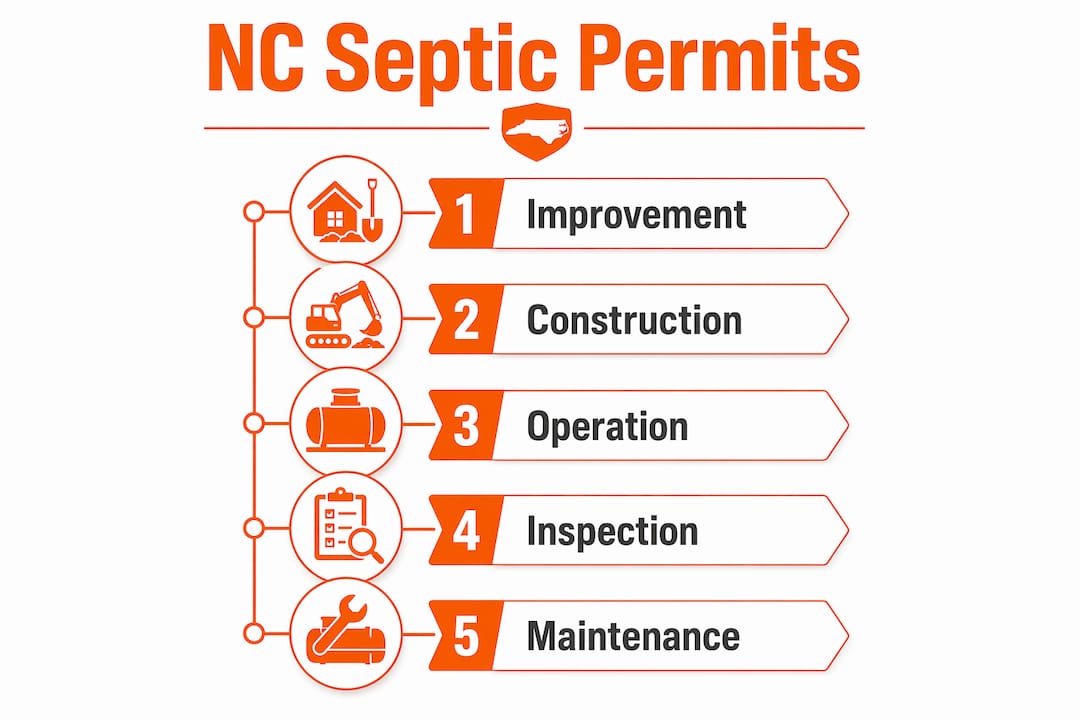
North Carolina’s onsite wastewater rules require three sequential permits before any septic system can be legally installed or operated. The three-permit sequence is not optional. Skipping a step or starting work before approval is a code violation that can result in fines, forced removal, and failed property sales.
The three permits are the Improvement Permit, the Construction Authorization, and the Operation Permit. Each one builds on the last. You cannot get a Construction Authorization without a valid Improvement Permit, and you cannot get an Operation Permit without passing a final inspection under your Construction Authorization.
Improvement permit: your starting point
The Improvement Permit (IP) is issued after a licensed soil scientist or county environmental health officer evaluates your property. This evaluation looks at soil morphology, site topography, and lot size to determine whether a septic system is feasible and what type is allowed. The IP is valid for five years, giving you time to plan construction without rushing.
Pro Tip: If you are buying undeveloped land in North Carolina, get an Improvement Permit before closing. This evaluation costs a few hundred dollars and takes a few weeks, but it confirms the lot can legally support a septic system before you commit to the purchase.
Construction authorization: design approval
Once you have an IP, a licensed Onsite Wastewater System Designer submits a system design to your county environmental health department. That design must match the exact site conditions documented in the IP. Design changes that differ significantly from the IP conditions require a new Construction Authorization before work can begin. The county reviews the design, approves it, and issues the Construction Authorization. Only then can a certified installer break ground.
Operation permit: final sign-off
After installation, a county inspector verifies that the system was built exactly as approved. A passed inspection results in an Operation Permit. For standard systems (Type I through Type IV), the Operation Permit is permanent. For advanced treatment systems (Type V and Type VI), the permit must be renewed every 60 months. That renewal requires documented professional inspections, not just routine homeowner upkeep.
What are NC septic system design and installation requirements?
North Carolina septic system requirements go well beyond simply digging a hole and dropping in a tank. The design process is technical, and the state requires licensed professionals at every stage.
Soil evaluation and system sizing
Soil morphology evaluation is the foundation of every NC septic design. A licensed soil scientist examines soil texture, structure, color, and drainage characteristics to classify the site. Percolation testing may also be used in some cases. The results determine which system type is permitted and how large the drainfield must be.

System sizing is based on two factors: the number of bedrooms in the home and the soil’s absorption capacity. A larger household or slower-draining soil means a larger drainfield. Minimum septic tank capacity in NC is 1,000 gallons, though many homes require larger tanks depending on occupancy and system type.
Licensed professionals are required
North Carolina law requires licensed Onsite Wastewater System Designers and certified contractors for all design and installation work. Homeowners may perform routine maintenance independently, but they cannot alter the permitted system design without triggering a new review. This rule protects both public health and your property value.
Here is a quick breakdown of the key design standards:
- Minimum tank size: 1,000 gallons for most residential systems
- Drainfield sizing: Calculated from soil data and household occupancy
- System type: Determined by soil classification (conventional, low-pressure pipe, drip irrigation, etc.)
- Setbacks: Required distances from wells, property lines, and structures vary by system type
- Designer credential: Must hold a current NC Onsite Wastewater System Designer license
| Design Factor | Standard Requirement |
|---|---|
| Minimum tank capacity | 1,000 gallons |
| Operation Permit renewal (Type V–VI) | Every 60 months |
| Improvement Permit validity | 5 years |
| Who may install | Certified contractors only |
| Who may design | Licensed Onsite Wastewater System Designers |
Pro Tip: Ask your designer to walk you through the site evaluation report before submitting the Construction Authorization. Understanding your soil classification helps you anticipate system type, cost, and drainfield size before the county reviews the application.
How do local and regional variations affect NC septic rules?
The county environmental health department controls local permitting and enforcement under the NC DHHS framework. Statewide codes set the technical floor, but counties add their own procedures, timelines, and documentation requirements. What works in Alamance County may differ from what Dare County or Buncombe County requires.
Coastal areas: extra layers of compliance
Coastal and ocean-hazard areas carry the most complex permitting requirements in the state. Septic tank replacement in coastal zones may require a CAMA (Coastal Area Management Act) permit in addition to the standard DHHS permits. This means coordinating with the NC Division of Coastal Management and potentially the Army Corps of Engineers, depending on the site.
Setback requirements near wetlands, estuaries, and the ocean are stricter than inland standards. A system that would be approved without issue in Graham, NC could face significant additional review in a coastal hazard overlay zone.
Mountain and piedmont distinctions
Mountain properties often deal with shallow soils, rock outcroppings, and steep slopes that limit system options. These sites frequently require engineered alternatives such as mound systems or drip irrigation systems. Piedmont soils, including those common across Alamance County and the surrounding Triad area, tend to offer more flexibility but still require careful soil evaluation.
Here are the most practical steps for confirming your local requirements:
- Contact your county environmental health department before hiring any contractor
- Ask specifically about local permit timelines and any county-specific documentation
- Confirm whether your property falls within a coastal overlay, floodplain, or other special zone
- Check whether your existing Improvement Permit was issued before january 1, 2024
Improvement Permits issued before the 2024 rule change remain valid until expiration, but any system design submitted under them must comply with the current 15A NCAC 18E standards. Confirm this directly with your county health department to avoid surprises during the Construction Authorization review.
You can also review the Alamance County septic workflow for a local-level breakdown of how the permit and inspection steps play out in practice.
What ongoing maintenance does NC law require for septic systems?
An Operation Permit is not a one-time achievement. North Carolina septic system laws require ongoing compliance, and the obligations differ significantly by system type.
-
Type I through Type IV systems receive permanent Operation Permits. These are conventional and low-pressure pipe systems. Homeowners are responsible for routine maintenance such as avoiding flushing harmful materials, limiting water use, and keeping vehicles off the drainfield. Professional pumping is recommended every three to five years, though the state does not mandate a specific pumping schedule for these systems.
-
Type V and Type VI systems are advanced treatment systems. Their Operation Permits must be renewed every 60 months. Renewal requires documented professional inspections, not just a homeowner’s word that the system is working. Missing a renewal deadline puts you out of compliance with NC wastewater management regulations.
-
Maintenance contracts are often required for advanced systems as a condition of the original permit. These contracts specify inspection frequency, reporting requirements, and who is responsible for submitting compliance documentation to the county.
-
Signs of system failure include sewage backups inside the home, slow drains throughout the house, standing water over the drainfield, and strong odors near the tank or yard. Any of these signs requires immediate professional evaluation. Delaying a call can turn a repair into a full system replacement.
-
Emergency repairs must still comply with permit requirements. You cannot simply dig up and replace components without notifying your county environmental health department. Even urgent repairs may require an amended Construction Authorization if the work changes the permitted design.
Pro Tip: Keep a physical folder with copies of all three permits, your soil evaluation report, and any inspection records. County offices can lose files, and having your own documentation speeds up every future interaction with the health department.
Learning how to prevent septic failure early is far less expensive than dealing with a failed system under regulatory scrutiny.
Key takeaways
North Carolina septic system compliance requires three sequential permits, licensed professionals, and ongoing maintenance obligations that vary by system type and location.
| Point | Details |
|---|---|
| Three-permit sequence | Improvement Permit, Construction Authorization, and Operation Permit are all required before legal operation. |
| Licensed professionals only | Only certified designers and contractors may design or install; homeowners handle routine maintenance only. |
| Advanced system renewals | Type V and Type VI Operation Permits must be renewed every 60 months with documented inspections. |
| County-level variations | Contact your county environmental health department to confirm local procedures before starting any work. |
| Pre-purchase soil evaluation | Getting an Improvement Permit before buying land confirms septic feasibility and prevents costly post-purchase surprises. |
What i’ve learned after years of NC septic permitting
The biggest mistake I see homeowners make is treating the permit process as a formality. They hire a contractor, assume the paperwork will sort itself out, and then call us in a panic when the county stops the job because a Construction Authorization was never issued. The three-permit sequence is sequential for a reason. Each step protects you legally and financially.
The second mistake is underestimating how much county-level variation matters. I have worked on jobs in Alamance County where the health department had specific documentation preferences that were not spelled out in the statewide code. A contractor who only knows the state rules and has never worked with your county’s office can cost you weeks of delays.
My honest advice: get your soil evaluation done early, build a relationship with your county environmental health office, and hire professionals who have a track record in your specific area. The 2024 rule changes under 15A NCAC 18E tightened a lot of the gray areas that older permits left open. If your property has a pre-2024 Improvement Permit, do not assume it still covers what you want to build. Verify it.
Good records are your best protection. Every permit, every inspection report, every maintenance receipt. Keep them all. When you sell the property or need an emergency repair, those documents are worth more than you think.
— Jason
How Jmseptic helps NC homeowners stay compliant

Jmseptic is a locally owned septic company based in Mebane, serving Burlington, Elon, Graham, Whitsett, McLeansville, and the broader Alamance County area. We handle new septic system installation, repairs, tank replacement, hydro jetting, and maintenance. Our team works directly with county environmental health departments to support the permitting and inspection process, so you are not navigating that alone. We know the local procedures, the soil conditions across the Piedmont Triad, and what it takes to get a system approved and operating correctly. If you are planning a new installation or dealing with a failing system, review the NC septic installation cost factors to understand what to budget before you call. We are ready to help you get it done right.
FAQ
What permits are required to install a septic system in NC?
North Carolina requires three permits in sequence: an Improvement Permit, a Construction Authorization, and an Operation Permit. Work cannot legally begin until the Construction Authorization is issued.
How long is an NC improvement permit valid?
An Improvement Permit is valid for five years from the date of issue. Permits issued before january 1, 2024 remain valid until expiration but must comply with current 15A NCAC 18E design standards.
Can a homeowner install their own septic system in NC?
No. North Carolina law requires licensed Onsite Wastewater System Designers for system design and certified contractors for installation. Homeowners may only perform routine maintenance without altering the permitted system.
How often do advanced septic systems need to be inspected in NC?
Type V and Type VI advanced treatment systems require professional inspections and Operation Permit renewal every 60 months. Routine maintenance alone does not satisfy the renewal requirement.
What should i do if my septic system shows signs of failure?
Contact a licensed septic professional immediately if you notice sewage backups, standing water over the drainfield, or strong odors. Notify your county environmental health department before making any repairs that alter the permitted system design.