
Locating Septic Tank Lids: A Homeowner’s Practical Guide
Discover effective tips for locating septic tank lids. Save time and effort with our practical guide that simplifies your search.

Locating septic tank lids starts with one simple move: find where your main sewer pipe exits the house, then follow it outward a typical distance. Most lids sit underground at varying depths, often within a few feet of the surface, with many homes having lids buried at shallow to moderate depths. Before you grab a probe or a shovel, check your county health department for a septic permit or as-built drawing. That single document often shows the tank’s exact position relative to your house corners and can save you hours of digging.
Here is a quick-start checklist to orient your search:
- Trace the 4-inch sewer pipe from your basement or crawl space to the exterior wall, note its direction, and mark that spot on the foundation
- Walk outward 10–25 feet in that direction,
and begin probing with a thin metal or fiberglass rod - Scan the yard for subtle clues: depressions, faster-growing grass, or patches where snow melts early
- Call your county health department and request the septic permit or as-built drawing for your address
- If DIY methods come up empty, hire a professional with an electronic pipe locator to trace the line precisely
Where septic tanks are typically located on your property
Septic tanks are usually installed a short to moderate distance from the house foundation, generally aligned with the sewer pipe exit. Building codes in most states set a minimum setback of 5–10 feet, though older rural properties sometimes pushed tanks further out when site conditions demanded it. The pipe connecting house to tank slopes at roughly one-quarter inch per foot, so at 20 feet of horizontal run, the pipe has dropped about 5 inches below where it left the foundation.
Burial depth varies more than most homeowners expect. In southern states like Florida and Texas, lids can sit as shallow as 4–12 inches because of high water tables. In northern freeze zones like Minnesota, lids may be buried 24–48 inches or deeper because frost lines reach 42–60 inches. Age and site conditions add more variation: an older tank on rocky ground might be offset from the sewer line’s straight path, placed wherever the excavator could dig.
A few more placement details worth knowing:
- Most residential tanks measure roughly 4×8 feet or 5×8 feet, giving you a footprint to triangulate once you find one edge
- Two access lids sit on the tank, one at the inlet end and one at the outlet, spaced roughly 1–2 feet apart along the tank’s length
- Sewer vent pipes on your roof and exterior cleanout pipes near the foundation both point toward the tank’s general direction
- Tanks are rarely found near wells, dense tree roots, property lines, or solid rock outcroppings, so you can rule those areas out early
- On sloped lots with no sewage pump, the tank will be downhill from the house; near lakes or waterways, look for a pumping station electrical box as a secondary clue
How to physically find the lid using tools and probing
The most reliable DIY method combines pipe-tracing with systematic probing. Work through these steps in order.
-
Find the sewer pipe exit inside the house. Go to your basement or crawl space and locate the main drain, typically a 4-inch pipe running toward an exterior wall. Note which wall it heads toward and at what height it exits.
-
Mark the exit point on the foundation outside. Stand at that spot on the exterior and note the pipe’s direction. This is your search axis.
-
Walk outward and probe at 6–12 inch intervals. Use a thin metal or fiberglass rod, sometimes called a soil probe, and push it gently into the ground as you move away from the house. When you hit a hard, hollow-sounding resistance distinctly different from soil, you have likely found the tank.
-
Work a grid pattern to map the tank’s edges. Once you find one point on the lid, move laterally in both directions to find the opposite edges. Then probe forward and backward to establish the full footprint. Marking each hit point with a small flag or stake lets you triangulate the tank’s outline without losing your place.
-
Use a metal detector for older tanks. Tanks installed before the mid-1980s often had cast iron lids or metal lifting handles. A basic metal detector scanned in overlapping grid patterns can pick up those handles at 12–18 inches depth. This method won’t work on purely concrete lids with no metal components, but it is a useful backup when probing alone isn’t giving clear results.
-
Use a plumbing snake for distance confirmation. Push a plumbing snake through the main building drain until it stops. That stopping point is usually the septic tank’s inlet baffle, telling you the maximum distance from the house to the tank.
-
Dig carefully once you’ve confirmed the location. Use a flat spade or round-point shovel. Avoid pickaxes or mattocks that could crack a concrete lid. Dig a test hole about 18 inches deep in the center of your target area, then work outward. Most concrete lids run 20–24 inches in diameter; riser lids are typically 24 inches.
Pro Tip: Gently rotate the probe as you push it down. That slight twisting motion helps you feel the edge of a lid rather than punching straight through a gap between the lid and tank wall, which could give you a false “miss.”

Reading your yard for visual clues to buried lids
Your yard often tells you where the tank is before you pick up a single tool. These surface signs develop over years as the tank settles and the biological activity inside generates slight warmth.
- Depressions or mounds: Soil above a concrete tank settles over time, creating a subtle low spot or, less often, a slight rise. On older properties, this grade difference is often visible from a few feet away.
- Grass that grows differently: The area directly over a tank sometimes grows faster due to nutrient seepage, or slower and browner if the lid is very shallow and the concrete blocks moisture. Either pattern is a clue worth investigating.
- Early snowmelt: In winter, heat from biological activity inside the tank warms the soil above it, causing snow to disappear there before the surrounding yard. This is one of the clearest seasonal indicators available.
- Previous owner markers: Stakes, decorative rocks, or specific plantings placed near the lid are common on older properties. Check under faux stones and around ornamental shrubs near the suspected zone.
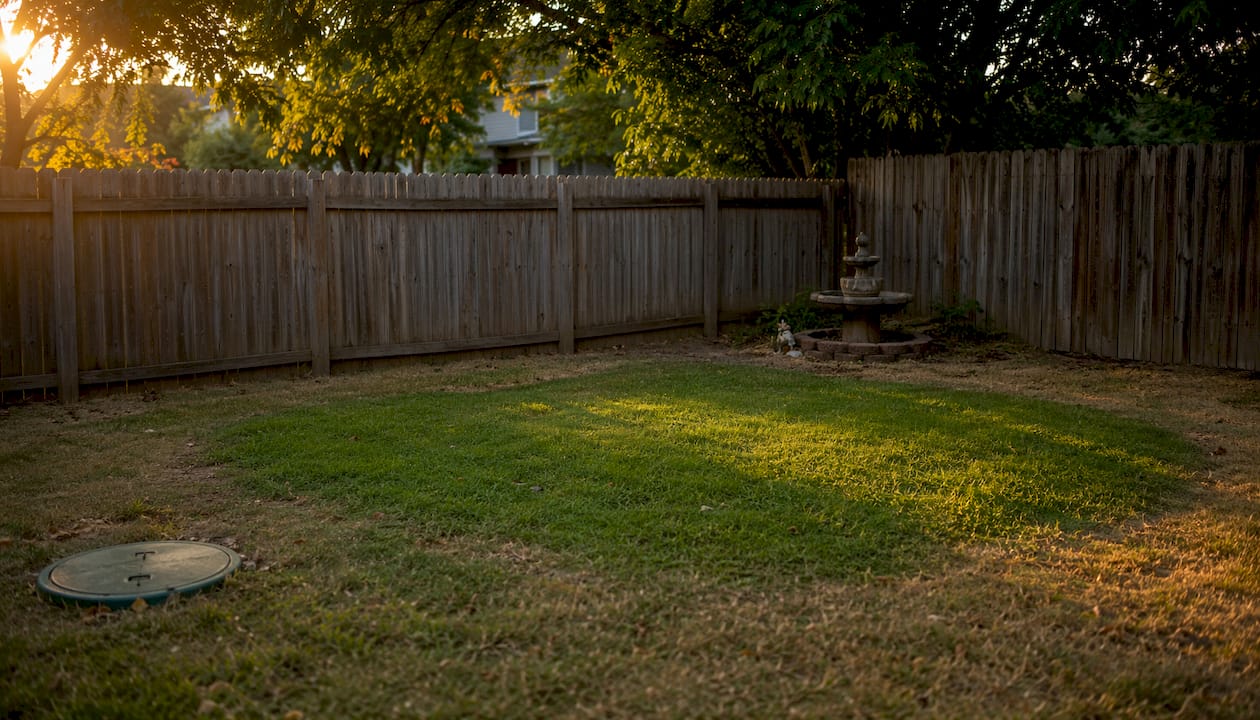
- Visible access hardware: Inspection ports, cleanout pipes sticking up a few inches, or a riser lid sitting flush with or slightly above grade are the most obvious indicators. Some lids are green or black plastic and visible once you know what to look for.
Understanding yard clues for septic systems takes a few minutes of observation and can save you an hour of probing.
What types of septic lids you might find and how deep they sit
Lid material tells you a lot about the tank’s age and how hard the search will be.
- Concrete lids are the most common on tanks installed before 2000. They are heavy, sometimes brittle with age, and can be difficult to distinguish from the surrounding concrete tank top during probing. Older concrete lids occasionally had metal handles set into them.
- Plastic and fiberglass lids became standard on systems installed or retrofitted after 2000. These are usually green or black, 24 inches in diameter, and much lighter than concrete. If someone previously installed a riser, the lid may be flush with or slightly above grade.
- Cast iron or steel lids appear on some older tanks and are the easiest to find with a metal detector.
- Risers are vertical pipes, typically 12–24 inches tall and 24 inches in diameter, installed between the existing tank lid and the ground surface. Installing risers is especially worthwhile when lids are buried more than 12 inches deep, since they bring the access point to grade and eliminate digging on every future service visit.
- Depth by region: Southern states often see lids at 4–12 inches; temperate climates average 12–24 inches; northern freeze zones push lids to 24–48 inches or more.
Safety rules you should follow before and during the search
Septic lid location carries real physical risk, and cutting corners here is where accidents happen.
- Never work alone. Always have someone nearby when you are probing, digging, or uncovering a lid.
- Avoid aggressive tools. Experts recommend thin, insulated fiberglass or metal probes with gentle, rhythmic motion. Heavy pry bars or forceful jabbing can crack brittle older lids or puncture buried pipes.
- Call 811 before digging. The national utility locating service marks underground gas, electric, and water lines for free. Hitting a utility line while digging for a septic lid is a serious hazard.
- Stop if the lid looks unstable. Cracked, sunken, or visibly compromised lids can collapse under weight. Back away and call a professional.
- Leave lid removal to trained professionals. Concrete lids are extremely heavy, and the gases inside an open tank, including hydrogen sulfide, can cause rapid loss of consciousness. No one should lean into or enter an open septic tank.
Warning: Opening a septic tank lid without proper training and equipment is potentially fatal. Septic tanks contain toxic and oxygen-displacing gases that can incapacitate a person in seconds. Safety guidance from the Washington State Department of Health is clear: never open or approach a lid alone, and stop immediately if the lid shows any sign of structural instability. Leave removal and inspection to a licensed septic professional.
Reviewing plumbing maintenance best practices before you start any digging around your septic system is a smart first step.
Using county records and professional services to find your lid
The fastest path to your septic tank lid is often a phone call, not a probe rod.
- County health department records hold septic permits and as-built drawings for most homes. Requesting the as-built drawing is usually the single most efficient step, since it often includes a hand-sketched diagram showing distances from the tank to house corners. Many counties now offer online permit lookup portals; others will email or mail a copy for free or a small fee.
- Closing documents from your home purchase may include a septic inspection report that notes the tank location and whether the lid was visible at the time.
- Electronic pipe locating is the professional gold standard. A technician inserts a transmitter into the sewer line and follows the signal with a surface receiver, tracing the pipe’s exact path to the tank without guesswork. Professional locating costs $100–$350 depending on your region and access conditions.
- Ground-penetrating radar (GPR) is available for tanks in difficult soil or where electronic tracing is inconclusive. It identifies tank location and depth without any excavation.
- When to call a pro: Unknown tank location on a rural property, lids buried more than 2 feet deep, any sign of lid instability, or a yard with active sprinkler lines that make probing risky.
- Document and mark the location once found. Record GPS coordinates, take a photo with location data active, and note measurements from two fixed reference points like house corners. Share the location with your septic service company so it is on file.
- Ask about riser installation at your next pump-out. If the lid is more than 12 inches below grade, a riser brings it to surface level and eliminates locating costs on every future visit. For a septic pump service appointment in Alamance County, Jmseptic can assess whether a riser makes sense for your system.
Key Takeaways
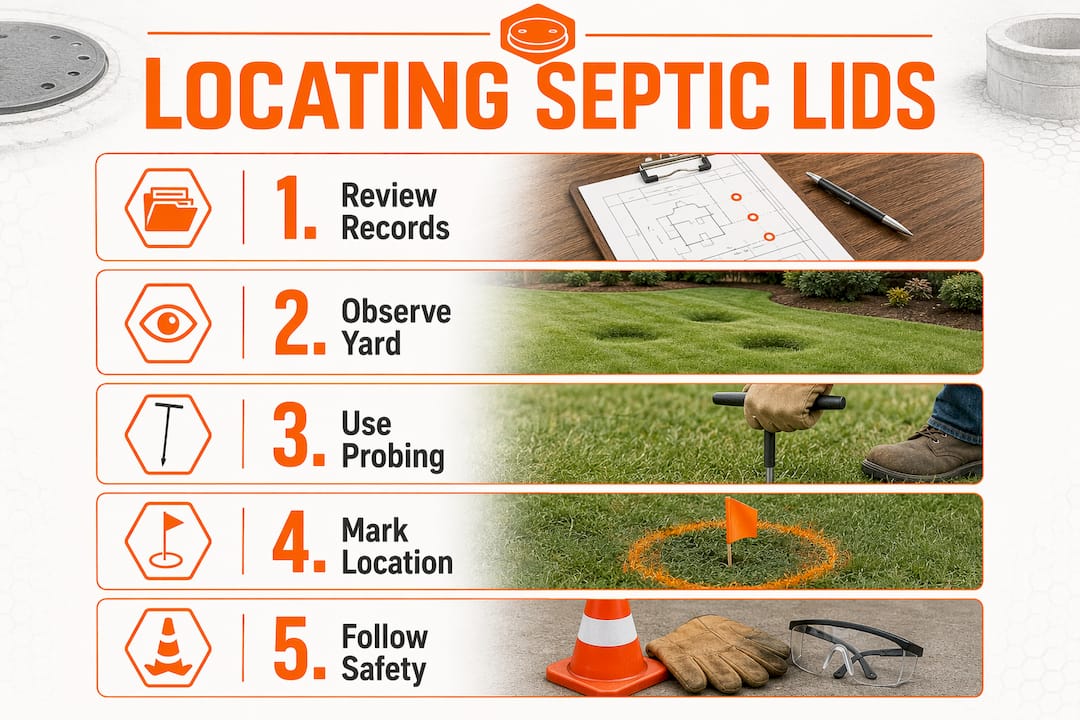
Locating septic tank lids requires tracing the main sewer pipe outward 10–25 feet, using probing tools and visual yard clues, and verifying with county permit records before any digging begins.
| Point | Details |
|---|---|
| Start with county records | Request the as-built drawing from your county health department before probing or digging. |
| Follow the sewer pipe | The tank sits 10–25 feet from the foundation along the sewer pipe’s exit direction. |
| Expect 4–48 inches of depth | Depth varies by climate; northern states often see lids at 24–48 inches, southern states as shallow as 4–12 inches. |
| Probe gently in a grid pattern | Use a thin fiberglass or metal rod at 6–12 inch intervals; rotate slightly to detect lid edges without cracking them. |
| Call a pro when DIY fails | Electronic pipe locating costs $100–$350 and pinpoints the tank without unnecessary digging. |