
Landscaping Over a Drain Field: Safe Plant Guide
Discover how to safely landscape over a drain field with shallow-rooted plants while ensuring proper maintenance and optimal soil health.

You can landscape over a septic drain field, but the rules are strict. Shallow-rooted, non-aggressive plants only. No trees, no edible gardens, no hardscaping, and nothing that traps moisture or blocks oxygen from reaching the soil. That single constraint shapes every decision you’ll make about what grows over those buried lines.
The drain field works because oxygen moves freely through the soil, feeding the bacteria that treat wastewater. Anything that disrupts that exchange — deep roots, compacted soil, added fill, impermeable coverings — degrades treatment and can shorten the life of a system that costs thousands to replace.
Quick do’s and don’ts:
- Do: Plant turfgrass or shallow-rooted herbaceous perennials
- Do: Keep the area mowed and accessible for service
- Do: Mark access ports and install risers for easy maintenance
- Don’t: Plant trees, shrubs, or anything with aggressive roots
- Don’t: Install patios, decks, sheds, or paved surfaces over the field
- Don’t: Grow vegetables, herbs, or any edible crops over the lines
- Don’t: Add thick mulch, landscape fabric, plastic, or gravel
Pro Tip: A healthy lawn is genuinely the best-looking and most functional cover for a drain field. Simple beats complex every time here.
Key Takeaways
Landscaping over a drain field is safe only with shallow-rooted plants, no added hardscape, and clear access maintained to every service port.
| Point | Details |
|---|---|
| Shallow-rooted plants only | Turfgrasses like bermudagrass, bahiagrass, and zoysiagrass are the safest drain field covers. |
| No edibles, no hardscape | Vegetables, fruit trees, patios, and sheds risk pathogen exposure and block system access. |
| Keep water away | Roof runoff, gutters, and irrigation heads must stay at least 10 feet from the field boundary. |
| Trees need real distance | Plant trees no closer than their mature height; aggressive species like willows need 50 ft or more. |
| Jmseptic maps and protects | Jmseptic provides line locating, riser installation, and inspection for Alamance County homeowners. |
Table of Contents
- How to locate and mark your septic system before you plant
- Water and soil rules that protect your drain field
- What to plant over a septic drain field
- How far should trees and shrubs be from a drain field?
- How to plant without damaging drain lines
- Signs your drain field may be failing
- What a septic contractor does to protect your landscaping investment
- A local contractor’s honest take on drain field landscaping
- Jmseptic can map, mark, and protect your drain field
- Sources
How to locate and mark your septic system before you plant
Planting anything over an unmarked system is how homeowners accidentally crack a distribution box or sever a lateral line with a shovel. Before you buy a single plant, know exactly where every component sits.
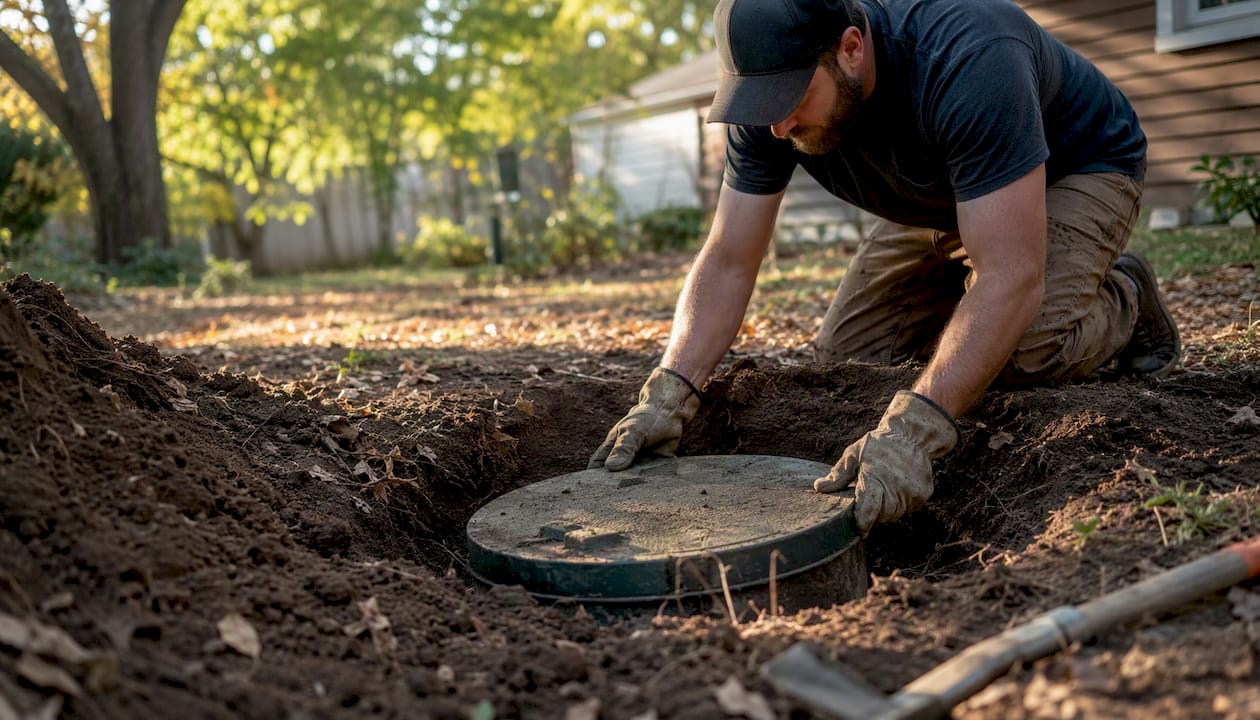
Start with your property records. Most counties require as-built drawings when a system is permitted, and your local health department or county office should have a copy on file. If you can’t find one, a septic contractor can locate lines electronically without digging. The components to map include the tank, the distribution box, all lateral drain lines, and the reserve area (the backup field set aside if the primary fails).
Once you have a map, mark everything physically:
- Use stakes or small flags to outline the drain field perimeter
- Mark each access port location clearly
- Note the reserve area and treat it with the same restrictions as the active field
- Keep a copy of the map with your home records and share it with any landscaper you hire
Install risers over access ports if they aren’t already in place. Risers bring the lid to grade level, eliminating the need to dig at every pump-out. They can be camouflaged with a movable planter box or decorative cover, but the cover must lift off completely for service access. Never plant directly over a lid or permanently anchor anything above an access port.
Pro Tip: Schedule your septic tank pump service before you start landscaping. The technician can confirm component locations while they’re on-site, saving you a separate locating visit.
Water and soil rules that protect your drain field
Water is the drain field’s biggest enemy when it comes from the wrong direction. The field is already receiving wastewater from the house; any additional moisture from rain runoff, gutters, or irrigation reduces the soil’s capacity to treat effluent before it reaches groundwater.
Keep roof runoff and irrigation away from the drain field and position sprinkler heads so irrigation water stays a sufficient distance from the field boundary. Regrade swales or extend downspout extensions if surface water currently drains toward the field. A yard flooding checklist can help you identify problem drainage patterns before they compound.
Soil rules are equally firm:
- Limit added topsoil to a minimal amount; excessive soil reduces air exchange and smothers the microbial layer.
- Never cover the field with landscape fabric, plastic sheeting, bark mulch, or decorative rock
- Avoid rototilling or any deep soil disturbance over the field
- Keep vehicles, ATVs, and livestock off the area entirely; compaction collapses the pore space the bacteria need
- If you must cross the field with equipment, use track boards and only when the soil is dry
Excess fill and impermeable covers suffocate the beneficial bacteria that do the actual treatment work. A thin layer of native topsoil to establish grass seed is fine. A raised bed with six inches of imported soil is not.
Pro Tip: If soil testing reveals higher salinity near the surface, a common condition in some older systems, choose salt-tolerant grass varieties like bermudagrass or bahiagrass rather than fighting poor establishment with more water.
What to plant over a septic drain field
Turfgrasses are the safest option for drain fields because their shallow, fibrous roots hold the soil without penetrating pipes, and they support evapotranspiration that helps dry the field between dosing cycles. Commonly recommended species include:
- St. Augustinegrass — warm-season, shade-tolerant, widely used in the Southeast
- Bahiagrass — drought-tolerant, low-maintenance, good for sandy soils
- Zoysiagrass — dense, slow-growing, handles foot traffic well
- Bermudagrass — fast-establishing, heat-tolerant, salt-tolerant
If you want something beyond plain turf, herbaceous perennials and native wildflower mixes work well when they match the site’s sun and moisture conditions and don’t require regular irrigation or fertilizer. UGA Extension lists plants like daylily, beebalm, yarrow, milkweed, aster, and pink Muhly grass as appropriate options depending on your region.
| Plant Type | Examples | Sun Needs | Irrigation After Establishment |
|---|---|---|---|
| Warm-season turfgrass | Bermudagrass, bahiagrass, zoysiagrass | Full sun | Minimal |
| Cool-season turfgrass | Tall fescue, Kentucky bluegrass | Full sun to part shade | Moderate |
| Native perennials | Daylily, yarrow, beebalm, aster | Full sun to part shade | Low |
| Native grasses | Pink Muhly, switchgrass | Full sun | Low |
Avoid these entirely:
- Edible gardens, vegetables, root crops, or fruit trees (pathogen risk plus root damage)
- Bamboo and pampas grass (aggressive, deep, invasive root systems)
- Water-loving plants like willows or cannas that draw excess moisture toward the field
- Dense mat-formers that require landscape fabric to establish
- Any plant that needs regular fertilizer or heavy irrigation to survive
Pro Tip: Plan your plantings with future repairs in mind. Inexpensive, easily replaceable groundcovers over the drain lines cost far less emotionally and financially if the field ever needs excavation.
How far should trees and shrubs be from a drain field?
The standard rule of thumb: plant trees at a distance at least equal to their mature height. Small trees (mature height 10–15 ft) need at least 10–15 ft of clearance. Medium trees (15–20 ft) need 15–20 ft. Large trees (25–30 ft) need 25–30 ft minimum. Aggressive species often need 50 ft or more.
Species to keep far away from any septic component:
- Willows and weeping willows
- Poplars and aspens
- Silver maples
- Elms
- Birches
These trees send roots toward moisture aggressively. They will find a drain line. When they do, the repair involves excavation, root cutting, and often hydro jetting to clear the lines before any pipe work begins.
If you want trees on the property, plant them beyond the drain field perimeter and the reserve area, not between the lateral trenches. A root barrier can help redirect growth, but it is not a substitute for adequate distance with aggressive species.
How to plant without damaging drain lines
Drain pipes often sit just a few inches below the surface. Lateral trenches are typically narrow and spaced several feet apart, requiring careful shallow digging to avoid damage., so a misplaced shovel can hit a line without warning. Shallow planting technique is non-negotiable.
- Dig no deeper than 6 inches anywhere over the drain field. Use hand tools, not power equipment.
- Dig wide, not deep. A wide, shallow planting hole encourages roots to spread laterally rather than downward.
- Amend soil sparingly. A small amount of compost mixed into the top few inches is fine; heavy amendments create a moisture-retaining pocket that can concentrate root growth.
- Avoid planting directly over access ports. Leave a clear, unplanted radius around every lid.
- Establish plants with minimal water. Overwatering during establishment is one of the most common ways homeowners inadvertently saturate the field.
- Use thin organic mulch only if needed. A light layer of straw or fine compost around new plantings is acceptable; thick bark mulch is not.
For riser camouflage, movable planter boxes or lightweight decorative covers work well. They must lift off without tools and must not be planted into or anchored to the ground.
Pro Tip: Oklahoma State University extension guidance notes that pipes can be only a few inches beneath the surface — treat every inch of the drain field as if a pipe is right below your spade.
Signs your drain field may be failing
Some of these show up gradually; others appear overnight after a heavy rain or a high-use period. Either way, they warrant attention before they get worse.
- Soggy or spongy ground over the drain field that stays wet even in dry weather
- Unusually lush, dark-green grass in a defined strip or patch over the field lines (effluent acting as fertilizer)
- Standing water or puddles on or near the field that don’t drain within a day
- Slow drains throughout the house, not just one fixture
- Gurgling sounds from toilets or drains
- Sewage odors indoors or in the yard near the field
- Sewage backup in the lowest fixtures of the house
Saturation is the core problem in most of these cases. When the soil stays wet, oxygen levels drop, microbial treatment slows, and partially treated effluent moves toward the surface or groundwater. A septic tank bog is one of the more visible outcomes.
If you see two or more of these signs together, stop using the system heavily and call a septic professional. Do not attempt to “dry out” the field by adding fill or covering it. That makes the problem worse.
What a septic contractor does to protect your landscaping investment
A licensed septic contractor brings tools and knowledge that change what’s possible. Electronic line locators can map buried components without a single shovel cut. That map becomes the foundation for every planting decision you make.
Services that matter most for homeowners planning or protecting landscaping:
- Line and component locating using electronic equipment, not guesswork
- Riser installation to bring access ports to grade and eliminate future digging
- Soil profile assessment to identify compaction, saturation, or failing zones before you plant
- Targeted repairs that minimize excavation footprint and preserve surrounding plantings
- As-built maps showing exact component locations for your records and future contractors
When you schedule a visit, ask for three specific things:
- A written or drawn map of all components, including the reserve area
- A recommended planting zone diagram showing safe distances from each component
- A written maintenance schedule with pump-out intervals appropriate for your household size
Most riser installations and locating visits are small jobs that take a few hours. A full inspection with a written report gives you a planning document you can hand to any landscaper or nursery. That document is worth more than any plant list.
Pro Tip: When a repair does require excavation, a contractor who knows the as-built layout can often limit the dig to the specific failed section rather than opening the entire field. Preventing septic failure before it reaches that point is always cheaper.
A local contractor’s honest take on drain field landscaping
Most homeowners get this backwards. They pick the plants first and then ask whether it’s okay. The right order is: map the system, mark the access ports, decide what the field can tolerate, and then choose plants that fit those constraints without compromising system function.
The second mistake is underestimating how shallow those pipes sit. A homeowner who has never seen a drain field excavated assumes the lines are buried deep. They often aren’t. Six inches of cover is common in many installations. That’s one enthusiastic shovel stroke away from a repair call.
My practical advice: put grass over the drain field and save the ornamentals for the borders. If you want perennials or native wildflowers in the field area, choose species that establish without irrigation and don’t need annual dividing or replanting. Keep the access ports clear and marked permanently, not just when you remember. And pump the tank on schedule, typically every three to five years for a standard household, because a backed-up tank is what turns a healthy field into a saturated one fast.
Landscaping around a septic system is genuinely achievable. The homeowners who do it well are the ones who treat the system as the fixed constraint and design around it, not through it.
Jmseptic can map, mark, and protect your drain field
If you’re not sure where your drain field sits, or you’ve noticed any of the warning signs above, Jmseptic is ready to help. We serve homeowners across Alamance County and the Piedmont Triad, including Burlington, Mebane, Graham, Elon, Whitsett, and McLeansville.

A locating and riser installation visit gives you a clear map of your system, access ports brought to grade, and a planting zone diagram you can actually use. No guesswork, no accidental damage. For homeowners facing urgent symptoms like standing water or sewage odors, our emergency septic repair service is available for Alamance County homes. For routine inspections, pumping, or a pre-landscaping system check, reach out through Jmseptic or call us directly. We’ll tell you exactly what you’re working with before you plant a single thing.
Sources
These extension and university sources back the recommendations throughout this guide. When you need state-specific rules or deeper technical detail, start here.
- Landscaping Over Septic Drain Fields | Home & Garden Information Center
- Landscaping tips: septic systems | UF/IFAS Extension
- Landscaping on or near Septic Drain Fields | UF/IFAS Extension (SS687)
- Landscaping for Septic Systems | Clark County – WSU Extension
- Do you have any general recommendations about how far apart any trees that we plant need to be from the septic system? | UMaine Extension
University extension publications and county health department guidance are the most reliable sources for this topic because they are based on field research, not marketing. Always check your state’s extension service for rules specific to your soil type and system design.