
Hydro jetting: the best fix for clear septic lines
Discover what is hydro jetting and why it's the best solution for clear septic lines. Say goodbye to clogs and restore your drains today!

When your drains keep backing up no matter how many times you snake them, the problem isn’t your patience. It’s your method. Most homeowners in Alamance County reach for the same old solution every time a drain slows down, and they end up calling a plumber every six months with the same complaint. Hydro jetting is a different approach entirely. It uses high-pressure water to blast through buildup that a snake simply pushes aside, and it’s becoming the go-to solution for homeowners who are tired of dealing with the same clogs over and over again.
Table of Contents
- What is hydro jetting and how does it work?
- How hydro jetting compares to traditional methods
- When is hydro jetting the right choice for your septic or drain lines?
- Planning, safety, and what to expect during a hydro jetting service
- What most companies won’t tell you about hydro jetting
- Find expert hydro jetting and septic solutions near you
- Frequently asked questions
Key Takeaways
| Point | Details |
|---|---|
| Complete pipe cleaning | Hydro jetting cleans drain and septic pipes far more thoroughly than traditional snaking methods. |
| Safer for septic systems | The process uses only water, making it safe for septic bacteria and environmentally friendly. |
| Not for every situation | Hydro jetting should be avoided in homes with very old or fragile pipes to prevent potential damage. |
| Best for stubborn clogs | Hydro jetting is especially effective for recurring grease, scale, and moderate root problems. |
What is hydro jetting and how does it work?
Hydro jetting isn’t just a fancy word for spraying water down a pipe. It’s a precision process that uses serious pressure to restore your drain and septic lines to near-original condition. Understanding how it works helps you know exactly what you’re paying for and why it outperforms older methods.
At its core, hydro jetting uses 1,500 to 4,000 PSI of pressurized water to cut through grease, sludge, mineral scale, and even small tree roots inside your drain and septic lines. That’s not a garden hose. That’s the kind of force that physically scrubs the interior walls of your pipes clean, not just punches a hole through whatever is blocking them.
The equipment includes a water tank, a high-pressure pump, and a long flexible hose fitted with specialized nozzles. Each nozzle type does a different job. Penetrating nozzles break up hard blockages. Rotating nozzles spin to scour the pipe walls. Root-cutting nozzles slice through smaller root intrusions. The hose enters through a cleanout access point, and rear-facing jets push the nozzle forward through the pipe while forward-facing jets destroy whatever is in the way.
Here’s what hydro jetting actually removes from your lines:
- Grease and fat buildup from kitchen drains that accumulates over years
- Sludge and sediment that settles in low spots in your septic lines
- Mineral scale from hard water deposits that narrows pipe diameter over time
- Soft and small tree roots that have crept into joints or cracks
- Soap scum and hair clogs that snake treatments leave behind
“Hydro jetting doesn’t just clear a path through a clog. It restores the full interior diameter of your pipe, which means water flows the way it was designed to flow.”
This is a critical distinction. A snake creates a hole. Hydro jetting creates a clean pipe. That difference matters enormously for how long your results last.
How hydro jetting compares to traditional methods
Most homeowners have had their drains snaked at least once. It’s fast, it’s relatively cheap, and it usually fixes the immediate problem. But if your drain clogs again within a few months, snaking probably didn’t fix the real issue. It just bought you some time.
Here’s a direct comparison of the two methods:
| Feature | Hydro jetting | Traditional snaking |
|---|---|---|
| Cleaning coverage | Full pipe circumference | Narrow channel only |
| Grease and scale removal | Yes, thorough | No, mostly bypassed |
| Root clearing | Small/soft roots | Partial, temporary |
| Result durability | Long-lasting | Short-term relief |
| Risk to fragile pipes | Higher | Lower |
| Typical cost | Higher upfront | Lower upfront |
| Best use case | Recurring clogs, buildup | Simple, isolated blockages |
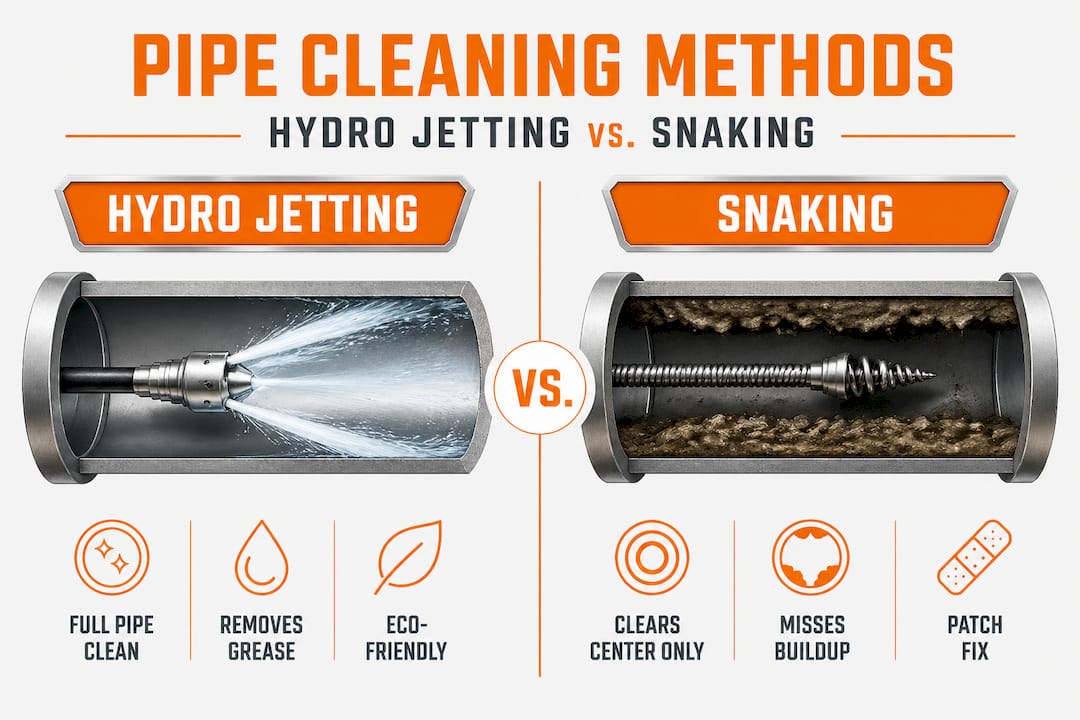
The data makes a clear case. Jetting cleans the full pipe circumference while snaking only punctures through the blockage, leaving grease and scale coating the walls. That leftover buildup is exactly why clogs come back so quickly after snaking.
That said, hydro jetting isn’t always the right call. Here are situations where snaking is still the smarter choice:
- Simple, isolated clogs caused by a single item like a wad of toilet paper
- Pipes that are already cracked or corroded, where high pressure could cause more damage
- Very old clay or cast iron pipes that haven’t been inspected recently
- Budget-constrained situations where a quick fix is all that’s needed right now
Pro Tip: If you’ve had the same drain snaked more than twice in a single year, that’s a strong signal that hydro jetting is the more cost-effective long-term solution. Repeated service calls add up fast.
The honest truth is that snaking is a maintenance patch. Hydro jetting is a reset. Knowing which one your situation calls for saves you money and frustration.
When is hydro jetting the right choice for your septic or drain lines?
Not every clog needs a hydro jet, and not every pipe can safely handle one. Knowing when to use it is just as important as knowing what it does. Here’s a practical guide for Alamance County homeowners trying to decide.
Hydro jetting works best in these specific scenarios:
- Recurring grease clogs in kitchen drain lines that keep coming back despite regular snaking
- Slow drains throughout the house, which often signal widespread buildup in the main line rather than a single isolated clog
- Septic system maintenance before or after a pump-out to clear the inlet and outlet lines
- Pre-sale home inspections where you want to confirm your drain lines are in top shape
- After a sewage backup to fully restore flow and remove all debris from the affected lines
For residential properties, 3 to 4 inch drain lines typically require 1,500 to 2,500 PSI to clean effectively without damaging the pipe walls. Larger commercial lines need more pressure, but for most homes in Burlington, Mebane, or Graham, the lower residential range is both effective and safe when applied by a trained technician.
One area where homeowners often have unrealistic expectations is root intrusion. Hydro jetting can clear soft and small roots temporarily, but those roots will regrow within 6 to 12 months if the underlying crack or joint gap isn’t repaired. Jetting is not a permanent fix for root problems. It’s a temporary clearing that buys you time to address the actual pipe damage causing the intrusion.
“If roots are getting into your septic lines, water pressure alone won’t stop them from coming back. You need to address the entry point, not just the symptom.”
Another major advantage that often goes unmentioned is the environmental angle. Because hydro jetting uses only water, there are no harsh chemicals involved. This is especially important for septic system owners. Chemical drain cleaners can kill the beneficial bacteria inside your septic tank that break down waste. Hydro jetting cleans your lines without disrupting that biological balance at all.
Pro Tip: Schedule hydro jetting as part of your regular septic maintenance every two to three years, not just when you have a problem. Catching buildup early is far cheaper than dealing with a full system backup.
Planning, safety, and what to expect during a hydro jetting service
If you’ve never had hydro jetting done before, knowing what to expect makes the whole process less stressful. Here’s a realistic picture of what a professional service visit looks like from start to finish.
Before the technician even starts, a proper inspection should happen. Reputable companies will run a camera through your lines first to assess pipe condition, locate blockages, and confirm the pipes can handle the pressure. Skipping this step is a red flag. Sending high-pressure water through a cracked or collapsed pipe can make a bad situation catastrophically worse.
The hose enters through a cleanout access point, which is a capped pipe fitting that gives direct access to your drain or septic line. If your home doesn’t have an accessible cleanout, the technician may need to create one or access the line another way.
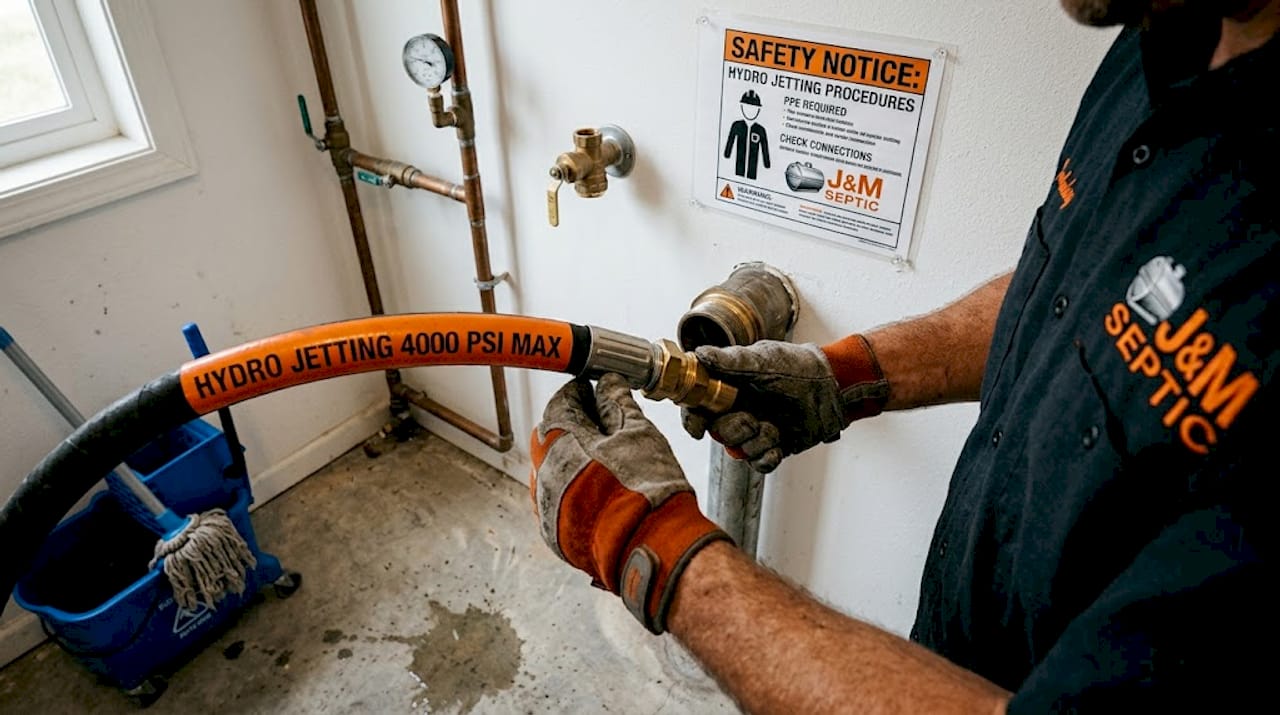
Here’s what a typical service visit involves:
| Stage | What happens |
|---|---|
| Initial camera inspection | Technician views pipe interior to assess condition and locate blockages |
| Cleanout access | Hose is inserted through the cleanout fitting |
| Jetting pass | Nozzle moves through the line, clearing buildup from walls |
| Flush and verify | Water and debris flush out; second camera pass confirms results |
| Report and recommendations | Technician notes any damage, cracks, or concerns found during inspection |
Questions you should ask before the work starts:
- Will you run a camera inspection before jetting?
- What PSI will you use, and is it appropriate for my pipe material?
- What happens if you find a cracked or damaged section during the job?
- Is there a warranty or guarantee on the service?
Typical results after a professional hydro jetting service include noticeably faster drains throughout the home, elimination of gurgling sounds in pipes, and in many cases, the complete resolution of slow drain issues that have persisted for years. Homeowners are often surprised by how dramatic the difference is compared to snaking.
The whole job usually takes one to two hours for a standard residential property, though more complex systems or severe buildup can take longer. You don’t need to leave your home during the process, and there’s no chemical smell or residue afterward.
What most companies won’t tell you about hydro jetting
Here’s something we’ve learned from years of working on septic systems across Alamance County: hydro jetting gets oversold. Not by every company, but by enough of them that homeowners end up spending money on a service that wasn’t the right fit for their situation.
Some companies push hydro jetting as a universal solution because it commands a higher price point than snaking. But if your pipe has a structural issue, a root invasion that’s already caused significant damage, or sections that are corroded and brittle, sending high-pressure water through those lines can cause a collapse or a blowout that turns a $300 job into a $3,000 repair.
The pipe inspection step isn’t optional. It’s the whole foundation of doing this job safely. Any company that quotes you for hydro jetting without mentioning a camera inspection first is cutting corners, and those corners are your pipes.
There’s also a misconception that hydro jetting is a permanent fix. It isn’t. It’s an excellent reset, and it dramatically extends the time between service calls compared to snaking. But if you have hard water, a lot of grease going down your drains, or trees near your septic lines, buildup and root growth will return. The goal is to extend your maintenance cycle, not eliminate it.
The homeowners who get the most value from hydro jetting are the ones who use it as part of a regular maintenance plan, not just as a last resort when things get bad. Catching buildup at 20% capacity is a quick, affordable job. Clearing a line that’s 90% blocked with years of hardened grease is a much bigger undertaking.
Our honest advice: get an inspection first, ask questions, and make sure the technician can explain exactly why jetting is the right call for your specific situation. A good technician will tell you if snaking is actually all you need.
Find expert hydro jetting and septic solutions near you
If slow drains, recurring backups, or septic odors are becoming a regular part of your life in Alamance County, it’s time to stop patching the problem and actually fix it.

At J&M Septic Installation & Repair, we serve homeowners across Burlington, Mebane, Elon, Graham, Whitsett, and McLeansville with honest assessments and real solutions. We don’t recommend hydro jetting unless it’s the right tool for your situation, and we always inspect before we jet. Whether you need a full septic line cleaning or just want to know what’s going on inside your pipes, our local septic experts are ready to help. Get a free hydro jetting quote today and find out what’s really going on in your lines before the next backup happens.
Frequently asked questions
Is hydro jetting safe for old pipes?
Hydro jetting can damage old or fragile pipes, so a professional camera inspection is essential before any work begins. Jetting is riskier for damaged pipes than snaking, which is why pipe condition must be confirmed first.
How often does hydro jetting need to be repeated?
Most clogs are resolved with a single jetting service, but roots regrow in 6 to 12 months without additional treatment or pipe repair. For grease and scale buildup, most homeowners benefit from jetting every two to three years as part of routine maintenance.
Is hydro jetting safe for septic bacteria?
Yes. Because hydro jetting uses only water, it does not introduce chemicals that would harm the beneficial bacteria inside your septic tank. It’s one of the safest cleaning methods available for septic system owners.
Does hydro jetting work for major root intrusion?
Hydro jetting can clear small to medium roots temporarily, but it is not a long-term solution for severe root invasion. If roots have caused significant pipe damage, the underlying entry point needs to be repaired to prevent rapid regrowth.