
How Often to Pump Your Septic Tank: A Homeowner’s Guide
Learn how often to pump your septic tank based on your household size and water usage. Ensure optimal performance and avoid costly repairs.

Most households should pump their septic tank regularly every few years. That’s the rule of thumb the U.S. EPA recommends, and it holds for a typical home with a standard tank and average water use. But “typical” covers a lot of ground. A family of five with a garbage disposal and a 750-gallon tank might need service every year. A retired couple with a 1,500-gallon tank and no disposal could go a decade between pumpings.
The main factors that push your interval shorter or longer:
- Tank size: Smaller tanks fill up faster relative to household output.
- Number of occupants: More people means more solids entering the tank daily.
- Garbage disposal use: Disposals send significantly more solids into the tank and often cut the interval to once a year.
- High water use: Long showers, frequent laundry, and water-heavy appliances accelerate solids accumulation.
- Alternative or mechanical systems: Systems with electrical pumps, aerators, or float switches need professional inspection annually, not every three years.
Even if your tank doesn’t need pumping, the EPA recommends a professional inspection at least every 3 years. Some homes, especially those with heavy use or older systems, need annual checks.
Key Takeaways
Most homeowners should pump their septic tank every 3–5 years, but the right interval depends on tank size, occupancy, and whether a garbage disposal is in use.
| Point | Details |
|---|---|
| Rule-of-thumb interval | Pump every 3–5 years for most households; adjust based on tank size and occupant count using the OSU Extension table. |
| EPA inspection frequency | The EPA recommends professional inspection at least every 3 years, and annually for systems with mechanical components. |
| Garbage disposal impact | MassDEP recommends annual pumping for homes with a garbage disposal, regardless of tank size. |
| Inspection thresholds | Pump when scum is within 6 inches of the outlet, sludge is within 12 inches, or solids exceed 25% of liquid depth. |
| Jmseptic service | Jmseptic provides pump-outs, full inspections, and written reports for homeowners across Alamance County and the Piedmont Triad. |
Table of Contents
- How often should you pump your septic tank? A frequency table by tank size and household
- What actually changes how often you need to pump
- Professional inspection thresholds: what the numbers actually mean
- How to calculate your own pumping schedule
- Special situations that change the schedule
- What a professional pump service includes and what it costs
- Practical maintenance steps that extend time between pumpings
- Urgent warning signs that mean call a pro now
- How a professional service visit protects your system long-term
- The part most homeowners get wrong
- Jmseptic handles pumping, inspection, and everything in between
- Sources
How often should you pump your septic tank? A frequency table by tank size and household
The table below is derived from Ohio State University Extension’s pumping-frequency estimates, which use a model assuming 24-hour wastewater retention and approximately 50% solids digestion inside the tank. These figures represent estimated years between pumpings under normal residential use.
Source: OSU Extension (Ohioline AEX-740). Estimates assume average residential water use and no garbage disposal. Local authorities such as San Diego County publish similar reference charts.
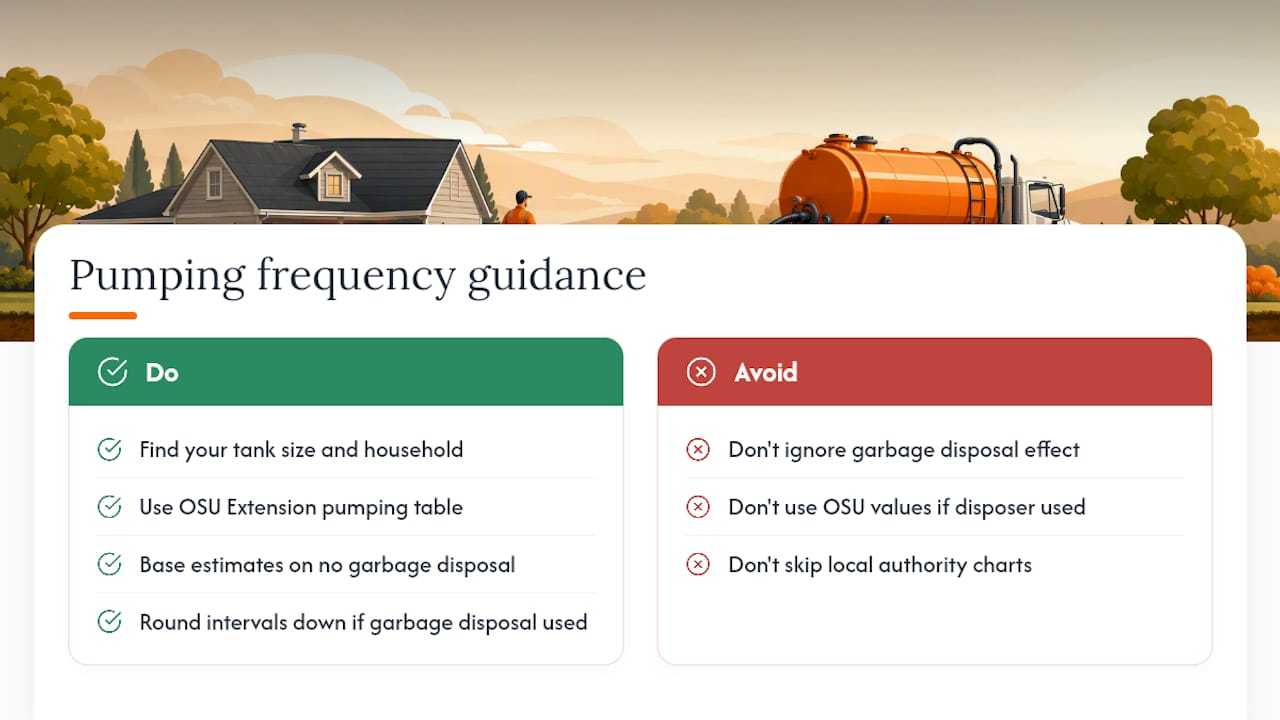
How to read this table: Find your tank size in the left column and your household size across the top. The number in the cell is your estimated pumping interval in years. If you use a garbage disposal, round the result down aggressively, often to half or less. Oregon State Extension specifically cautions that garbage disposals increase solids load and require more frequent pumping than these baseline estimates suggest.
What actually changes how often you need to pump
Tank size and occupancy are the starting point, but several other variables can shift your schedule significantly.
Tank capacity is the most straightforward lever. A 500-gallon tank serving two people fills up roughly twice as fast as a 1,000-gallon tank serving the same household. If you don’t know your tank size, check your property records, the original permit, or ask a pro to measure during the next inspection.
Household occupancy matters more than most homeowners realize. Adding one person to a household doesn’t just add one person’s waste; it also adds laundry, showers, and kitchen use. Two people in a 1,000-gallon tank can expect about 5.9 years between pumpings. Add two more people and that drops to 2.6 years, per OSU Extension data.
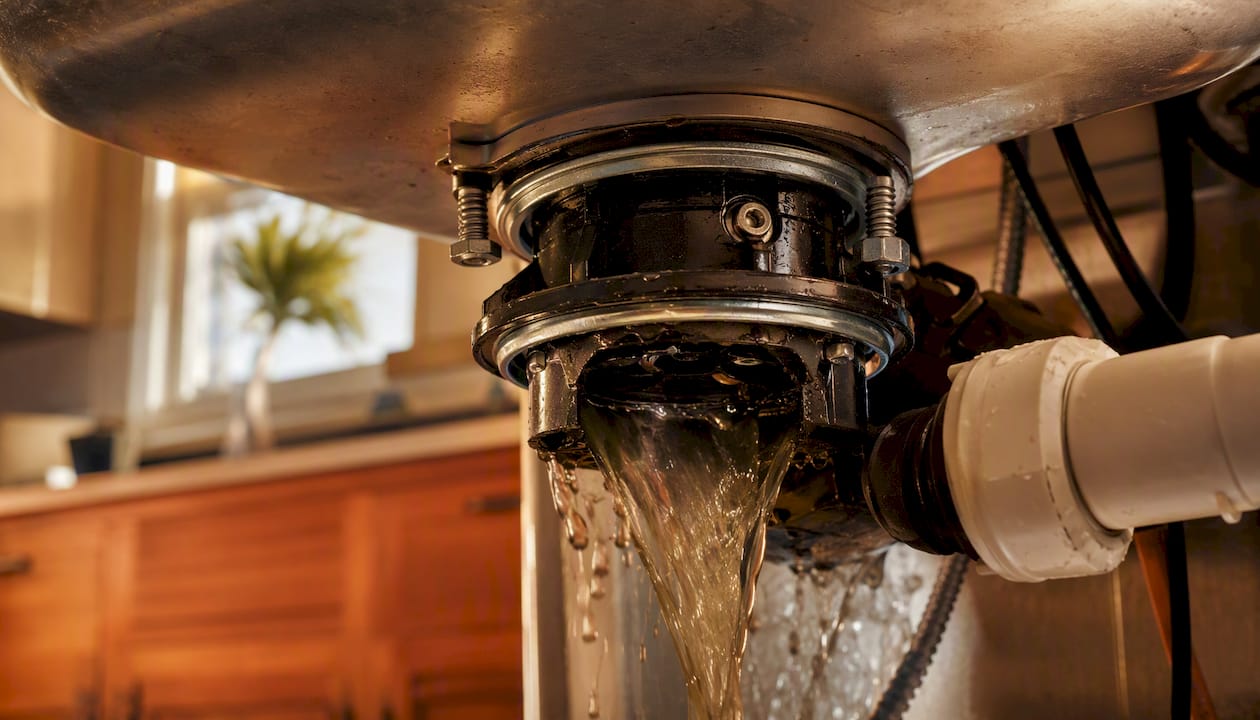
Garbage disposals are the single biggest behavioral factor. MassDEP recommends annual pumping for any home using a garbage disposal, compared to at least every three years for homes without one. Ground food waste doesn’t break down in the tank the way human waste does; it accumulates as sludge faster than the system can digest it.
Water-efficient fixtures work in your favor. Low-flow toilets, shorter showers, and efficient washing machines reduce the daily hydraulic load on the tank, giving solids more time to settle and digest. Homes that have upgraded to WaterSense-certified fixtures often see noticeably longer intervals.
Seasonal and part-time occupancy cuts both ways. A vacation home that sits empty for eight months a year obviously accumulates fewer solids. But when a large group arrives for a holiday weekend, the sudden surge can overwhelm a tank that hasn’t been maintained. Seasonal homes still need periodic inspection, even if pumping frequency is lower.
Alternative and mechanical systems operate under different rules entirely. Any system with an electrical pump, aerator, or float switch needs annual professional inspection because mechanical components wear out faster than a gravity-only concrete tank.
Professional inspection thresholds: what the numbers actually mean
A septic tank is always full of liquid. Pumping isn’t triggered by liquid level; it’s triggered by solid accumulation. Professionals measure two layers: the floating scum layer at the top and the settled sludge layer at the bottom. The EPA’s inspection criteria are specific:
- The bottom of the scum layer must stay at least 6 inches above the outlet pipe.
- The top of the sludge layer must stay at least 12 inches below the outlet pipe.
- If solids occupy more than 25% of the tank’s liquid depth, pumping is overdue.
When either layer crosses those thresholds, solids can escape into the drainfield. Once that happens, you’re no longer looking at a $300–$600 pump-out; you’re looking at a drainfield repair that can run into the thousands. Waiting for backups or slow drains to tell you the tank is full usually means the drainfield is already taking damage, a point MassDEP and extension sources consistently emphasize.
Pro Tip: Ask your contractor to install a riser, an extension pipe from the tank lid to ground level, during the next service visit. It eliminates the need to dig up the lid every time, which cuts inspection costs and makes it far more likely you’ll actually schedule regular checks. The EPA notes risers as a straightforward way to reduce maintenance friction.
How to calculate your own pumping schedule
You don’t need a spreadsheet. The method Oregon State Extension uses rests on two assumptions: the tank retains wastewater for at least 24 hours, and roughly 50% of the solids that enter the tank decompose inside it. The rest accumulates as sludge and scum until pumped.
Worked example: 1,000-gallon tank, 2-person household
Using the OSU Extension table, a 1,000-gallon tank with 2 occupants has an estimated interval of 5.9 years. Here’s how to apply that to your situation:
- Confirm your tank size. Check your permit, property records, or ask a pro. If unknown, a 1,000-gallon tank is the most common size for a 3-bedroom home.
- Count actual occupants. Use the number of people who live in the home full-time, not bedrooms.
- Look up the table estimate. Find the intersection of your tank size and occupant count.
- Adjust for modifiers. Garbage disposal? Cut the interval in half, at minimum. High water use or heavy laundry? Subtract another year. Water-efficient fixtures? You may be able to add a year.
- Round conservatively. If the table says 5.9 years, schedule at 5 years. If it says 2.6 years, schedule at 2.
- Set a calendar reminder now. The date you last pumped plus your adjusted interval is your next target inspection date.
After the first inspection on your new schedule, ask the technician to note the sludge depth. That single data point, compared to the depth at the next visit, gives you the most accurate interval for your specific system.
Special situations that change the schedule
Garbage disposals
The math is blunt: MassDEP recommends annual pumping for homes with garbage disposals, and Oregon State Extension backs that up. Ground food waste adds a category of solids the tank’s bacterial environment handles poorly. If you use a disposal daily, treat your pumping schedule as annual regardless of what the table says.
Seasonal and vacation homes
A home occupied only in summer accumulates far fewer solids than a year-round residence. But the risk is the opposite problem: long idle periods can reduce bacterial activity in the tank, and a sudden influx of guests can overwhelm a system that hasn’t been serviced in years. A good rule for seasonal homes is to inspect every 3 years even if pumping isn’t needed, and to pump before a long period of heavy use.
High-occupancy households
Households with more people than the home’s bedroom count suggests (multigenerational families, frequent long-term guests) should move to the next occupancy column in the table and schedule accordingly. The math scales linearly with solids input.
Alternative and mechanical systems
Systems with pumps, aerators, or electrical components need annual professional inspections because a failed float switch or pump motor can cause a backup within days. These systems often have service contracts for exactly this reason.
What a professional pump service includes and what it costs
A standard residential pump-out takes between 20 and 45 minutes under normal access conditions. Buried lids, heavy solids buildup, or difficult site access can push that to an hour or more.
Typical service flow:
The technician locates the tank lid (or accesses the riser if one is installed), opens the access port, and inserts a vacuum hose. The truck pumps out the septage, which includes liquid, sludge, and scum. A reputable contractor will then visually inspect the baffles, check sludge depth, and look for cracks or signs of structural issues before resealing the lid.
Cost factors:
Pump-only jobs at a straightforward residential tank generally run in a moderate price range, though costs vary by region, tank size, and site conditions. A full pump-plus-inspection with a written report typically costs more. Travel distance, sludge condition, and whether the lid needs to be excavated all affect the final number.
Questions to ask before booking:
- Does the service include a baffle inspection and sludge-depth measurement, or is it pump-only?
- Will you receive a written report with findings and recommendations?
- Are you licensed and insured in this state?
- Are septage disposal fees included in the quoted price?
- Do you note sludge depth so I can track accumulation over time?
The difference between a contractor who hands you a written report and one who just pumps and leaves is the difference between data you can use to plan and a receipt that tells you nothing. Virginia Cooperative Extension guidance specifically recommends confirming whether inspection and reporting are included before accepting an estimate.
Practical maintenance steps that extend time between pumpings
The goal isn’t just to pump on schedule; it’s to slow solids accumulation so the schedule stays as long as possible.
- Limit garbage disposal use. Even reducing disposal use from daily to occasional can meaningfully extend your interval.
- Spread out laundry loads. Running five loads in one day sends a large hydraulic surge through the tank. Spacing loads across the week gives solids time to settle.
- Keep fats, oils, and grease out of the drain. These don’t break down in the tank; they accumulate in the scum layer and accelerate the rate at which it reaches the outlet threshold.
- Avoid flushing non-biodegradables. Wipes (even “flushable” ones), paper towels, and hygiene products don’t decompose and add to sludge volume faster than organic waste.
- Protect the drainfield from compaction. Keep vehicles, heavy equipment, and even dense plantings away from the drainfield area. Compacted soil reduces the field’s ability to absorb effluent. For a deeper look at protecting your drain field, Jmseptic’s guide covers eight specific practices.
- Use water-efficient fixtures. WaterSense-labeled toilets and showerheads reduce daily hydraulic load without any change in behavior.
Pro Tip: Keep a simple log: the date of each pump-out, the sludge depth the technician measured, and any findings noted. After two or three service visits, you’ll have real data on how fast your specific tank accumulates solids, which is far more reliable than any table estimate. The EPA identifies record-keeping as the best basis for planning future pumping intervals.
Urgent warning signs that mean call a pro now
These aren’t “schedule something soon” situations. If you see any of the following, stop running water-heavy appliances and call a septic professional the same day.
- Sewage backing up into drains or toilets. Solids have likely reached or passed the outlet, and the tank or drainfield may be failing.
- Slow drains throughout the entire house. A single slow drain is usually a pipe issue. Slow drains everywhere point to the septic system.
- Strong sewage odors outside, near the tank or drainfield. Odors at ground level indicate gases escaping where they shouldn’t, often a sign of a full tank or a compromised drainfield.
- Standing water or soggy ground near the drainfield. Effluent surfacing above ground means the field can’t absorb what the tank is sending. This is a health hazard and a regulatory issue in most states.
- Gurgling sounds from toilets or drains. Gurgling indicates air being displaced by rising liquid in the lines, a sign the system is under pressure it can’t handle.
Any one of these signs means the system is past the point of routine maintenance. For a detailed breakdown of warning signs that need immediate service, Jmseptic’s homeowner guide covers each symptom and what it typically indicates.
How a professional service visit protects your system long-term
A well-run service visit does more than empty the tank. Here’s what a reputable provider should deliver:
Service flow from start to finish:
- Scheduling confirmation with an estimated arrival window.
- On-site location of the tank lid or riser access point.
- Pump-out of all septage (liquid, sludge, and scum layers).
- Visual inspection of inlet and outlet baffles for damage or displacement.
- Measurement and documentation of sludge depth before and after pumping.
- Check for cracks, root intrusion, or structural concerns in the tank walls.
- Reseal of the access port and backfill if excavation was needed.
- Written report with findings, sludge depth, and recommended next service date.
Benefits that compound over time:
- Preserved drainfield life. Keeping solids inside the tank is the single most effective way to prevent drainfield clogging, which is the most expensive septic repair a homeowner faces.
- Lower long-term costs. A $400 pump-out every few years is far less than a drainfield replacement, which can run $5,000–$20,000 depending on system type and site conditions.
- Written records for resale. Documented maintenance history adds credibility during a home sale and can prevent delays during inspection contingencies.
- Early detection. A cracked baffle or a failing distribution box caught during a routine visit costs a fraction of what it costs after a full system failure.
Jmseptic serves homeowners across Alamance County and the surrounding Piedmont Triad, including Burlington, Mebane, Elon, Graham, Whitsett, and McLeansville. Services include pump-outs, full inspections, hydro jetting, repairs, and tank replacement. Every service visit includes a written report with findings and a recommended maintenance schedule.
The part most homeowners get wrong
The conventional wisdom on septic maintenance is “pump it every 3–5 years and you’re fine.” That’s not wrong, but it’s incomplete in a way that costs people money.
The 3–5 year rule assumes a specific combination of tank size and household occupancy that may not match your home at all. A 1,000-gallon tank with four people should be pumped closer to every 2.6 years, not every 5. A 1,500-gallon tank with two people can safely go 9 years. Applying the generic rule to either household leaves one family at risk of drainfield damage and the other spending money they don’t need to.
The second mistake is treating pumping and inspection as the same thing. Pumping removes solids. Inspection tells you whether the baffles are intact, whether the sludge is accumulating faster than expected, and whether the tank itself is structurally sound. You can pump a tank every year and still miss a cracked baffle that’s been sending solids toward the drainfield for months. Ask for both, every time.
The third mistake is the most expensive: waiting for a symptom. By the time sewage backs up or the yard turns soggy, the drainfield has almost certainly been compromised. Routine maintenance isn’t just cheaper than repair; it’s the only reliable way to prevent the repair from becoming necessary in the first place.
Jmseptic handles pumping, inspection, and everything in between
If you’re not sure when your tank was last serviced, or if you’ve never had a written inspection report, that’s the right place to start. Jmseptic provides full pump-out and inspection services for homeowners across Alamance County and the Piedmont Triad, with written reports and a recommended next-service date included with every visit.

Beyond routine pump service, the team handles hydro jetting for line blockages, baffle repair, tank replacement, and emergency response when symptoms appear. Every client in the service area receives a documented inspection with findings and recommendations, not just a receipt.
To schedule a pump-out or inspection, visit the septic tank pump service guide or call Jmseptic directly. If you’re seeing warning signs now, the emergency septic repair guide explains what to do before the technician arrives.
Sources
- How to Care for Your Septic System | US EPA
- Septic System Maintenance | Ohioline
- Mass
- Septic tank maintenance (Oregon State Extension)