
5 Minute Homeowner Check: Is Green Grass Over Your Septic a Problem?
A 5-minute checklist for homeowners to tell harmless septic green-up from failure. Learn the key warning signs—soggy ground, sewage odor, slow drains—and...

A greener patch over your septic tank or drain field is usually harmless, caused by nutrients and heat rising from below. It only becomes urgent when you see soggy ground, sewage odor, bright fluorescent green that won’t fade, or green grass that stays lush through a drought while the rest of your yard browns out. If any of those show up, stop heavy water use and call a professional before it turns into a bigger repair.
TL;DR:
- Green patches over a septic system that persist through dry spells or are intensely fluorescent typically indicate a leak or shallow lid, not just natural nutrient absorption.
- Signs requiring immediate action include soggy ground, sewage odor, and active surfacing effluent, especially if combined with slow indoor drains.
- Soil type influences greening severity, with clay soils causing more noticeable patches, while sandy soils usually show minimal surface effects even when issues exist.
- Routine water use and scheduled pump-outs are crucial to prevent nutrient overloads that cause excessive greening and system failure.
- Proper landscaping involves shallow-rooted grasses and avoiding trees, shrubs, or heavy equipment near the drain field to prevent root intrusion and soil compaction.
Table of Contents
- What Causes Green Grass Over a Septic Tank or Drain Field?
- Normal Green-Up vs. Warning Signs: A Quick Comparison
- How to Check Your Yard Right Now
- Landscaping Over Septic: What to Plant and What to Avoid
- When a Pro Gets Involved: What to Expect
- How Soil Type Changes the Way Your Lawn Looks Over a Septic Field
- Seasonal Changes in Grass Color Above Your Septic System
- Health and Environmental Risks Tied to a Failing System
- Preventing Nutrient Overload That Causes Excessive Greening
- How Your Septic System’s Design Shapes Grass Growth Patterns
- Author perspective: a short note from Jason at J&M Septic
- Get an Inspection Before a Green Patch Becomes a Bigger Problem
- Sources
What Causes Green Grass Over a Septic Tank or Drain Field?
Septic effluent works like a slow-drip fertilizer. Treated wastewater moving through the soil carries 20 to 85 mg/L of nitrogen and 10 to 15 mg/L of phosphorus, both of which are the same nutrients bagged lawn fertilizer supplies in far higher concentrations. Grass roots pull up that nitrogen and phosphorus, and the result is a patch that looks a shade or two darker than the surrounding lawn.
Heat plays a role too. Tanks and distribution lines sit close to the surface in many yards, sometimes under just a foot or two of soil, and the microbial activity inside generates warmth that speeds up grass growth nearby. Combine that with shallower soil over the trenches, which drains and warms faster than undisturbed ground, and you get an early green-up in spring or a patch that recovers faster after a dry spell.
Location matters for how worried you should be. Even greening spread evenly across the whole drain field is typically routine. Grass that’s noticeably greener right over the tank lid, though, deserves a second look. That kind of concentrated growth often points to a leaking riser or a lid that’s buried too shallow, not a general nutrient boost.
Normal Green-Up vs. Warning Signs: A Quick Comparison
Most homeowners can rule out a real problem in under five minutes just by walking the yard and paying attention to a handful of signals. The table below breaks down what to expect in each scenario and what to do about it.
| Signal | Normal | Warning: action needed |
|---|---|---|
| Grass color | Slightly darker green, gradual | Bright, fluorescent, or neon green |
| Ground feel | Firm, springs back underfoot | Soft, squishy, or muddy |
| Odor | None | Sewage or rotten-egg smell |
| Pattern | Even across the whole field | Concentrated over the tank lid or in stripes |
| Behavior in drought | Fades or browns like the rest of the lawn | Stays green and lush while everything else browns |
| Indoor plumbing | No issues | Slow drains, gurgling pipes, or backups |
If you’re only seeing one item from the warning column, keep an eye on it and cut back on water use for a few days. Two or more warning signs together, especially odor paired with soggy ground, means it’s time to reduce indoor water use immediately and get a professional inspection scheduled. Extension research from the University of Kentucky backs this up: green stripes that persist through dry weather often signal hydraulic overload rather than a healthy field doing its job.
How to Check Your Yard Right Now
You don’t need special tools to get a good read on what’s happening under your lawn. Run through these checks in order.
- Do the sponge-foot test. Walk the entire drain field slowly. If the ground gives way like a wet sponge under your boots, that’s surfacing effluent, not just soft soil from rain.
- Smell test, carefully. Take a few breaths near the suspect area without lingering. A sewage or rotten-egg smell is a clear signal. Don’t stay in one spot for long if the odor is strong.
- Check indoor drains. Slow drains, gurgling toilets, or backups happening around the same time as the yard changes point to the same underlying issue.
- Pull your pump-out records. The EPA and most extension offices recommend pumping every three to five years for a typical household. If you’re overdue, that alone could explain a struggling field.
- Start a photo timeline. Snap a picture of the area weekly. Patterns that spread week over week are far more telling than a single snapshot.
Pro Tip: Photograph the green patch at the same time of day and distance each week. Rapid spreading over two or three weeks is one of the clearest early signs of a failing drain field, according to field observations from Inspectapedia.
If drains are slow and the ground is soft at the same time, cut back on laundry and long showers today and get someone out to look before it gets worse.

Landscaping Over Septic: What to Plant and What to Avoid
The safest cover for a drain field is shallow-rooted turfgrass, and that’s not just a preference. Grasses like St. Augustinegrass, bahiagrass, zoysiagrass, and bermudagrass hold soil in place and pull moisture out through evapotranspiration without threatening buried lines. Anything with deeper, woodier roots is a different story.
- Avoid trees and shrubs. Their roots seek out moisture and can grow directly into distribution pipes, cracking or clogging them over time.
- Skip vegetable gardens over the field. Digging disturbs the soil cap, and there’s a contamination risk from effluent that hasn’t fully filtered through.
- Never add soil, mulch, or bring heavy equipment onto the field. Compacted or piled-on soil reduces the field’s ability to absorb and treat wastewater.
- Don’t irrigate a brown patch hoping to green it up. Extra water reduces the soil’s treatment capacity and can push a marginal field toward failure.
- Want ornamentals nearby? Get your lines marked first, then keep any plantings well outside the field, choosing only shallow-rooted species.
A local landscaper or soil testing service can help you confirm soil conditions before you plant anything new near the field. For a fuller breakdown of safe species and layout tips, see our guide to landscaping over a drain field.
When a Pro Gets Involved: What to Expect
A standard inspection covers the tank seams and risers, the distribution box, and the trenches themselves, checking for cracks, blockages, or uneven flow between lines. Most licensed technicians can complete this walkthrough in under an hour for a typical residential system.
Short-term fixes are often enough for marginal cases. A pump-out combined with a week or two of reduced water use lets an overloaded field rest and recover, which resolves plenty of situations that looked alarming at first. Persistent surfacing, spreading green zones, or a system that doesn’t respond to reduced water use usually means something more serious, like a cracked tank or a biomat clog in the trenches that requires partial drain-field replacement.
Three signs together mean you shouldn’t wait: soggy ground, sewage odor, and slow indoor drains. That combination points to active surfacing effluent, and the fix gets more expensive the longer it sits. Cut back on water use immediately, isolate the area from foot traffic, and get a technician out as soon as you can.
How Soil Type Changes the Way Your Lawn Looks Over a Septic Field
Sandy soil drains fast, which means effluent moves through quickly and rarely pools near the surface. Grass over a sandy drain field tends to look only mildly greener than the rest of the yard, and browning during dry spells looks close to normal.
Clay-heavy soil behaves very differently. It holds water and nutrients longer, so effluent has more contact time with plant roots before it moves on. That can produce a much more obvious green patch, but it also raises the odds of surfacing effluent during wet seasons because clay doesn’t drain fast enough to keep up with daily wastewater flow. Homeowners on clay lots tend to see warning-level greening more often, simply because the soil itself is working against fast drainage.
Loam sits in between, draining well enough to avoid standing water while still holding enough moisture and nutrients to support a visible, but usually mild, green-up. If you know your soil type, you already have a baseline for how much greening to expect before you start worrying. Rocky or shallow-soil lots present their own issue: less soil depth over the pipes means less filtration distance, and any effluent that reaches the surface does so faster than it would in six feet of loam. That’s part of why the same drain field can look completely different from one property to the next, even with similar household water use.
Seasonal Changes in Grass Color Above Your Septic System
Spring is when most homeowners first notice the contrast. Cooler soil elsewhere in the yard is slower to wake up, while the extra warmth generated by tank and trench activity gives grass over the septic system a head start. That early green-up is one of the most common and least concerning patterns homeowners report.
Summer brings the real diagnostic value. This is when the drought test matters most: a normal patch fades along with the rest of your lawn during a dry stretch, while a patch that stays lush and green despite weeks without rain is very likely getting extra moisture from surfacing effluent, not just old, established root systems. If you want a strong signal, summer dry spells are the clearest testing window a homeowner ever gets.
Fall growth tends to level out as temperatures drop and grass growth slows everywhere. Any lingering greening you notice heading into fall is worth documenting, since it may resurface as a bigger issue with spring rains.
Winter is where the same principle shows up differently. In colder climates, snow often melts faster over a septic tank or field due to underground heat, leaving a visible bare patch that mirrors the same warmth pattern behind the summer green-up. Extension resources note this snowmelt pattern as a useful cold weather clue for locating buried components and spotting potential problem areas before spring growth hides them again.
Health and Environmental Risks Tied to a Failing System
Grass conditions are often the first visible clue that something below the surface has gone wrong, and the risks behind that clue go well beyond a soggy lawn. Surfacing effluent means untreated or partially treated wastewater is reaching the ground surface, which creates a direct pathway for bacteria and pathogens to reach pets, kids, and anyone who walks through the yard barefoot.
Groundwater contamination is the bigger, less visible concern. A failing drain field can let nitrogen, phosphorus, and pathogens migrate down into groundwater, especially in sandy or rocky soils where filtration distance is short. If your property relies on a private well, this is not a theoretical risk. Nearby surface water, ponds, streams, or drainage ditches can pick up runoff from a badly failing system too, contributing to nutrient loading that shows up later as algae blooms.
There’s also a simple structural risk that gets overlooked: standing effluent softens the ground, which can undermine footing near the tank and create a safety hazard for foot traffic or equipment. None of this is meant to cause alarm over a mildly green lawn. It’s meant to explain why the warning signs in the comparison table above are worth acting on quickly rather than waiting to see if they resolve on their own.
Preventing Nutrient Overload That Causes Excessive Greening
The single biggest lever homeowners have is water use. Every extra load of laundry, long shower, or running faucet adds volume to a system that has a fixed daily capacity, and pushing past that capacity is what drives nutrients and effluent toward the surface in the first place. Spacing out laundry loads through the week instead of running three in one day gives the system time to process what’s already in the tank.
Routine pump-outs matter just as much. Skipping scheduled service lets solids build up in the tank, which reduces the space available for wastewater to settle properly before it moves into the drain field. That backs up the whole system faster than most homeowners expect. Fixing leaky faucets and running toilets helps too, since a running toilet alone can add hundreds of gallons a day to a system that was never sized for that extra flow.
Avoid pouring grease, cooking oil, or harsh chemicals down the drain. These substances interfere with the bacterial activity inside the tank that’s responsible for breaking down waste before it reaches the field. A system with disrupted bacterial balance processes nutrients less efficiently, which can show up above ground as uneven or excessive greening in the exact spots getting the most nutrient load.
How Your Septic System’s Design Shapes Grass Growth Patterns
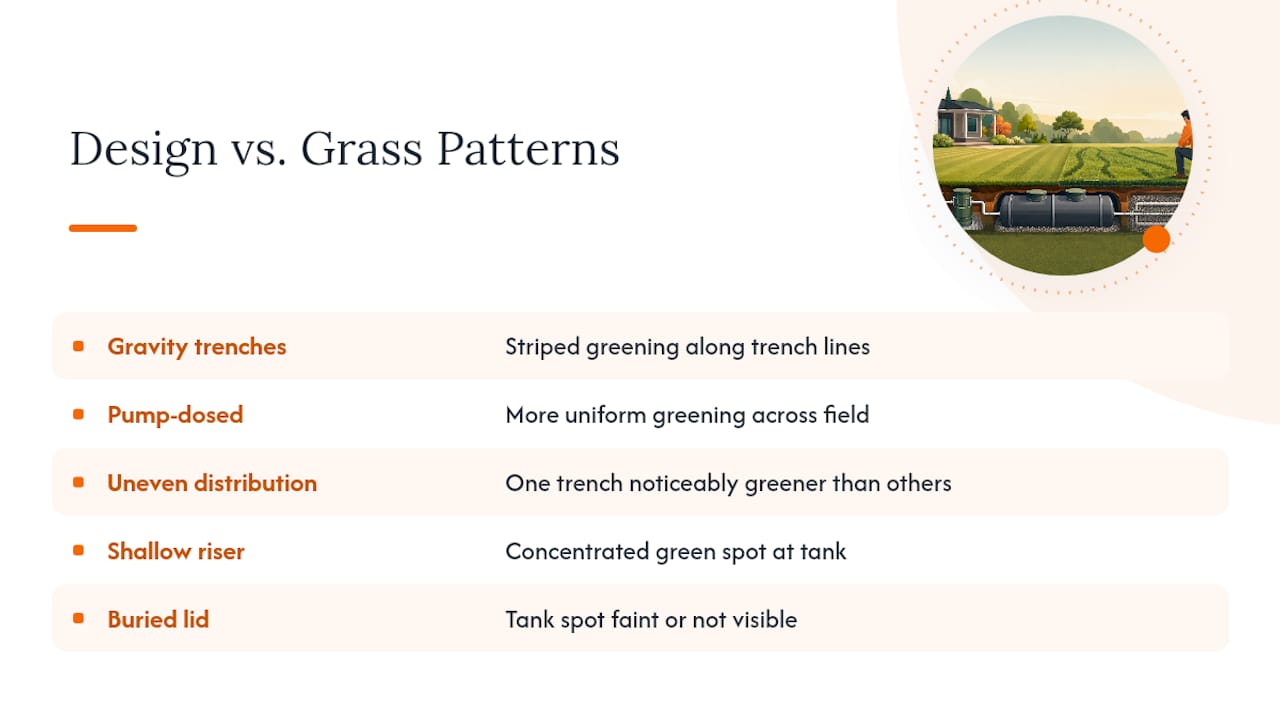
Not every drain field looks or behaves the same, and a lot of that comes down to design choices made when the system went in. Conventional gravity-fed systems with a distribution box send effluent to multiple trenches, and grass growth typically follows those trench lines in fairly even stripes, since each line gets a similar dose of nutrients.
Pump-fed or dosed systems distribute wastewater in scheduled bursts rather than a continuous trickle, which tends to produce more uniform greening because every part of the field gets treated at roughly the same rate over time. Systems with uneven distribution boxes, where one line gets more flow than others, often show one noticeably greener trench while neighboring lines look ordinary. That’s a design or maintenance issue worth flagging to a technician rather than something to write off as normal variation.
Tank depth and riser placement affect the pattern too. Shallow risers and lids sitting close to the surface generate a more concentrated warm, green spot right at the tank, distinct from the broader field pattern. Older systems without risers can bury the lid deep enough that this effect barely shows, while modern installs with risers make tank location, and any associated greening, much easier to spot from above ground. Systems designed with proper depth and even distribution generally produce the gentlest, most uniform green-up, which is exactly the low-drama outcome you want.
Author perspective: a short note from Jason at J&M Septic
The mistake we see most is homeowners watering a brown patch over the drain field, trying to match the green next to it. That extra water is often what pushes a marginal field into failure. We’ve also found that shallow tank lids, buried closer to the surface than they should be, are behind a lot of the hot, bright green spots people worry about. If your patch is even and fades with the rest of your lawn in a dry spell, relax. If it doesn’t, that’s worth a call, not a garden hose.
— Jason
Get an Inspection Before a Green Patch Becomes a Bigger Problem
If you’ve walked through the checklist above and something doesn’t sit right, soggy ground, a smell that won’t go away, or drains that gurgle when you run the dishwasher, that’s exactly the kind of case J&M Septic handles every week across Alamance County. Full inspections typically check tank seams, risers, the distribution box, and trench performance, followed by pump-outs, hydro jetting, or repairs depending on findings. No guessing, no upsell, just a clear read on what your system actually needs.

Many green-patch issues are often addressed effectively by routine pump-outs and a period of lighter water use. The ones that don’t get caught early are the ones that turn into partial drain-field replacements, which cost far more than a routine service call. If you’re seeing any of the warning signs above, check the full list of signs your septic needs service and give us a call to schedule an inspection before it turns into an emergency repair.
Sources
- Landscaping the drain field (UF/IFAS)
- Turfgrass color as an indicator of septic system performance (UK extension)