
Homeowners: Evidence Based Septic Fixes for Flushable Wipe Damage
Why labeled flushable wipes do not break down in septic tanks, how that raises repair costs, and clear, pro backed steps homeowners can take now.

No, don’t flush wipes into a septic system, flushable or not. Michigan State University Extension testing found that wipes stay largely intact for weeks or even months inside a septic tank, unlike toilet paper, which breaks apart almost immediately. The label on the package describes what happens in a toilet bowl, not what happens in the anaerobic sludge of your tank.
TL;DR:
- Flushed wipes can stay intact for weeks or months in a septic tank, unlike toilet paper that disintegrates within minutes.
- Wipes use bonded nonwoven or synthetic fibers, making them resistant to breakdown and prone to forming dense mats that clog the tank and drainfield.
- Industry standards and third-party certifications for wipe flushability are limited, and legal actions have revealed misleading marketing claims about flushable wipes.
- Damage from wipes includes clogging baffles, reducing tank capacity, and speeding up drainfield failure, with repair costs ranging from a few hundred to thousands of dollars.
- The safest approach is to stop flushing wipes immediately, use septic-safe alternatives like damp toilet paper or bidets, and schedule regular septic inspections.
Table of Contents
- Flushable Wipes vs Toilet Paper: What Actually Happens in a Septic Tank
- The Evidence Behind the “Don’t Flush Wipes” Rule
- How Flushed Wipes Damage a Septic System (and What Repairs Cost)
- Already Flushing Wipes? Here’s Your Recovery Plan
- Septic-Safe Alternatives That Feel Just as Clean
- What a Septic Pro Actually Checks for Wipe Damage
- Why the TP-Only Rule Is the Cheapest Insurance You’ll Ever Buy
- When to Call In a Septic Professional
- Sources
Flushable Wipes vs Toilet Paper: What Actually Happens in a Septic Tank
Toilet paper is engineered to fall apart. Drop a square in water and swirl it, and it disintegrates in one to four minutes because its short paper fibers are barely bonded together on purpose. Wipes are built the opposite way: they use bonded nonwoven or synthetic fibers, sometimes reinforced with resins or preservatives that keep them strong when wet, because a soggy, disintegrating wipe would be useless for cleaning.
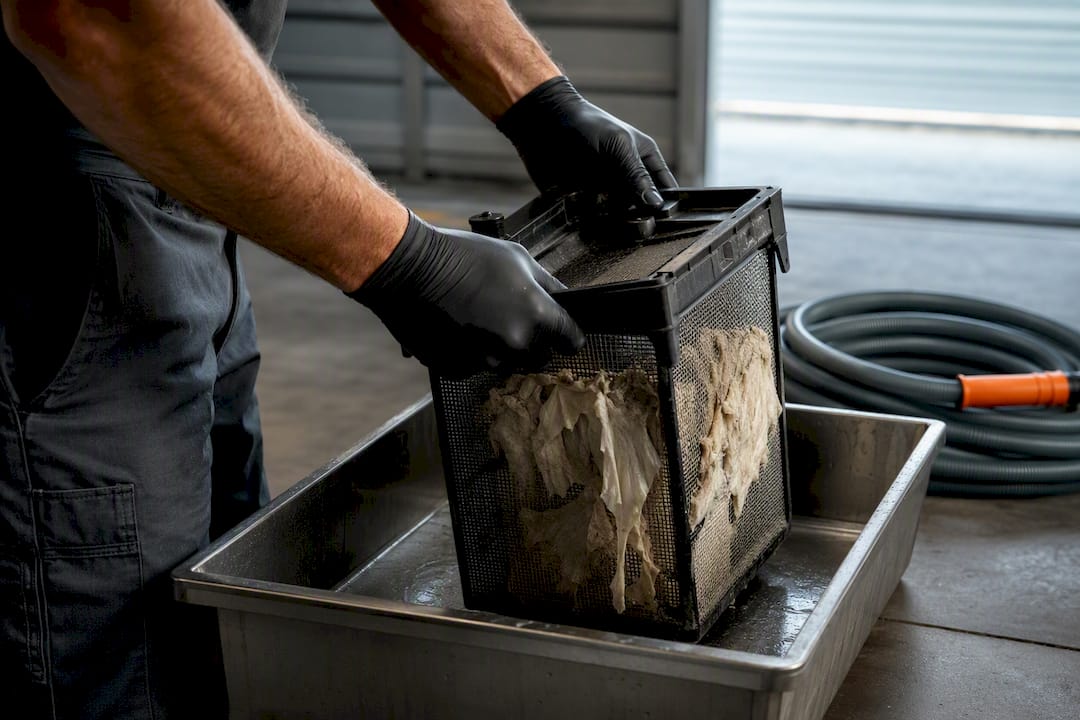
That strength is the whole problem once it lands in your tank. Septic tanks are low-agitation, oxygen-starved environments, nothing like the spinning drum of a washing machine or a lab beaker. Wipes that survive a manufacturer’s agitation test can still refuse to break down in that quiet environment, and instead of dissolving, they tangle with hair, grease, and other debris into a dense, ropy mat.
That mat does not stay put:
- It snags on the inlet baffle, the piece designed to keep solids from washing straight into the drainfield.
- It builds up around effluent pumps in systems that use them, straining the motor.
- It can shade and block bacterial digestion of solids sitting nearby, slowing the biological breakdown your tank depends on.
- Over time, it reduces how much liquid can actually pass through the tank on schedule.
Once a mat forms, it does not shrink on its own. It grows.
The Evidence Behind the “Don’t Flush Wipes” Rule
The consensus against flushing wipes isn’t a guess dressed up as advice. It’s built on repeated, independent findings pointing the same direction.
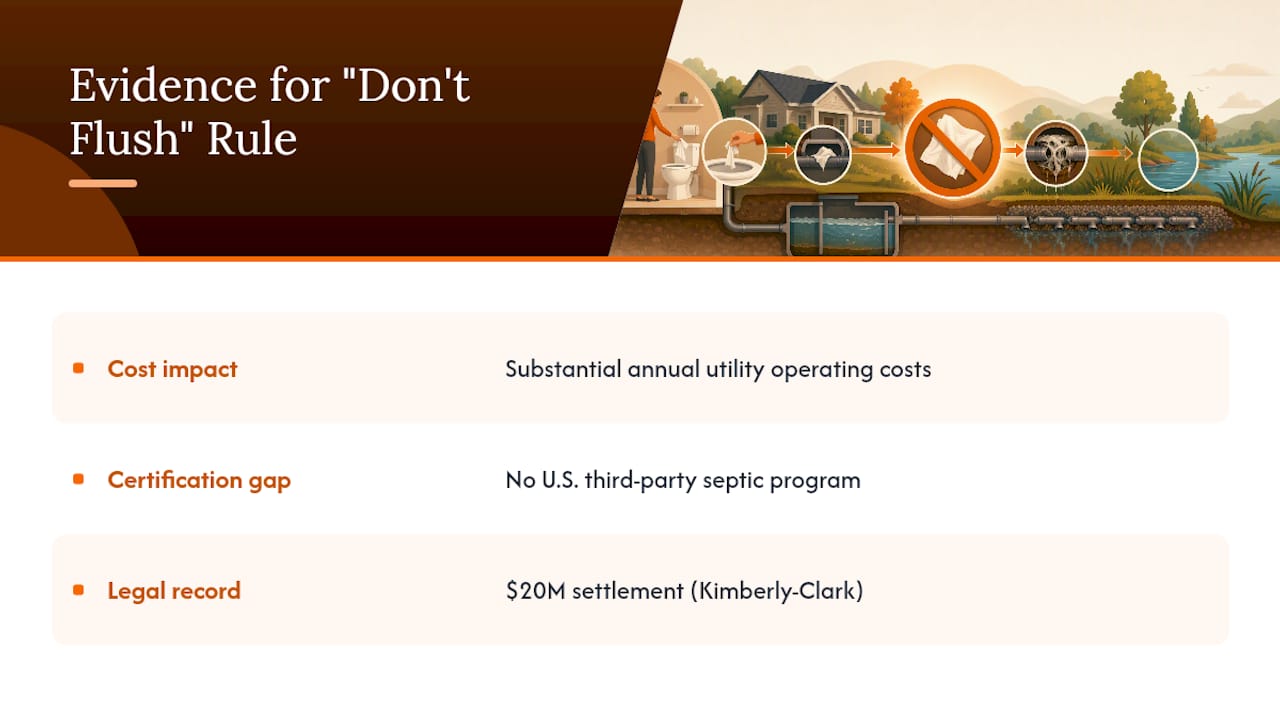
Wipes cost real money, at scale. Consumer Reports cites an industry estimate that wipes add substantial annual operating costs for U.S. clean water utilities. That figure covers municipal sewer systems, not private septic tanks, but it reflects the same underlying failure: these products don’t break down the way toilet paper does.
Certification hasn’t kept pace with the marketing. There’s no widely accepted third-party program in the U.S. that verifies a wipe is safe for a septic tank, and the UK’s “Fine to Flush” certification program shut down in 2024, narrowing the pool of independent validation even further. Industry-run testing groups like INDA have published their own flushability guidelines, but those are voluntary standards set by the wipe makers themselves, not an outside referee.
The legal record backs up the skepticism. Kimberly-Clark paid a $20 million settlement tied to misleading “flushable” and septic-safe marketing claims, a signal that “flushable” on a package has meant something looser than most homeowners assume.
How Flushed Wipes Damage a Septic System (and What Repairs Cost)
Wipes cause trouble in a fairly predictable sequence, and each stage carries its own price tag.
- Line and inlet baffle clogs. A mat snags at the baffle first, since that’s the tank’s first line of defense against solids.
- Reduced tank capacity. Undigested wipes pile up faster than sludge normally would, shrinking usable tank volume.
- Drainfield stress. If solids slip past a clogged or damaged baffle, they can accelerate biomat buildup in the drainfield, the part of the system that’s the most expensive to fix.
Costs scale with how far the problem has traveled. A standard pump-out to clear a wipe mat runs a few hundred dollars in most cases. Clog clearing or hydrojetting to break up matted material in the lines costs more. Drainfield replacement, the worst-case outcome, can be very expensive. The hidden cost is the one nobody budgets for: a tank collecting wipes needs pumping far more often than a normal three-to-five-year schedule, and that accelerated timeline quietly adds up over the life of the system.
Already Flushing Wipes? Here’s Your Recovery Plan
If wipes have been going down your toilets, the goal now is to stop the damage before it compounds.
- Stop flushing wipes immediately. Put a lidded trash bin in every bathroom that uses them, and treat it as the new default.
- Schedule a septic inspection and pump-out. Ask the pumper specifically to check the inlet baffle, the effluent filter if your system has one, and to look for signs of a wipe mat while the tank is open.
- Watch for warning signs that call for a professional. Slow drains, gurgling pipes, sewage odors, or standing water in the yard mean the problem has likely moved past a simple pump-out and into needing hydrojetting or a drainfield evaluation.
A pumper can usually pull a wipe mat out during a routine pump-out if you catch it early. Wait too long, and the mat’s effects on the drainfield can outlast the pumping itself.
Pro Tip: Even a working effluent filter gets overwhelmed if wipes keep coming. If you’ve been flushing them for months, ask your pumper to inspect the filter specifically, not just the tank, since a clogged filter is often the first sign of trouble.
Septic-Safe Alternatives That Feel Just as Clean
You don’t need wipes to feel clean. A few swaps remove the risk entirely:
- Dampen a square of septic-safe toilet paper. It gives you the wet-wipe feel without introducing solids that won’t break down.
- Install a bidet attachment. These typically run $30 to $100 for a basic seat attachment and keep wipes out of your wastewater stream for good, which is often the simplest fix homeowners never consider.
- If you keep using wipes anyway, never flush them. Seal them in a bag and put them in the trash, full stop.
What a Septic Pro Actually Checks for Wipe Damage
During a standard pump-out, we look past the obvious. We check inlet baffle condition, inspect and clear the effluent filter if one’s installed, and measure sludge and scum layers to see if a wipe mat has been quietly eating into tank capacity.
Common fixes we handle include:
- Routine pump-outs with a full baffle and filter check
- Hydrojetting to clear matted debris from lines
- Effluent filter cleaning or replacement
- Drainfield assessment when solids have already migrated past the tank
Our standing advice is simple: stop flushing wipes, watch for slow drains or odors, and get on a regular inspection schedule before a small mat becomes a drainfield problem.
Why the TP-Only Rule Is the Cheapest Insurance You’ll Ever Buy
The toilet paper only rule isn’t overcautious, it’s just math. A wipe mat that costs a few hundred dollars to pump out now can turn into a drainfield replacement costing thousands later if it’s ignored. Put a trash bin in the bathroom today. It’s a small habit that protects a system that’s expensive to fix and annoying to live without.
— Jason
When to Call In a Septic Professional
There are other ways to guess your way through septic trouble: watch the yard for standing water, hope the smell goes away, or wait until a drain backs up before doing anything. None of those tell you what’s actually happening inside the tank. A pump-out and inspection does, and it’s the fastest way to know whether wipes have already built a mat around your baffle.

If you’re in Burlington, Mebane, Elon, Graham, Whitsett, or McLeansville and you’ve been flushing wipes for a while, don’t wait for a backup to find out the damage. J&M Septic handles inspections, pump-outs, effluent filter service, and hydrojetting for homes across Alamance County, and we’ll tell you plainly whether your system needs a simple cleaning or something more. Book a septic tank pump service to get ahead of it, or if you’re already seeing slow drains or odors, reach out about emergency septic repair before it turns into a drainfield replacement.
Sources
- Are flushable bathroom products safe for sewer and septic systems? — Michigan State University Extension
- Are flushable wipes really flushable? — Consumer Reports
- Are Flushable Wipes Safe for Septic? The Truth About ‘Flushable’ Labels 2026 — The Septic Guide