
Homeowners: One Crossing Can Damage a Septic Tank. What to Do Next
Vehicle crossed your septic tank or drainfield? Mark the spot, avoid more traffic, use plywood or plates for a single crossing, watch for sinking, call an...

Don’t drive or park over a septic drainfield, ever. A septic tank can sometimes handle a single, careful crossing, but only if the cover and installation were built for vehicle traffic. If a vehicle already crossed your system, get it off the area now, mark the spot, and watch for sinking ground or slow drains before calling a septic contractor.
TL;DR:
- A septic tank’s lid can crack under a passenger car or ATV, especially if it is old, shallow, or not rated for vehicle weight.
- Drainfields rely on loose, aerated soil that can collapse or compact when driven over, reducing their treatment capacity.
- Vehicle weight distribution and soil saturation significantly affect the risk, with construction equipment posing the highest danger.
- Signs of damage include slow drains, soggy patches, lush grass over the field, or sewage odors, which can take weeks or months to surface.
- Protect your system by avoiding repeated crossings, using load-spreading materials, and ensuring proper engineering if a driveway is planned over a tank.
Table of Contents
- Drive Over Septic Tank Risks: Why Tanks and Drainfields Fail Differently
- Weight Limits for Driving Over a Septic System
- Factors That Determine How Much Risk You’re Taking
- Warning Signs Your Septic System Was Damaged
- What to Do Right After a Vehicle Drives Over Your Septic System
- Temporary Protection Methods for Crossing a Septic Area
- Septic Tank Cover Requirements and Access Rules
- Building a Driveway Over a Septic Tank: When Engineering Makes It Work
- Who Pays When a Vehicle Damages a Septic System
- Real-World Examples of Drive-Over Damage
- What We See in the Field, and When to Call Us
- Get a Septic Inspection Before Small Damage Becomes a Big Repair
- Where to Learn More About Septic Access Rules
- Sources
Drive Over Septic Tank Risks: Why Tanks and Drainfields Fail Differently
A septic tank and a drainfield share a job but not a design, and that difference is exactly why one sometimes tolerates traffic and the other almost never does.
Tanks are rigid, buried concrete, plastic, or steel boxes engineered to hold soil pressure evenly across the lid. Most residential lids were never rated for a rolling wheel load, which concentrates weight on a small point instead of spreading it the way soil does. A standard lid can hold years of foot traffic and lawn care, then crack the first time a delivery truck parks on it.
Drainfields work through a completely different mechanism. Perforated pipes sit in gravel trenches just below the surface, relying on loose, aerated soil to let effluent filter down and get treated by soil bacteria. Compress that soil with a vehicle’s weight, even once, and you collapse the air pockets the system depends on. The ground doesn’t have to crack for the field to fail; it just has to get dense.
Depth matters here too. Drainfield lines commonly sit only 6 to 24 inches below grade, while tank lids can be anywhere from a few inches to over a foot under soil depending on the installation. Both are shallower than most homeowners assume, which is why:
- A single ATV pass can compact drainfield soil enough to reduce its treatment capacity.
- A tank lid buried under just a few inches of fill can still crack under a passenger car’s tire.
- Neither component was designed with vehicle traffic in mind unless a contractor specifically engineered it that way.
Weight Limits for Driving Over a Septic System
There’s no universal safe weight for driving over a septic system, and any guide claiming otherwise is oversimplifying a genuinely variable risk. The real factors are axle weight distribution, how that weight lands on the ground, and whether the lid underneath was ever rated for it.
A vehicle’s gross weight matters less than how it’s distributed. A loaded pickup with weight concentrated on two rear tires can do more damage to a shallow tank than a lighter vehicle with weight spread across four wheels. That’s part of why some technical advisories suggest limiting contact to one axle at a time over a tank top, when traffic is unavoidable.
Rough categories, from lowest to highest risk:
- Lawn mowers and ATVs: Low weight, but still enough to compact wet drainfield soil or crack an aging lid.
- Passenger cars: Moderate risk on a tank with a standard lid; higher risk on any drainfield.
- Light trucks, vans, and RVs: High risk to both tanks and drainfields, especially when parked rather than just passing through.
- Construction and delivery equipment: Very high risk; these loads are exactly what standard residential lids were never built for.
Statistic Callout: Traffic-rated septic lids designed for vehicle areas are commonly built to hold wheel loads in the range of 2,250 pounds per lid, according to technical advisory guidance. A standard residential lid isn’t built to that spec at all.
Wet ground amplifies every one of these risks. Saturated soil offers far less bearing support, so a vehicle that would cross dry ground safely can sink or crush components after a week of rain. A parked vehicle is worse than a moving one, since sustained weight in one spot gives the ground no chance to recover.
Factors That Determine How Much Risk You’re Taking
No two septic systems face the same risk from the same vehicle, because the ground and the hardware underneath vary property to property. Walking through these factors gives you a realistic read on your own situation before you decide whether a crossing is worth it.
- Soil bearing capacity. Sandy, well-drained soil compacts differently than dense clay, and compacted soil loses much of its ability to support future loads or let effluent filter through.
- Depth of cover and lid thickness. More soil over a tank generally spreads vehicle weight more evenly, but a thin or aging lid can still fail regardless of how much dirt sits above it.
- Tank material and age. Older concrete tanks can develop hairline cracks that weaken under sudden load, plastic tanks can flex and deform, and steel tanks are prone to corrosion that thins the material over decades.
- Water table and saturation. Wet or seasonally high water tables reduce soil strength dramatically, which is part of why spring conditions are riskier than a dry summer.
- Frequency of crossings. A one-time emergency crossing is a different risk profile than a driveway that regularly routes traffic over the same ground; repeated pressure compounds damage that a single pass wouldn’t cause.
Warning Signs Your Septic System Was Damaged
Some damage announces itself immediately. Other damage takes months to surface, which is exactly why a “nothing happened” moment right after a vehicle crosses your yard doesn’t mean you’re in the clear.
Immediate red flags include visible sinking, a sudden dip in the ground, or an outright collapse around a lid. Any of these is a safety hazard first, not just a repair issue, since a cave-in near a tank can be deep enough to be dangerous.
Slower warning signs tend to show up over the following weeks or months:
- Slow drains or gurgling pipes that suggest a crushed inlet or outlet line.
- Soggy patches or standing water over the drainfield that wasn’t there before.
- Unusually green, lush grass in strips over the field lines, a classic sign of nutrient-rich effluent surfacing.
- Sewage odor outdoors, especially near the tank or field after rain.
Pro Tip: Walk the area again about a week after any vehicle crossing, and again after the next hard rain. Compaction damage to a drainfield often doesn’t show symptoms until the soil gets wet and can’t drain the way it used to.
What to Do Right After a Vehicle Drives Over Your Septic System
The first few minutes after you realize a vehicle crossed your tank or field matter more than most homeowners assume, mostly because acting fast and carefully can prevent a bad situation from becoming a dangerous one.
- Move people and vehicles off the area immediately if there’s any sign of sinking, cracking, or shifting ground. Treat a possible collapse as a safety issue before a repair issue.
- Cordon off the spot with cones, stakes, or rope so nobody else, including delivery drivers or kids, crosses it again while you assess.
- Check what’s visible from a safe distance. Look for new depressions, cracked lid edges, or wet patches, but do not pry open any lid or dig near one yourself.
- Call an emergency service if there’s a collapse or open hole, and call a septic contractor for anything short of that. Field diagnostics like a sewer camera scope can confirm whether a line is crushed without unnecessary digging.
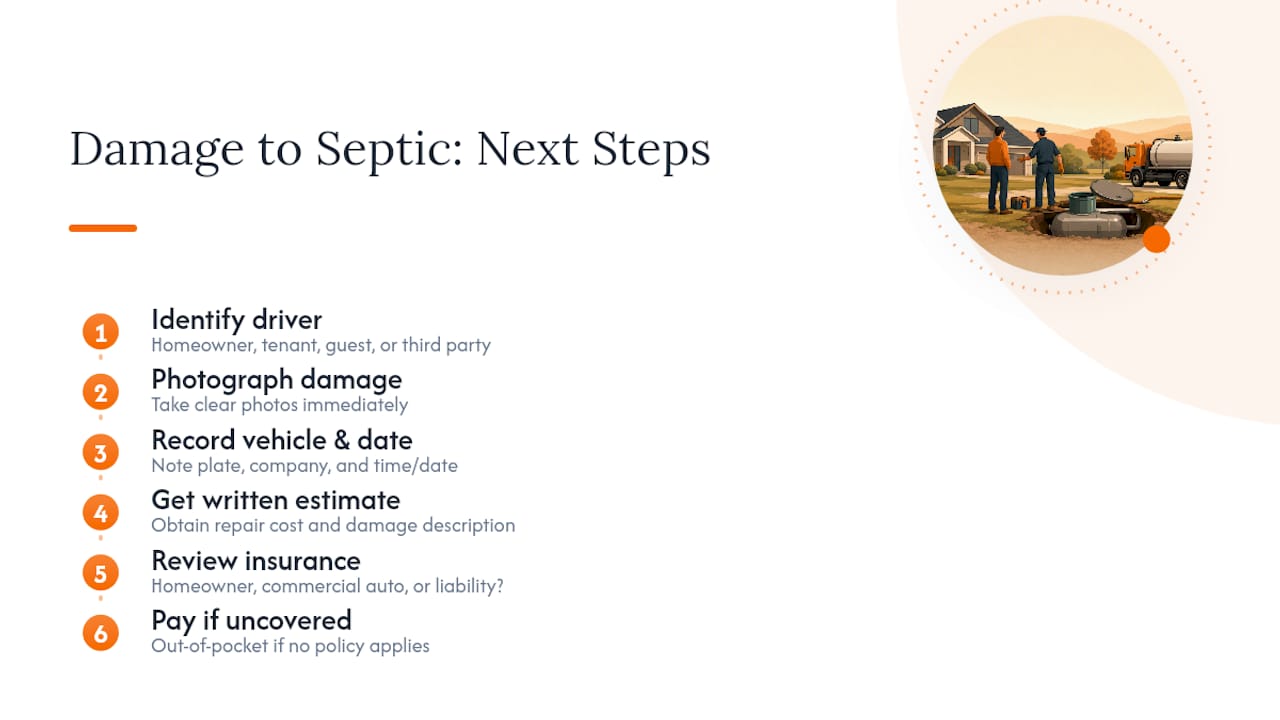
- Document everything before repairs begin. Photograph the site, the vehicle involved, and any visible damage, since this record supports insurance claims or disputes over who’s responsible.
Temporary Protection Methods for Crossing a Septic Area
Sometimes a crossing is genuinely unavoidable. Moving equipment, delivering furniture, or handling a one-time repair might force a vehicle over ground you’d otherwise never drive on. When that happens, load-spreading materials can lower the risk, though they don’t eliminate it.
Double-layered plywood sheets or heavy timber mats spread a wheel’s weight across a wider footprint, which reduces the point pressure that cracks lids and compacts soil. Steel road plates do the same job with more durability but need to be placed carefully so edges don’t dig in and shift under weight. None of these fixes a lid that’s already damaged or reinforces a drainfield’s soil structure long term.
- Lay plywood or mats so they span well past the tank lid or pipe run on both sides, not just directly over it.
- Time the crossing for dry conditions; wet soil erases most of the benefit these materials offer.
- Keep the vehicle load as light as possible and avoid stopping or parking on the covered path.
- Never treat plywood as a permanent fix. It buys you a single safer crossing, not a driveway.
- Skip repeat crossings over the same spot, even with protection, since cumulative compaction still adds up.
Pro Tip: If you find yourself needing “temporary” protection more than once or twice a year, that’s a signal you need an engineered solution, not more plywood. Plywood and mats can prevent an isolated crossing from causing crush damage, but they were never meant to replace a structural fix.
Planning your route matters as much as the materials. If you know a delivery or piece of equipment is coming, walk the property first and pick the path that avoids the tank and field entirely, even if it means a longer route to the driveway. And never park a vehicle over any part of the system, since sustained weight in one spot is worse than a single pass.
Septic Tank Cover Requirements and Access Rules
Many state health codes treat septic access as a legal requirement, not a suggestion, and that’s worth knowing before you assume a buried lid is fine to build or drive over.
Access risers that bring covers up near ground level are commonly required so a pumping truck and inspector can reach the tank without excavation. Massachusetts regulation on septic tank access specifies that covers must be brought within a few inches of finished grade, and similar rules exist in states like New Hampshire, which sets minimum access opening sizes and limits on how far a pumping truck can be from the tank.
- Riser diameters are frequently specified between 20 and 30 inches, depending on tank depth and capacity.
- Lids placed in any area vehicles might cross generally need a wheel-load rating, not just a standard cover.
- Some codes limit how much depth or distance separates the tank from where a service truck parks.
None of these rules are optional extras. If you’re considering installing risers to bring your covers to grade, your local health department or your installer needs to sign off on whether a traffic-rated design is appropriate for your situation. Rules vary enough by state and county that assuming your neighbor’s setup applies to your property is a mistake worth avoiding.
Building a Driveway Over a Septic Tank: When Engineering Makes It Work
Locating a driveway or parking area over a tank isn’t automatically off the table, but it isn’t a weekend project either. It requires a stamped engineering plan, not a homeowner’s best guess.
Vehicle-rated lids and reinforced concrete slabs are the two tools that make this legitimate. A traffic-rated lid is built and certified to a specific wheel-load rating, while a reinforced slab spreads weight across the tank top the way a bridge deck spreads weight across a span. Design guidance for traffic areas over tanks often limits contact to one axle or two wheels over the tank at a time, and specifies minimum concrete strength and increased slab thickness compared to a standard installation.
- Vehicle-rated lids need engineering sign-off matched to expected traffic weight, not a generic upgrade.
- Reinforced slabs require thicker concrete and higher compressive strength than a standard tank lid.
- Plans must be stamped by an engineer and typically require local health department approval before construction.
- Long-term trade-offs include harder access for pumping, more complex repairs, and higher upfront cost.
Homeowners considering this route should treat it as a design decision made once, correctly, rather than a workaround.
Who Pays When a Vehicle Damages a Septic System
Damage from a vehicle crossing usually falls into a gray area between homeowner’s insurance, auto insurance, and out-of-pocket repair, and which one applies depends heavily on who was driving and what caused the damage.
If a homeowner or resident damages their own system, most standard homeowner’s policies treat septic repairs the way they treat other underground utility damage: coverage depends on the specific policy language and whether the cause was sudden and accidental versus gradual wear. A one-time crushed pipe from an unexpected delivery truck is more likely to get sympathetic treatment from an adjuster than years of repeated compaction from a routinely used shortcut across the yard.
If a third party, like a delivery service, contractor, or moving company, damages the system while on your property, their commercial auto or general liability insurance may be responsible, but only if you can show the damage happened on their watch. That’s exactly why documenting the incident with photos, the vehicle’s identifying information, and the date matters so much. Insurers and contractors alike want a paper trail, not a verbal account weeks later.
Property managers face an added layer of liability if a tenant or their guest causes the damage. Lease agreements that specify tenant responsibility for yard hazards, combined with clear signage or marking over known septic locations, can strengthen a landlord’s position if a dispute over repair costs ends up in front of an insurer or, in rarer cases, small claims court.
Get a written estimate and a clear description of the damage from whoever repairs the system. That paperwork is often the difference between a smooth reimbursement and a drawn-out argument with an adjuster.
Real-World Examples of Drive-Over Damage
Field reports across the septic industry describe a fairly consistent pattern: the damage is rarely dramatic in the moment and almost always more expensive than the homeowner expected once it’s diagnosed.
One recurring scenario involves a moving truck or dumpster delivery parked temporarily over what the property owner assumed was solid ground, only for the tank lid to crack under the sustained weight. The result isn’t always visible right away. Weeks later, slow drains or a sewage smell in the yard lead to a camera inspection that reveals a crushed inlet pipe or a hairline-fractured lid slowly letting soil infiltrate the tank. Documented field cases describe exactly this kind of delayed-symptom damage, along with more severe cases where a lid gave way entirely and a wheel dropped partway into the tank.
Drainfield compaction tends to follow a quieter timeline. A homeowner who routinely parks a boat trailer or RV over one corner of the field for a season may not notice anything wrong until the following spring, when that section of yard stays soggy long after the rest of the lawn has dried out. By that point, the fix usually isn’t a quick repair. It’s a partial field replacement, since compacted soil doesn’t loosen back up on its own.
The repair outcomes in both patterns share a lesson: the cost of fixing damage after the fact is almost always higher than the cost of avoiding the crossing in the first place, whether that means a longer driveway route or a one-time investment in a properly rated riser.
What We See in the Field, and When to Call Us
Most drive-over damage we encounter didn’t start as a dramatic accident. It’s usually a delivery truck that parked where it shouldn’t have, or a driveway that quietly drifted into use over a field line nobody marked. By the time a homeowner calls, it’s often a slow drain or soggy patch that’s been building for months.
Routine fixes like riser installs or lid replacement solve most early cases. Compacted drainfields or crushed lines usually mean partial field replacement or excavation. Either way, a prompt look at the site almost always costs less than waiting for the next stage of failure.
— Jason
Get a Septic Inspection Before Small Damage Becomes a Big Repair
If a vehicle has already crossed your tank or drainfield, guessing whether it’s fine is the expensive option. Local septic service providers handle onsite inspections, riser and lid installation, engineered reinforced covers, drainfield repair, and emergency service in various areas of Alamance County and the surrounding Piedmont Triad.

A typical service call starts with a safety check of the affected area, photo documentation of any visible damage, and a written estimate before any digging begins. That’s the same process whether you’re dealing with a cracked lid from a delivery truck or a drainfield that’s been quietly compacting for a season under a parked trailer.
If you’re weighing whether your covers need to be brought to grade or rated for the traffic your property actually sees, our riser installation guide walks through what that upgrade involves. And if you’re already seeing slow drains, soggy ground, or a lid that looks off after a vehicle crossed it, call Jmseptic for an inspection before the damage grows into a full field replacement.
Where to Learn More About Septic Access Rules
For code specifics, review the Massachusetts septic access regulation and Inspectapedia’s drive-over guidance. Always confirm final rules with your local health department.
Sources
- Massachusetts regulation on septic tank access (310 CMR 15.228)
- Michigan Dept. of Environment, Great Lakes, and Energy — tank riser and lid advisory