
Common Sources of Yard Flooding: Alamance County Guide
Discover the common sources of yard flooding in Alamance County. Learn how to identify and fix issues like poor grading and soil absorption.

Yard flooding is defined as the accumulation of standing water on residential property caused by conditions that disrupt natural water flow or soil absorption. The most common sources of yard flooding include improper grading, compacted or clay-heavy soils, overwhelmed gutters and downspouts, low-lying terrain, and failing septic drain fields. Standing water persisting longer than 48 hours after rain signals that your soil has reached its absorption limit. That threshold is the clearest diagnostic standard available to Alamance County homeowners, and it tells you the problem runs deeper than a single heavy storm.
1. Common sources of yard flooding: improper grading
Poor yard grading is the single most frequent cause of backyard water accumulation in residential properties. When the ground around your home slopes toward the foundation instead of away from it, rainwater has nowhere to go except down into your basement or across your lawn in sheets.
Proper grading requires a 6-inch drop over the first 10 feet away from your home’s foundation. Without that slope, water pools against the structure and saturates the surrounding soil. Low spots and natural depressions in the yard compound the problem by acting as collection basins after every rain event.
The fix does not always require a full regrade. Drainage swales, which are shallow channels cut into the yard to redirect water, often solve persistent pooling at a fraction of the cost. Regrading costs range from $500 to $1,500, while ignoring the problem risks foundation damage that can cost tens of thousands to repair.
- Walk your yard during or just after a rainstorm to watch where water flows.
- Look for areas where water sits more than a few hours after rain stops.
- Check that soil near your foundation slopes away, not toward the house.
- Note any low spots that consistently collect water across multiple storms.
Pro Tip: Photograph your yard during a rainstorm from an upstairs window. The water flow patterns you capture will show you exactly where grading problems exist, without any guesswork.
2. Soil compaction and clay-heavy soils
Soil compaction is a leading cause of drainage issues in yards because it physically prevents water from moving downward through the ground. Foot traffic, construction equipment, and natural settling all compress soil particles together, closing off the tiny pores that water needs to pass through.
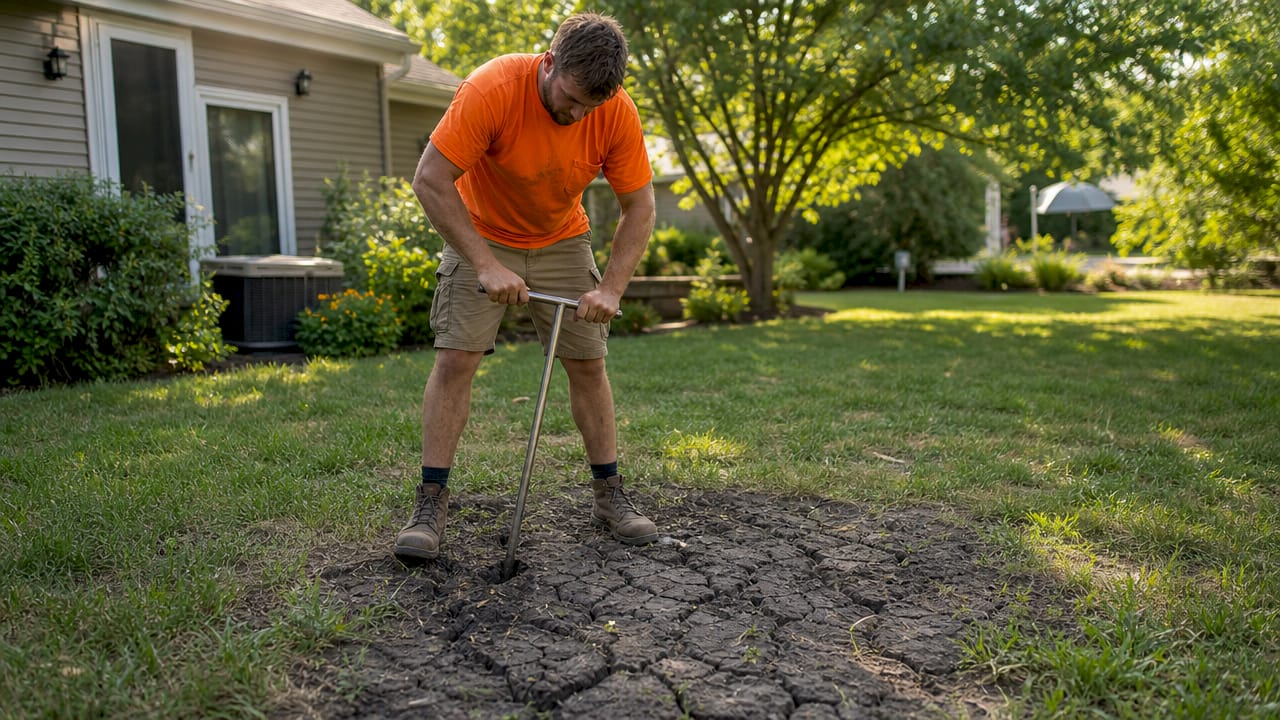
Clay-heavy soil absorbs less than 0.05 inches of water per hour, compared to sandy soil that absorbs 1 to 6 inches per hour. That difference is enormous. Alamance County soils contain significant clay content, which means even moderate rainfall can overwhelm absorption capacity quickly.
You can test your soil compaction at home with a simple screwdriver test. Push a standard screwdriver into the ground with hand pressure alone. If the screwdriver is hard to push in, your soil is compacted and water will sit on the surface rather than drain through it.
- Perform the screwdriver test in multiple yard areas to map compaction zones.
- Aerate compacted areas using a core aerator, which pulls small plugs of soil out of the ground.
- Topdress aerated areas with compost to improve soil structure and water absorption over time.
- Avoid heavy foot traffic on wet soil, which worsens compaction significantly.
- Reseed bare or thin areas after aeration to establish grass roots that naturally loosen soil.
Pro Tip: Rent a core aerator from a local equipment supplier rather than buying one. A single annual aeration session on clay-heavy Alamance County soil makes a measurable difference in how fast your yard drains after rain.
3. Gutters, downspouts, and hardscape features
Downspouts dumping too close to the home create concentrated water flow that overwhelms soil absorption and damages foundations. A single downspout can discharge hundreds of gallons of water in a short storm. When that water hits the ground within two or three feet of your house, the soil cannot absorb it fast enough.
Clogged gutters make the problem worse by causing water to overflow along the entire roofline instead of channeling it to a single exit point. Impervious surfaces like driveways, sidewalks, and patios act as barriers that redirect water toward your lawn or foundation rather than allowing it to soak in naturally.
- Clean gutters at least twice per year, in spring and fall.
- Extend downspouts at least 6 feet from the foundation using flexible extensions.
- Check that patios and driveways slope away from the house, not toward it.
- Consider channel drains along driveway edges to capture runoff before it reaches the lawn.
Hardscape slope is a detail most homeowners overlook when planning patios or walkways. A patio that tilts even slightly toward the house can redirect significant water volume during heavy rain. Consulting a landscaping design professional before installing hardscape prevents costly drainage corrections later.
4. Septic system issues and underground leaks
A failing septic drain field is one of the most misunderstood causes of yard flooding. Most homeowners assume standing water in the yard means a drainage or grading problem. When puddles appear during dry weather with no recent rain, the cause is almost certainly underground.
Puddles during dry weather typically indicate failing septic drain fields, irrigation leaks, or broken underground pipes. These conditions require urgent professional evaluation before the problem spreads to the home’s foundation or contaminates the surrounding soil.
Septic drain field failure causes water to surface in the yard because the field can no longer absorb and treat wastewater at the rate it receives it. The result looks like a drainage problem but is actually a sewage problem. The signs to watch for include wet, spongy ground over the drain field, unusually green or lush grass in one area, and odors near the wet zone.
Jmseptic serves Alamance County homeowners dealing with exactly this situation. A professional inspection can distinguish between a drainage issue and a septic failure before either problem causes serious property damage. Catching drain field failure early prevents the far more expensive outcome of a full system replacement.
5. How does terrain and surrounding runoff influence yard flooding risks?
Your yard does not exist in isolation. Water flows from neighboring lots, rooftops, driveways, and public roads onto your property, and your terrain determines whether that water passes through or stays.
| Runoff Source | Impact on Your Yard |
|---|---|
| Neighboring lot at higher elevation | Directs sheet flow directly onto your property |
| Adjacent driveway or road | Channels concentrated runoff along property edge |
| Your own roof via downspouts | Deposits high-volume water near foundation |
| Uphill lawn areas | Saturates lower yard zones before rain even stops |
Low-lying terrain amplifies every one of these inputs. If your yard sits at the bottom of a natural drainage basin, you receive runoff from every property uphill from yours. A continuous 2% slope is often enough to move water through your yard without pooling, but only if that slope has a clear outlet. A blocked outlet turns even a well-graded yard into a pond.
Interception and diversion strategies address outside runoff without requiring you to regrade your entire property. A French drain installed along the uphill property line captures incoming water and routes it around your yard. A drainage swale performs the same function at lower cost. The standing water guide from Jmseptic covers these options in detail for Alamance County conditions.
6. Repeated water accumulation in the same spot
Water accumulating repeatedly in the same yard area indicates a localized drainage system failure, not a random weather event. That pattern tells you the ground in that zone cannot move water fast enough, and the fix needs to be targeted to that specific location.
Yellowing grass in consistently wet areas signals root suffocation from oversaturation. Grass roots need oxygen, and waterlogged soil pushes all the air out of the root zone. The lawn damage you see is a symptom of the drainage failure underneath.
French drains and drainage swales are the two most effective targeted solutions for repeat flooding zones. A French drain is a gravel-filled trench with a perforated pipe that collects subsurface water and routes it to a safe outlet. A swale is a shallow surface channel that intercepts and redirects surface water. Both work best when installed with a clear outlet point, such as a storm drain, dry creek bed, or low area away from structures.
The Alamance County septic workflow guide from Jmseptic outlines how to sequence these fixes when both drainage and septic issues are present on the same property.
Key Takeaways
Yard flooding in Alamance County results from a combination of grading, soil type, hardscape design, and septic system health, and fixing it requires addressing the correct root cause first.
| Point | Details |
|---|---|
| Standing water beyond 48 hours | Signals soil absorption failure, not just heavy rain. |
| Grading is the first fix to check | A 6-inch drop over 10 feet prevents most foundation-area pooling. |
| Clay soil limits absorption sharply | Alamance County clay absorbs far less water per hour than sandy soil. |
| Dry-weather puddles mean septic trouble | Call a professional immediately if water appears without recent rain. |
| Targeted fixes beat full regrading | French drains and swales solve repeat flooding zones at lower cost. |
What I’ve learned diagnosing yard flooding in Alamance County
Most homeowners I talk to have already spent money on the wrong fix. They filled in a low spot, added topsoil, or extended one downspout, and the yard still floods. The reason is almost always the same: they treated the puddle as the problem instead of tracing it back to the source.
Puddles are symptoms. The real cause is usually a combination of soil type, slope continuity, and water volume coming from outside the property. Alamance County’s clay-heavy soils make this worse than it would be in sandier regions, because the ground simply cannot absorb water fast enough even when the grading is correct.
The mistake I see most often is homeowners skipping the diagnosis and going straight to an expensive fix. Regrading a yard that actually has a septic drain field problem wastes money and leaves the real issue untouched. Before spending anything significant, walk your yard during a rainstorm, do the screwdriver test in multiple spots, and check whether any wet areas appear during dry weather. Those three steps will tell you more than any estimate from a contractor who hasn’t looked at your specific yard.
Local expertise matters here. Alamance County’s terrain, soil composition, and typical rainfall patterns are specific enough that generic drainage advice often misses the mark. Work with someone who knows the area and can read your yard as a system, not just a collection of isolated wet spots.
— Jason
Jmseptic’s yard flooding and septic solutions for Alamance County
Persistent yard flooding tied to septic issues needs a local expert who understands Alamance County soil conditions and drainage patterns.

Jmseptic, based in Mebane, provides septic installation, repair, and maintenance across Burlington, Graham, Elon, Whitsett, and the surrounding Piedmont Triad area. If your yard shows wet spots during dry weather, slow drains, or strong odors near the lawn, those are signs your septic system needs attention before the damage spreads. The team at Jmseptic handles everything from emergency septic repairs to full septic system installations designed for your property’s specific conditions. Call Jmseptic before a manageable repair becomes a costly replacement.
FAQ
What causes standing water to last more than 48 hours?
Standing water persisting beyond 48 hours indicates that soil has reached its absorption limit, usually due to compaction, clay-heavy soil, or a high water table. This threshold is the standard diagnostic marker for a drainage problem that requires active intervention.
How do I know if my septic system is causing yard flooding?
Puddles appearing during dry weather with no recent rain are the clearest sign of a failing septic drain field or underground leak. Contact a septic professional immediately, as this condition can contaminate soil and worsen quickly.
What is the correct grading slope around a home?
The standard is a 6-inch drop over the first 10 feet away from the foundation. This slope directs water away from the structure and prevents soil saturation near the home’s base.
Can gutters and downspouts really flood a yard?
Yes. Downspouts that discharge within two to three feet of the foundation concentrate large volumes of roof runoff in a small area, overwhelming soil absorption. Extending downspouts at least 6 feet from the house is one of the lowest-cost fixes available.
What is the screwdriver test for soil compaction?
Push a standard screwdriver into the soil using only hand pressure. If it resists penetration, the soil is compacted and water will pool on the surface rather than drain through. Core aeration corrects this condition and improves drainage over time.