
Avoid a Five Figure Repair: Clay Soil Septic Solutions for Homeowners
Avoid a five figure repair. See which engineered systems suit clay and what perc tests and licensed installers must document before installation.

Engineered alternatives, mainly mound systems or pressurized/drip distribution paired with an aerobic treatment unit, are the reliable path forward on clay soil. Which one fits your property depends entirely on a licensed site evaluation and perc test, not on guesswork or what your neighbor installed. Skip that step and you’re gambling with a five-figure system.
TL;DR:
- Perc tests exceeding 30 minutes per inch generally rule out conventional drain fields, making engineered solutions like mound or pressurized systems necessary.
- Site evaluation, including soil layering, water table depth, and setbacks, is crucial to determine the most suitable septic system for clay soil; skipping this increases failure risk.
- Engineered systems on clay, such as mound or aerobic treatment units, require regular maintenance, more detailed installation processes, and higher costs than traditional systems.
- Proper installation depends on site-specific data, with experienced contractors performing test pits and soil assessments before designing or quoting any system.
- Blending sand into clay soil at small scales can worsen drainage problems, making professional evaluation and tailored solutions essential.
Table of Contents
- Why Clay Soil Causes Septic System Problems
- Engineered Septic Solutions That Work On Clay Soil
- What Do Perc Tests And Site Evaluations Actually Determine?
- Maintenance, Lifespan, And Cost Expectations On Clay Sites
- What A Reputable Installer Actually Does On A Clay Site
- Jason’s Field Perspective: Practical Do’s And Don’ts For Homeowners
- How J&M Septic Can Help With Clay Soil Right Now
- Sources
Why Clay Soil Causes Septic System Problems
Clay particles pack so tightly that water barely moves between them. A slow percolation rate typically signals trouble for a conventional gravity system, and many clay sites test far slower than that. Wastewater sits in the drainfield trench instead of dispersing, and that standing moisture builds a layer of bacterial slime called biomat along the trench walls. Once biomat forms in saturated clay, it rarely clears on its own. It thickens, chokes off what little absorption capacity existed, and the field fails from the inside out.
Clay adds a second complication: it swells when wet and shrinks when dry. That movement stresses pipes, disturbs distribution boxes, and can crack components that a stable soil would never touch.
A few site conditions make this worse:
- Shallow groundwater or a hardpan layer just below the surface, leaving no room for effluent to move downward
- Compacted subsoil from grading or construction equipment
- Seasonal high water tables that shrink usable soil depth for months at a time
The EPA’s overview of septic system types confirms that alternative dispersal and pretreatment methods become standard once native soil can’t accept a conventional drain field. That’s exactly the situation most clay-heavy lots present.
Engineered Septic Solutions That Work On Clay Soil
Once conventional gravity fields are off the table, a handful of engineered designs pick up the slack. Each one solves the clay problem differently, and each comes with its own footprint, cost, and upkeep.
Mound systems build an elevated bed of imported sand on top of the natural soil, giving effluent a filtering layer it can actually pass through before it reaches the ground below. They work well where the water table sits high or the topsoil layer is thin. However, they take up visible yard space and need enough elevation change or lot size to make the mound practical.
Pressurized drip dispersal feeds effluent through a network of small tubing in shallow, evenly spaced doses across a wide area instead of dumping it into one trench. The footprint is smaller and less visible than a mound, but drip systems demand pretreatment before dispersal and a pump that needs periodic servicing.
Aerobic treatment units (ATUs) inject oxygen into the treatment process, which breaks down solids more thoroughly than a standard septic tank. That higher-quality effluent lets the system discharge to a smaller or less permeable drain field than a conventional design would allow, according to Oklahoma State Extension. The trade-off is a mechanical system with electrical components that needs regular inspection.
Sand filters, constructed wetlands, and peat systems offer another pretreatment route, effectively pre-cleaning effluent before it ever touches the clay. They’re practical where lot size allows the extra footprint these systems need.
Pressure-dosed distribution doesn’t pretreat effluent, but it doses the field in controlled intervals rather than one continuous flow, giving each zone time to rest and drain between doses. That resting period is what keeps clay from saturating in one spot.
Surface discharge or spray systems exist as a last resort where no subsurface option works at all. They require intensive disinfection and are tightly regulated, often restricted by lot size and setback rules that many residential properties simply can’t meet.
Pro Tip: Don’t assume mixing sand into your yard’s clay will fix drainage on its own. University of Illinois Extension research found that blending sand into clay at small scale can backfire, sometimes creating a texture closer to concrete than improved soil.
For homeowners weighing options beyond a traditional leach field, it helps to understand the full range of septic systems without leach fields before committing to a design.
What Do Perc Tests And Site Evaluations Actually Determine?
A perc test measures how fast water drops in a test hole, usually reported in minutes per inch. Rates beyond roughly 30 minutes per inch generally rule out a conventional field and push the design toward one of the engineered options above. Beyond that number, a full evaluation looks at several things at once, and each one narrows your choices further:
- Test pits dug across the proposed site reveal soil layering, texture, and where clay bands sit relative to the surface.
- Depth to seasonal high water table determines how much vertical separation a system needs, which often decides between a mound and an in-ground design.
- Setback distances from wells, property lines, streams, and structures can eliminate certain layouts before design even starts.
- A licensed wastewater engineer reviews the data and drafts a design that the county health department must approve before installation begins.
Understanding your soil conditions before you hire anyone puts you in a much stronger position to evaluate the design an engineer hands you.
Maintenance, Lifespan, And Cost Expectations On Clay Sites
Engineered systems on clay need closer attention than a conventional field on sandy loam ever would. Because clay leaves so little margin for error, solids that would cause minor issues elsewhere can trigger full drainfield failure here.
Professional guidance from NC State Extension recommends pumping the tank at least every 3 years for systems in challenging soils, with annual inspections to catch drainfield saturation or component wear early. Systems with pumps or ATUs often need more frequent checks since mechanical parts fail differently than gravity components.
Cost drivers vary by design, but three factors show up again and again, per Home Septic Solutions:
- Imported fill and sand for mound construction
- Pumps, blowers, and electrical components for ATUs and drip systems
- Engineering and permitting fees tied to site complexity
Keep a written maintenance record. It protects your warranty, speeds up future service calls, and gives you leverage if a system underperforms. Our guide on how often to pump your septic tank breaks down cadence by system type.
What A Reputable Installer Actually Does On A Clay Site
A contractor who knows clay starts with a real site walk, not a drive by. That means digging test pits, pulling perc data, and documenting the soil profile layer by layer before recommending anything.
From there, a solid installer will:
- Specify imported fill and distribution method in writing, with setbacks documented against your survey
- Time excavation and installation around soil moisture to avoid compacting wet clay further
- Use erosion control measures during grading, since disturbed clay washes and shifts easily
- Hand off a maintenance schedule, control panel instructions, and inspection reports at project close
Pro Tip: Ask any bidding contractor to walk you through their test pit data before they hand you a design. If they can’t show you the numbers behind the recommendation, that’s a red flag worth taking seriously.
Jason’s Field Perspective: Practical Do’s And Don’ts For Homeowners
Testing before design, not after, saves the most money on clay lots. I’ve seen homeowners skip the perc test to save a few hundred dollars, then pay thousands more when the wrong system gets installed and fails within a couple of seasons.
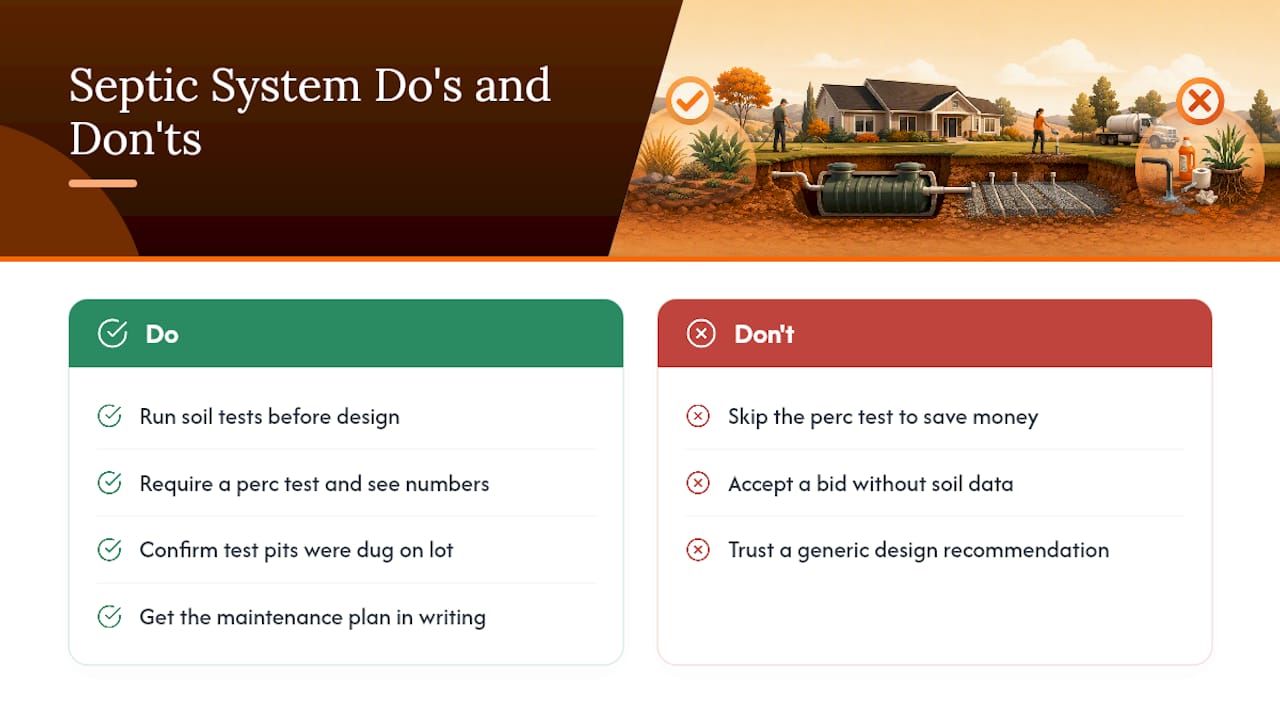
Watch for bids that quote a price before any soil data exists. That’s a guess, not an estimate. A trustworthy bid references your actual test pit results and explains why a specific design fits your soil, not a generic recommendation copied from the last job.
Before hiring anyone: confirm they’ve dug test pits on your lot, ask to see the perc numbers, and get the maintenance plan in writing before signing anything.
— Jason
How J&M Septic Can Help With Clay Soil Right Now
Clay doesn’t have to mean a failed drainfield and a repeat repair bill. Professional septic service providers handle the full sequence that clay sites demand: licensed site evaluation, perc testing, engineered design for mound or pressurized systems, and installation that accounts for how clay behaves during excavation and backfill, as explained in the Austin ETJ Water Capacity Small Development Financing Guide. Unlike a general contractor guessing at a one-size design, installations should be based on what your soil test actually shows.

Before you call for a quote, have your lot survey, any existing perc or soil test results, and access points to your yard ready. That speeds up the evaluation and gets you a real design faster instead of a placeholder estimate. If you’re planning new construction on a clay lot in Alamance County or the surrounding Piedmont Triad, start with our septic systems for new construction guide to see what the process looks like from evaluation to final inspection, then reach out to schedule your site visit.
Sources
- Septic systems and their maintenance — NC State Extension
- Aerobic treatment system — Oklahoma State Extension
- Best Septic System for Clay Soil — Home Septic Solutions