
Best Laundry Detergent for Septic: Shortlist + How to Use It
Discover the best laundry detergent for septic systems. Our top picks are gentle on your system and help maintain beneficial bacteria. Switch today!

The best laundry detergent for a septic system is a low-dose, liquid, phosphate-free formula with biodegradable surfactants. Tonight, switch to one of these widely available options and cut your dose to less than the bottle recommends:
- Seventh Generation Free & Clear — plant-based surfactants, often carries EPA Safer Choice signals
- ECOS (Earth Friendly) Free and Clear Liquid — Safer Choice-certified, plant-derived, widely stocked
- Charlie’s Soap Laundry Detergent — highly concentrated; a fraction of a dose goes a long way
- Arm & Hammer Sensitive Skin Free & Clear — phosphate-free, easy to find at any big-box store
- Dr. Bronner’s Sal Suds — short ingredient list, biodegradable surfactants, multi-use
- Planet Ultra Liquid — low-sudsing, HE-compatible, gentle on tank biology
Why these? Liquid detergents break down faster than most powders, and non-antibacterial, low-surfactant formulas leave the beneficial bacteria in your tank intact. The EPA SepticSmart program specifically recommends phosphate-free, low-sudsing products. The single most important action: use less than half of the manufacturer’s recommended dose and spread loads across the week rather than stacking them on one day.
Table of Contents
- Which detergents are best for septic systems?
- How do you choose a detergent that won’t harm your septic system?
- Daily laundry habits that protect your septic system
- Why “septic safe” on the label isn’t an official guarantee
- Key Takeaways
- A septic pro’s perspective: routine beats the perfect bottle
- Your septic system needs more than the right detergent
- Authoritative sources and further reading
Which detergents are best for septic systems?
EPA Safer Choice-certified and plant-based detergents consistently top septic-aware recommendation lists. The table below covers the core dimensions that matter for your tank.
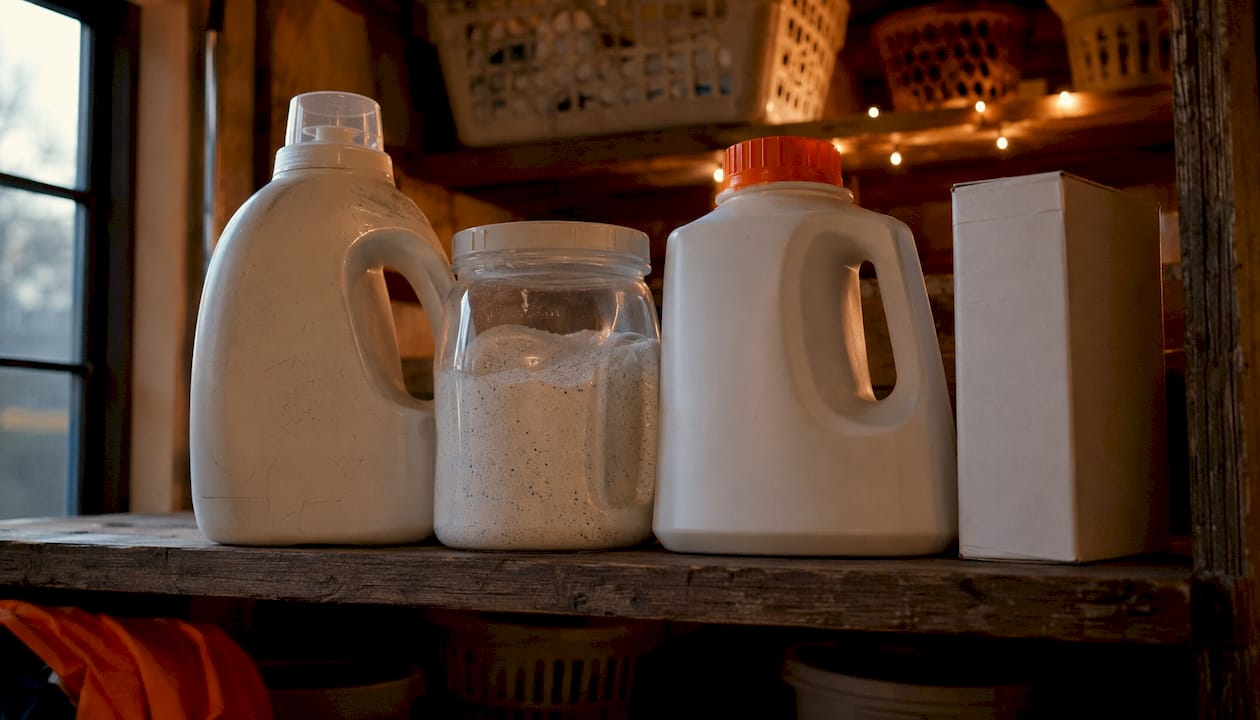
| Product | Form | Low-sudsing / HE | Phosphate-free | No antibacterial/bleach | Biodegradable surfactants | Dosing note | Best for |
|---|---|---|---|---|---|---|---|
| Seventh Generation Free & Clear | Liquid | Yes | Yes | Yes | Yes | Use a reduced dose | Eco-certified liquid |
| ECOS Free and Clear Liquid | Liquid | Yes | Yes | Yes | Yes | Use a reduced dose | Eco-conscious buyers |
| Charlie’s Soap Laundry Detergent | Powder/Liquid | Yes | Yes | Yes | Yes | 1 tbsp per load | Low-filler, concentrated |
| Arm & Hammer Sensitive Skin Free & Clear | Liquid | Yes | Yes | Yes | Partially | Use a reduced dose | Budget, retail availability |
| Dr. Bronner’s Sal Suds | Liquid | Yes | Yes | Yes | Yes | Small amount | Multi-use households |
| Molly’s Suds Original Laundry Powder | Powder | Yes | Yes | Yes | Yes | 1–2 tbsp | Low-filler powder |
| Biokleen Laundry Powder | Powder | Yes | Yes | Yes | Yes | Use a reduced dose | Cleaner powder option |
| Ecover Laundry Products | Liquid/Powder | Yes | Yes | Yes | Yes | Per label, halved | Multiple formats |
| Planet Ultra Liquid | Liquid | Yes | Yes | Yes | Yes | Use a reduced dose | Sensitive skin |
| Earth Breeze Laundry Detergent Sheets | Sheets | Yes | Yes | Yes | Varies | 1 sheet | Low-waste packaging |
| Mrs. Meyers Laundry Detergent | Liquid | Yes | Yes | Yes (choose Free & Clear) | Yes | Use a reduced dose | Mainstream grocery |
| Country Save Laundry Products | Powder | Yes | Yes | Yes | Yes | Small dose | Budget powder |
| Mountain Green Ultra Laundry Liquid | Liquid | Yes | Yes | Yes | Yes | Use a reduced dose | Concentrated liquid |
| Equator | Liquid | Yes | Yes | Yes | Yes | Per label, halved | Fragrance-free option |
| Amway S-A-8 | Powder/Liquid | Yes | Yes | Yes | Yes | Small dose | Concentrated formula |
Quick notes by product:
- Seventh Generation Free & Clear and ECOS are the two most consistently recommended liquids across septic-aware sources. Both carry EPA Safer Choice signals and are stocked at Target, Walmart, and Amazon.
- Charlie’s Soap (powder or liquid) is the standout for concentration: one tablespoon per load is the standard guidance, which means almost no filler reaches your drain field. Low-sudsing powders like Charlie’s and Molly’s Suds are acceptable exceptions to the liquid-first rule when dosed correctly.
- Arm & Hammer Sensitive Skin Free & Clear is the easiest budget pick. Phosphate-free and available everywhere, though the surfactant blend is partially synthetic — still a solid choice at half dose.
- Earth Breeze Sheets reduce packaging waste, but surfactant chemistry varies by batch. Read the ingredient list before buying.
- Mrs. Meyers: choose the Free & Clear or fragrance-free variant. The scented lines add fragrance compounds that can stress tank biology over time.
- Fresh Start and Amway S-A-8 are marketed with minimal additives; review labels for optical brighteners and quats before purchasing.
Three quick picks by priority:
- Budget: Arm & Hammer Sensitive Skin Free & Clear or Country Save powder at half dose
- Sensitive skin: Planet Ultra Liquid or Seventh Generation Free & Clear
- Minimal chemistry: Charlie’s Soap or Dr. Bronner’s Sal Suds
Pro Tip: Even the best septic-safe detergent will stress your system if you run six loads back to back. Dose and pacing matter more than the brand on the bottle.
How do you choose a detergent that won’t harm your septic system?
Read the label before you buy. These are the signals that actually matter.
Ingredient checklist:
- Phosphate-free — phosphates disrupt drain field soil chemistry and are banned in most U.S. states for laundry use, but verify anyway.
- No chlorine bleach — chlorine kills the anaerobic bacteria your tank depends on.
- No antibacterial claims — any product labeled “antibacterial” contains actives (triclosan, benzalkonium chloride) that harm tank biology.
- Biodegradable surfactants — anionic and plant-derived nonionic surfactants biodegrade faster under anaerobic tank conditions than synthetic antibacterial actives.
- Low or no optical brighteners — these synthetic compounds accumulate and can persist in the drain field.
- Low fragrance — heavy fragrance packages often include fixatives and synthetic musks that don’t break down quickly.
Form: liquid vs. powder vs. sheets vs. pods
Liquid is the default recommendation. Some powders contain clay or sodium-based fillers that don’t fully dissolve and add to tank sludge over time. The exceptions are concentrated, low-filler powders like Charlie’s Soap and Molly’s Suds, which work fine at small doses. Sheets are convenient but check the surfactant list. Pods are the riskiest format because they often pack concentrated boosters, brighteners, and fragrances into a single packet — the chemical load per wash can be high even though the physical size is small.
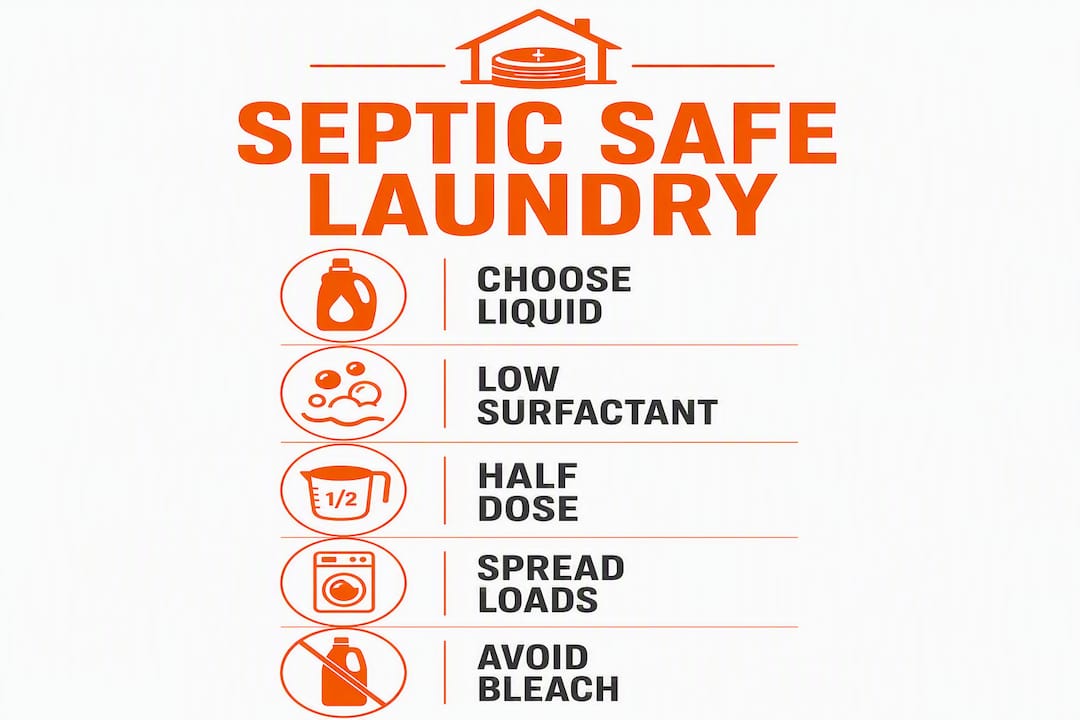
Dosing guidance:
| Washer type | Manufacturer dose | Recommended for septic |
|---|---|---|
| Standard top-loader | Full cap | 1/2 to 1/3 of cap |
| HE front-loader | HE line on cap | 1/2 of HE line |
| Concentrated formula | Per label | 1 tsp to 1 tbsp |
The EPA recommends using 1/2 to 1/3 of the manufacturer’s dose for homes on septic systems. Most detergents are formulated for municipal water systems where excess surfactant gets treated downstream. Your tank has no such buffer.
Dos and don’ts:
- Do choose HE-labeled detergents even if you don’t own an HE machine — they use less surfactant per load.
- Do check for “free and clear” or “fragrance-free” variants of mainstream brands.
- Don’t use liquid fabric softeners. They contain quats (quaternary ammonium compounds) that are toxic to septic bacteria.
- Don’t add scent boosters or laundry pods as supplements to a regular detergent wash.
- Don’t assume “natural” means septic-safe — some natural formulas still contain antibacterial essential oils.
Daily laundry habits that protect your septic system
The brand you buy matters less than how you do laundry. Here’s what actually moves the needle.
Pace your loads. OSU Extension guidance recommends no more than two loads per day on a standard washer and up to three for HE machines. Running five loads on Saturday floods your drain field with water before bacteria can process the waste. Spread laundry across Monday, Wednesday, and Friday instead.
Run full loads, not overloaded ones. A half-empty washer uses nearly as much water as a full one, sending diluted but still-chemical-laden water to the tank more often. Fill the drum to capacity without packing it.
Choose the right cycle. Normal and eco cycles use less water than heavy-duty or extra-rinse settings. Reserve the heavy cycle for genuinely soiled items, not routine loads.
Avoid these additives entirely:
- Chlorine bleach (kills tank bacteria fast)
- Liquid fabric softeners (quats persist in the tank)
- Scent boosters and in-wash fragrance packets
- Antibacterial detergent boosters
Wool dryer balls replace fabric softener for static and softness with zero chemical impact on your system. Oxygen bleach (sodium percarbonate) is a safer alternative to chlorine bleach when you need whitening power, used sparingly.
Septic pros consistently find that routine and dosing matter more than chasing the perfect detergent. Spreading loads, cutting the dose, and dropping fabric softener will do more for your system’s long-term health than switching brands every few months. The behavioral change is the highest ROI move a homeowner can make.
Pro Tip: If you notice slow drains, gurgling pipes, soggy patches in your yard, or sewage odors after a heavy laundry week, stop running loads and check for signs of system stress before the problem compounds. These are the signals that warrant a professional inspection, not a new detergent.
Why “septic safe” on the label isn’t an official guarantee
“Septic safe” is not a regulated term. Any manufacturer can print it on a bottle without independent testing or government verification. It is marketing language, not a certification.
What to look for instead:
- EPA Safer Choice certification — the EPA evaluates each ingredient for safety to human health and the environment. It is not a “septic” certification specifically, but it screens out the most harmful surfactants and additives. Products like Seventh Generation Free & Clear and ECOS carry this designation.
- Short, readable ingredient lists — if you can’t identify most of the ingredients, that’s a flag.
- University extension recommendations — OSU Extension and University of Minnesota Extension both publish guidance on laundry products and septic systems, based on field and lab evidence rather than marketing.
- Guidance from your septic professional — a technician who services your county’s systems has seen what products cause problems locally.
Why certain chemicals damage your tank:
Chlorine bleach and antibacterial actives (triclosan, quats) kill the anaerobic bacteria that break down solids in the tank. Without those bacteria, solids accumulate faster, sludge builds up, and the drain field gets overloaded with partially treated waste. Phosphates, meanwhile, disrupt soil chemistry in the drain field itself, reducing its ability to filter effluent. The damage is cumulative: one bleach load won’t kill your system, but a steady diet of antibacterial products will shorten its life.
The practical screening approach: pick an EPA Safer Choice or plant-based detergent, cut the dose to half, and eliminate liquid fabric softeners. That combination reliably reduces risk to tank biology without requiring you to memorize a chemistry textbook.
Key Takeaways
Choosing a septic-safe detergent matters, but using it correctly — at half dose, spread across the week, without fabric softeners — protects your system more than any single brand switch.
| Point | Details |
|---|---|
| Use liquid, low-dose, phosphate-free | Seventh Generation, ECOS, Charlie’s Soap, and Arm & Hammer Sensitive Skin Free & Clear are the top U.S.-available picks. |
| Cut your dose significantly | EPA guidance recommends using half to one-third of the manufacturer’s dose on septic systems. |
| Pace loads across the week | Limit the number of loads per day on standard washers to prevent hydraulic overload of the drain field. |
| Drop liquid fabric softeners | Quats in fabric softeners are toxic to septic bacteria; switch to wool dryer balls instead. |
| Jmseptic for system issues | If you see slow drains, odors, or soggy yard patches, contact Jmseptic in Alamance County for inspection and repair. |
A septic pro’s perspective: routine beats the perfect bottle
Most homeowners spend time comparing detergent labels when the bigger problem is sitting right next to the washer: a full bottle of liquid fabric softener and a habit of doing all the laundry on Sunday.
What technicians see in the field is rarely a single catastrophic product choice. It’s the accumulation of small habits: overdosing detergent for years, adding a scent booster to every load, running eight loads on one day because the week got busy. Those patterns stress the bacterial population in the tank and, over time, push solids into the drain field before they’re adequately broken down. That’s when you get the soggy lawn, the slow drains, the odor. By then, the fix is a pump-out or a hydro-jetting service call, not a new detergent.
The honest advice: pick any of the liquids on the shortlist above, use less than the label says, and spread your laundry across the week. That triple-play — right product, right dose, right pacing — is what actually extends system life. Switching from Tide to Seventh Generation while still running six loads on Saturday and pouring in fabric softener changes almost nothing.
Small, sustained changes to how you do laundry reduce service calls more reliably than any single product upgrade. The homeowners who call least often aren’t the ones with the fanciest detergent. They’re the ones who treat the system like the living infrastructure it is.
Your septic system needs more than the right detergent
Even the best laundry routine can’t fix a system that’s already stressed. If you’re seeing slow drains, standing water near the drain field, gurgling pipes, or sewage odors inside the house, those are signs your system needs a professional look, not a different bottle of detergent.

Jmseptic serves homeowners across Alamance County and the Piedmont Triad area, including Burlington, Mebane, Graham, Elon, Whitsett, and McLeansville. The team handles septic inspections, tank pumping, hydro jetting, line clearing, and full system repairs. If you’re not sure what’s going on with your system, a diagnostic visit is the fastest way to find out before a manageable problem becomes a costly one. Schedule an inspection or call for emergency service — Jmseptic handles both.
Authoritative sources and further reading
- EPA SepticSmart Program — federal guidance on septic-safe products, dosing, and laundry habits
- EPA Safer Choice — ingredient-level certification program for safer household products
- OSU Extension: Safe laundry detergent for septic tanks — university extension guidance on form, fillers, and load pacing
- University of Minnesota Extension — guidance on fabric softeners, quats, and septic bacteria
- Decentralized Wastewater Resource: Is “Septic Safe” Really Safe? — explanation of unregulated “septic safe” labeling
- Jmseptic: Washing machines and septic tanks — local guidance on laundry habits and system protection
- Jmseptic: How to prevent septic failure — maintenance strategies for Alamance County homeowners
- Jmseptic: Eco-friendly septic solutions — broader context on environmentally conscious septic practices