
Above Ground Septic Systems: When Buried Fields Fail
Explore above ground septic systems as effective solutions when traditional buried fields fail, ensuring your property remains compliant and functional.

Above ground septic systems are engineered alternatives to buried drainfields, built for properties where a conventional system simply will not work. When the water table sits too close to the surface, bedrock cuts off the soil too early, or the soil itself drains too fast or too slow, a mound, sand filter, aerobic treatment unit, or holding tank steps in to do what a standard trench field cannot.
The main types you’ll encounter on a bid or a permit application are mounds, recirculating sand filters, at-grade systems, pressure-dosed drip fields, gravelless chamber systems, aerobic treatment units (ATUs), and holding tanks. Most of these are permanent, code-approved solutions. A few, like portable holding tanks, are stopgaps.
Before you spend money on any of them, get a licensed site evaluation and soil profile. That single document determines which system is even legal on your lot, and it will save you from paying twice.
Three quick signs you’re a candidate for an above-grade system:
- Your property has a high seasonal water table or standing groundwater within a few feet of the surface.
- Bedrock, hardpan, or shallow soil depth rules out a buried trench field.
- A percolation test comes back too slow (dense clay) or too fast (gravel, fractured rock) for a conventional design.
The EPA’s overview of septic system types confirms mounds and sand filters are accepted engineered alternatives for exactly these conditions, and tank manufacturers build to standards like ASTM C1227, which governs septic tank labeling, capacity, and structural requirements. Jmseptic, working across Alamance County and the Piedmont Triad, evaluates these site conditions daily and can tell you within one visit whether your lot needs a mound, an ATU, or something simpler.
Key Takeaways
Above ground septic systems solve sites where buried drainfields fail, but only a licensed soil evaluation and correctly sized, well-maintained components make them work long term.
| Point | Details |
|---|---|
| Confirm you need one | High water table, shallow bedrock, or poor percolation are the main reasons to consider a mound, sand filter, or ATU. |
| Get the site evaluation first | A soil profile and percolation test determine which system is legal before you compare any contractor bids. |
| Budget for higher upfront cost | Mounds and ATUs typically run $8,000 to $20,000-plus, against a real environmental payoff on sites conventional fields can’t serve. |
| Plan for ongoing maintenance | Pumps, filters, and ATU service contracts need attention on a fixed schedule, not just when something breaks. |
| Work with an experienced local installer | Jmseptic evaluates sites and builds mound, ATU, and holding tank systems across Alamance County and the Piedmont Triad. |
Table of Contents
- What Are the Main Types of Above Ground Septic Systems?
- How Do Above Ground Septic Systems Actually Work?
- Which Properties Actually Need an Above Ground System?
- Weighing the Advantages and Drawbacks
- What Does an Above Ground Septic System Cost, and How Long Does It Take?
- Do You Need a Permit for an Above Ground Septic System?
- What Happens During Installation, Step by Step?
- How Often Do These Systems Need Maintenance?
- How Do You Choose a Contractor for This Kind of Job?
- Why Vertical Separation Distance Determines Your Options
- Protecting Groundwater and Nearby Wells
- Troubleshooting the Problems Unique to Above-Grade Systems
- How Long Do These Systems Actually Last?
- Let Jmseptic Handle the Site Assessment and the Build
- Where to Verify Regulations and Technical Guidance
- Frequently Asked Questions
- Sources
What Are the Main Types of Above Ground Septic Systems?
Every above-grade system solves the same problem (getting effluent treated without burying it in bad soil) but each does it a different way. Here’s what you’ll actually see quoted.
- Mound systems. A septic tank feeds a pump chamber, which doses effluent under pressure into a bed of imported sand built up above natural grade, then distributes it through perforated pipe to the surrounding soil. This is the workhorse solution for shallow soil over bedrock or high groundwater.
- Recirculating sand filters. Effluent gets pumped repeatedly through a sand or synthetic media bed before discharge, providing a higher level of treatment than a single pass, often used where nearby wells or surface water need extra protection.
- At-grade systems. Similar to a mound but built with a shallower profile, using fabric and gravel or chambers directly on the natural soil surface instead of a tall raised bed. These fit smaller lots better than a full mound.
- Pressure-dosed / drip distribution systems. Effluent is metered out through small-diameter drip tubing across a wide, shallow area, which works well on sloped or irregular lots where a mound would look out of place.
- Gravelless chamber systems. Plastic chambers replace the gravel trenches of a conventional field; some designs get built partially above grade when soil depth is marginal.
- Aerobic treatment units (ATUs). These inject oxygen into the treatment tank to accelerate bacterial breakdown, producing cleaner effluent before it reaches the soil, and they require a service contract most homeowners don’t expect at purchase time.
- Holding tanks. A sealed, surface-mounted or partially buried tank stores raw sewage with no treatment or dispersal at all. It has to be pumped out regularly by a licensed hauler.
Mounds, sand filters, at-grade systems, and ATUs are typically permanent, permitted installations meant to last decades. Holding tanks are the exception. The TAMU On-Site Sewage Facility program treats them as a last resort for permafrost, extremely shallow bedrock, or sites where no other option is legally permitted, precisely because they require pumping every two to six weeks for a full-time home.
If you’re shopping for tanks or a temporary holding solution, you’ll come across manufacturer names like PolyJohn, Quadel Industries, Ace Roto-Mold, and Norwesco. These companies make polyethylene and roto-molded tanks used in septic and portable sanitation applications, and seeing their names on a spec sheet doesn’t mean one brand outperforms another. It just means the tank meets a recognized manufacturing standard. Your installer should be able to tell you which tank spec matches your permit requirements.
How Do Above Ground Septic Systems Actually Work?
The short version: tank, then pump, then sand or media, then native soil. Every above-grade system follows this basic treatment sequence, even though the hardware looks different from one job to the next.
Wastewater leaves the house and settles first in the septic tank, where solids drop out and grease floats to the top. From there, an effluent filter (typically built to ANSI/NSF Standard 46) screens out remaining solids before liquid moves downstream. Skipping or ignoring that filter is one of the fastest ways to clog a pump or a mound’s distribution piping.
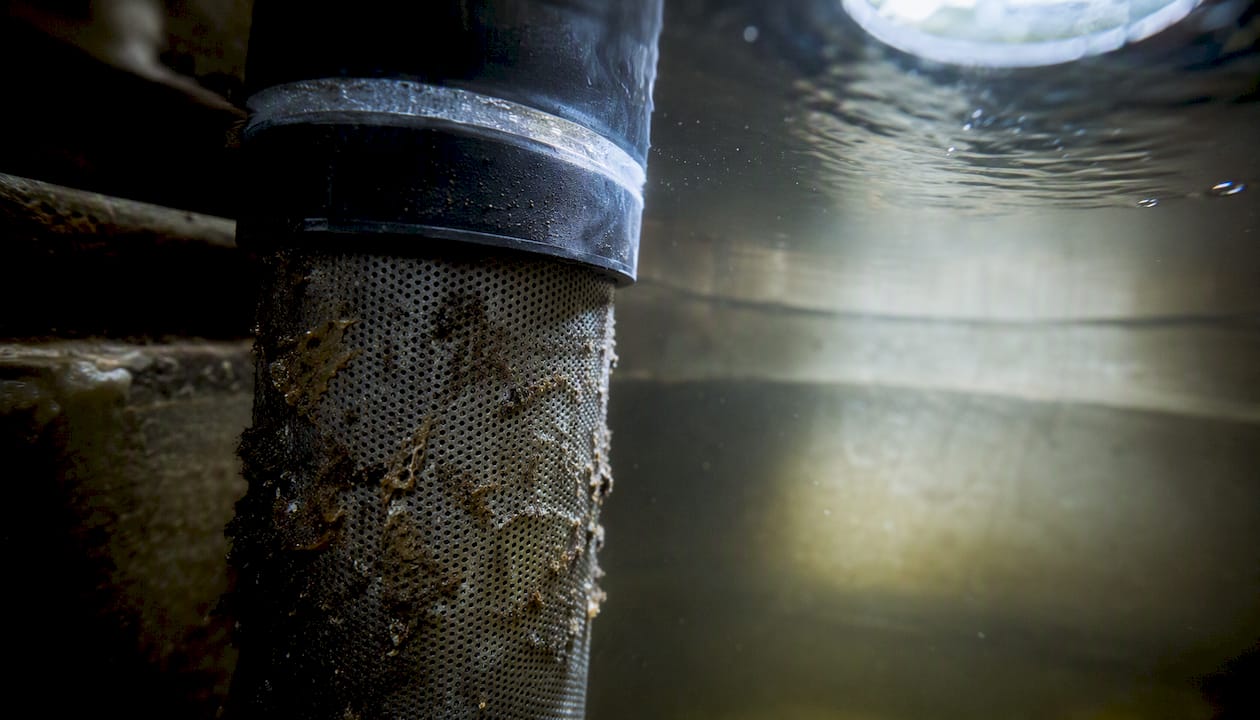
Next comes the dosing chamber. A pump, usually controlled by float switches and a timer, pushes measured doses of effluent up into the mound, sand filter, or drip field at set intervals rather than a constant trickle. This dosing pattern matters: too much effluent at once floods the media and drowns the bacteria that do the actual treatment work.
Statistically speaking, the design margin here is narrow. State guidance such as the Ohio EPA’s OSTS interim standards calls for 2 to 4 feet of unsaturated soil beneath a system to remove bacteria, viruses, and protozoans before effluent reaches groundwater. Lose that separation, through a failed pump, a saturated mound, or a poorly maintained filter, and pathogens travel further than the design ever intended.
- Septic tank: often sized larger for above-grade systems to buffer pump cycling, with dual compartments common.
- Effluent filter: catches fine solids; needs a rinse or replacement on a schedule, not just when problems show up.
- Dosing chamber and pump: timed doses protect the sand media from flooding and short-circuiting.
- Distribution piping: pressurized, small-diameter lines spread effluent evenly across the mound or field.
- Sand media or mound fill: certified filter sand, not generic construction sand, does the physical and biological filtering.
Which Properties Actually Need an Above Ground System?
You don’t need a hydrogeology degree to spot the warning signs. Most homeowners who end up with a mound or ATU saw one of these conditions before a contractor ever showed up.
- A high seasonal water table that rises into the root zone during spring thaw or heavy rain.
- Shallow bedrock or a dense clay hardpan within a few feet of the surface.
- Soil that percolates too slowly (dense clay) or too fast (gravel, karst, fractured rock) to treat effluent properly.
- A small lot near a lake, well, or stream where extra treatment protects drinking water and surface water.
- Cold climates with seasonal permafrost or frost heave affecting buried pipe.
- Temporary or seasonal use, such as a campground, construction site, or cottage occupied only part of the year.
A few red flags should stop you before you commit to any design. If your lot doesn’t have enough vertical separation between the seasonal high water table and the surface, even a mound may not be legal, since a mound raises the drainfield but doesn’t eliminate the separation requirement. If your county has no permit pathway for the system your contractor is proposing, that’s not a paperwork delay, it’s a dead end. And if your lot is too small to fit a mound’s required footprint (often larger than people expect once setbacks from wells, property lines, and the house are factored in), you may be looking at a holding tank or a variance request instead.
Weighing the Advantages and Drawbacks
An above-grade system isn’t a lesser version of a buried field. It’s a different tool for a site a buried field simply cannot handle. But it comes with real trade-offs worth knowing before you sign a contract.
What works in its favor:
- It solves sites that would otherwise have no legal septic option at all, turning an unbuildable lot into a usable one.
- Components sit above or near grade, which makes inspection ports, risers, and pump access far easier to reach than digging up a buried trench field.
- A properly designed and maintained system protects groundwater as effectively as a conventional field, according to EPA guidance on septic systems.
- Technology options like ATUs and sand filters give engineers flexibility on tight, environmentally sensitive, or oddly shaped lots.
What works against it:
- Upfront cost runs meaningfully higher than a conventional buried field, especially once sand import and pump equipment enter the estimate.
- Pumps, alarms, and ATU blowers need ongoing monitoring that a gravity-fed buried system never demands.
- A raised mound changes your yard’s grading and is visible in a way a buried field is not.
- Holding tanks, while cheaper to install, carry ongoing pumping costs that add up fast, sometimes exceeding $3,000 a year for full-time use, according to Texas A&M’s on-site sewage program.
The Angi consumer guide on above-ground septic tanks draws a useful line here: an above-ground tank is usually a temporary holding solution, while an above-ground system, a mound, sand filter, or ATU, is the engineered permanent alternative most jurisdictions actually permit for year-round homes.
What Does an Above Ground Septic System Cost, and How Long Does It Take?
Sizing and cost depend heavily on your soil report, but a few benchmarks hold across most jobs. Septic tanks for above-grade systems commonly run 1,000 to 1,500 gallons for a typical single-family home, with some codes requiring a minimum 1,000-gallon tank for average daily flows. Larger households or ATUs may need bigger tanks or two-tank configurations.
On price, a mound system typically lands in the $10,000 to $20,000 range, though full projects with difficult access or a large mound volume can climb higher. Cost data from Current Cost puts the typical raised system average around $12,000 to $15,000, with a broader range of $8,000 to $25,000 depending on site conditions. ATUs often run $8,000 to $15,000 or more once the service contract is factored in, and holding tanks can look deceptively cheap upfront at $3,000 to $8,000, until you add years of pumping bills on top.
| System Type | Typical Installed Cost | Typical Pump/Maintenance Frequency |
|---|---|---|
| Mound system | $10,000–$20,000 | Tank pumped every 3–5 years; pump/float check annually |
| Sand filter | $10,000–$20,000+ | Media inspection annually; tank pumped every 3–5 years |
| ATU | $8,000–$15,000+ | Service visit quarterly or annually per permit; annual sludge check |
| Holding tank | $3,000–$8,000 | Pumped every 2–6 weeks for full-time use |
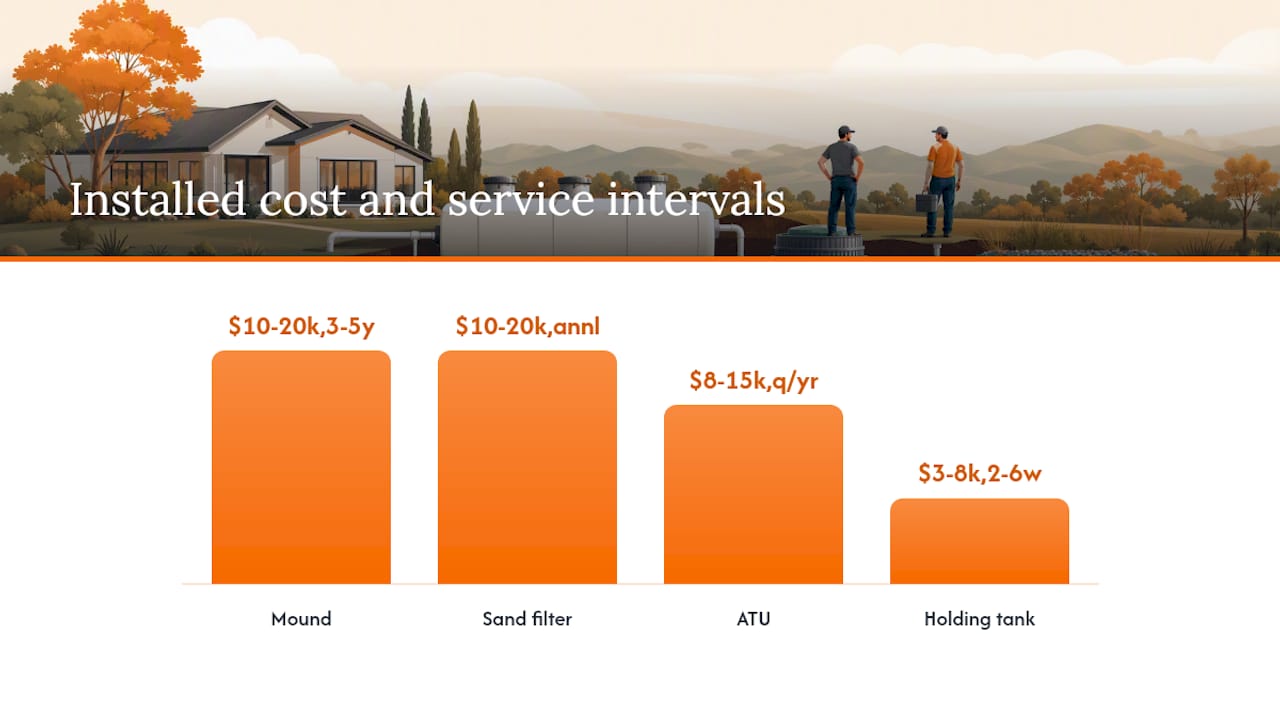
Statistically speaking, sand import and site access drive most of the cost swing between bids. Two lots needing the same tank size can differ by thousands of dollars purely because one needs 40 dump-truck loads of certified filter sand and the other needs ten.
Timeline runs on a predictable arc: site evaluation and soil testing take one to a few weeks depending on county scheduling, permit approval can take another two to six weeks, construction itself usually wraps in three to seven working days for a mound, and final inspection plus settling time before you can plant grass adds another week or two. Budget six to twelve weeks total from first call to a fully commissioned system, longer if your county has a backlog or your design needs an engineer’s stamp.
Do You Need a Permit for an Above Ground Septic System?
Yes, in virtually every jurisdiction, and skipping this step is the single most expensive mistake a homeowner can make. Above-grade systems are more heavily regulated than conventional fields, not less, because the design margins are tighter.
Three offices you’ll likely deal with, in this order:
- County or local health department. This is almost always the primary permitting authority for septic systems, and the office that reviews your soil evaluation and issues the installation permit.
- State environmental agency. States publish their own on-site sewage treatment (OSTS) guidance, like the Ohio EPA’s design standards, which set the numeric rules (vertical separation, minimum trench length, pretreatment triggers) your local office enforces.
- Building or permitting office. Once the septic permit is issued, your general building permit process usually needs to reference it before construction can start.
Before you meet with any of these offices, gather:
- A completed site evaluation report from a licensed soil scientist or sanitarian.
- Percolation test results or a full soil profile.
- An engineered design with a professional stamp, required in most states for mounds, ATUs, and any system serving more than a standard single-family flow.
- An operation and maintenance contract, mandatory in nearly every jurisdiction that permits ATUs.
- A documented inspection schedule tied to your permit conditions.
Requirements vary meaningfully by county and state, so treat every number in this article as a starting point, not a guarantee. Your local health department’s own code always governs. Jmseptic’s septic system installation guide for NC homeowners walks through what North Carolina permitting specifically looks like if you’re in Alamance County or the surrounding Piedmont Triad.
What Happens During Installation, Step by Step?
Knowing the sequence ahead of time helps you spot delays before they turn into change orders.
- Site evaluation and soil testing. A licensed evaluator digs test pits, runs a percolation test, and measures seasonal high water table depth. This report is the foundation for every decision that follows.
- Design and engineering. A designer or engineer sizes the tank, pump, and mound or field based on your soil report and household flow, then stamps the design if your state requires it.
- Permitting. Your design goes to the county health department for approval, which can take anywhere from two to six weeks depending on local backlog.
- Procurement. Certified filter sand, the tank, pump, and distribution piping get ordered. Sand volume is often the long pole here; a large mound can need dozens of truckloads.
- Construction. Crews excavate for the tank and pump chamber, build up the sand mound or filter bed, lay distribution piping, and backfill.
- Final inspection and commissioning. The health department inspector checks riser placement, pump alarm function, and grading before signing off, and the system gets started up under load.
During and after the job, walk the site yourself and check for a few things: inspection ports and risers that are actually accessible (not buried under six inches of soil), a working pump alarm you can hear from the house, and final grading that sheds surface water away from the mound rather than toward it. On mound systems, grass seeding over the finished cap matters more than it looks. The Humboldt County guide to mound system maintenance recommends grass cover specifically because it preserves the oxygen exchange the mound needs to keep working.
Common pressure points that blow past the original estimate: more imported sand than the initial soil test suggested, restricted equipment access on tight urban or wooded lots, utility lines that force a redesign mid-project, and additional engineering sign-off if your first design gets rejected.
How Often Do These Systems Need Maintenance?
Above-grade systems demand more attention than a buried gravity field, and skipping that attention is how a $15,000 mound turns into a $15,000 mound plus a $6,000 emergency repair.
- Pump the septic tank every 3 to 5 years, sooner if your household runs heavier than average flow.
- Check and rinse the effluent filter at least once a year, more often for larger households.
- Inspect the pump chamber, floats, and alarm annually, since a failed float switch is one of the most common causes of a mound flooding out.
- Service ATUs on the schedule your permit requires, often quarterly or annually, since most jurisdictions mandate a maintenance contract as a condition of the permit itself.
When something goes wrong, a few checks can tell you a lot before you call anyone. A sewage odor near the mound often means the cap has settled or cracked, breaking the soil seal. Soggy ground downslope of a mound usually signals the sand bed is saturated or the distribution piping has clogged unevenly. A pump alarm going off means the chamber is filling faster than it’s dosing, which can be a failed pump, a stuck float, or simply too much water use for the system’s capacity. Reduced drain performance inside the house often traces back to a clogged effluent filter rather than the mound itself.
Pro Tip: If your pump alarm sounds, cut back on water use immediately (skip laundry, shorten showers) and call a licensed contractor the same day. Continuing to use full water volume while a pump or float is failing is how a fixable problem turns into a flooded mound.
One detail people don’t ask about until the electric bill shows up: septic pumps draw continuous power whenever they cycle, and most codes require them on a dedicated circuit separate from household loads. A properly sized, well-maintained pump and a sensible dosing schedule keep that draw modest; a failing pump running constantly does not.
How Do You Choose a Contractor for This Kind of Job?
Not every septic installer has real experience with mounds, sand filters, or ATUs, and the gap between someone who does and someone who doesn’t shows up years later, not on installation day.
Ask every bidder these questions before you sign anything:
- Are you licensed and insured for on-site sewage system installation in this county?
- How many mound or ATU systems have you installed in this specific area in the last few years?
- Can you provide references or examples of completed jobs nearby?
- What warranty comes with the pump, tank, and workmanship?
- Who is stamping the engineered design, and is that person separate from the installation crew?
That last question matters more than most homeowners realize. A designer or engineer should size and stamp the system; the installer builds it to that spec. When the same person or company does both with no independent design review, you lose a built-in check on the work.
Watch for these red flags: a soil assessment that reads generically or skips a percolation test entirely, a design with no inspection ports or risers specified, a bid that substitutes unspecified “fill sand” for certified filter sand to save money, and no written operation and maintenance plan for an ATU. That last one isn’t optional. Most permits require it.
| Evaluation Point | What to Look For |
|---|---|
| Credentials | Current state license, liability insurance, bonding where required |
| Mound/ATU experience | Multiple completed jobs in your county, not just conventional fields |
| Equipment access | Owns or has reliable access to excavation and sand-hauling equipment |
| Warranty | Written warranty covering pump, tank, and workmanship separately |
| Price transparency | Itemized bid showing sand volume, tank spec, and permit fees separately |
Jmseptic’s guide to custom septic system design covers why a site-specific design, rather than a one-size-fits-all template, tends to hold up better on difficult lots over time.
Why Vertical Separation Distance Determines Your Options
Vertical separation distance, often shortened to VSD, is the measured gap between the bottom of your drainfield’s distribution layer and the seasonal high water table or bedrock beneath it. It’s the single number that decides whether you get a conventional field, a mound, or nothing at all without a variance.
Design guidance from state OSTS programs generally calls for 2 to 4 feet of unsaturated soil beneath a system to adequately remove bacteria, viruses, and protozoans before effluent reaches groundwater. That soil column does the biological work no pipe or tank can replace.
Codes measure VSD differently depending on system type. A conventional buried field measures from the trench bottom down to the limiting layer. An at-grade or shallow system measures from the soil surface itself. A mound measures the fill depth added on top of the natural grade, because the treatment happens as effluent moves down through the imported sand and into the native soil beneath it.
That unsaturated soil layer isn’t a formality, it’s where oxygen exchange happens. Aerobic bacteria living in that zone break down pathogens and organic matter as effluent percolates through. Compact the soil, saturate it too often, or reduce the layer’s thickness, and you cut off the oxygen those bacteria need, letting effluent pass through with far less treatment than the design assumed.
Statistically speaking, a 200-foot minimum lineal trench requirement for new systems, a figure specified in guidance from Ohio’s OSTS program, shows how much distribution length regulators expect even on an otherwise favorable site. When your lot can’t fit that footprint, that’s when pressure distribution, pretreatment, or a holding tank stop being options and start being the only legal path forward.
Pro Tip: Ask your soil evaluator to give you the actual VSD number in feet, not just a pass or fail. Knowing you cleared the minimum by six inches versus three feet changes how conservatively you should design pump cycles and dosing.
Protecting Groundwater and Nearby Wells
The entire point of the vertical separation and sand media requirements above is groundwater protection, and above-grade systems exist specifically because some sites can’t achieve that protection any other way underground.
The biggest contamination risk on any above-grade system comes from short-circuiting: effluent finding a fast path through cracked cap soil, a settled mound edge, or surface water pooling and flowing straight through the treatment media instead of percolating slowly. Keeping surface runoff, roof drainage, and irrigation water diverted away from a mound or sand filter preserves the slow, even percolation the design depends on.
If your property sits near a well, lake, or stream, ask your designer specifically about setback distances and whether a sand filter or ATU (which provide higher treatment levels than a basic mound) makes sense given your proximity. Certified filter sand matters here too. Generic construction sand clogs faster and treats less effectively, which is a quiet but real long-term contamination risk that doesn’t show up on inspection day, only years later when the mound stops performing as designed.
Jmseptic’s guide on eco-friendly septic solutions covers additional low-impact dispersal choices if protecting a nearby water source is a top priority for your property.
Troubleshooting the Problems Unique to Above-Grade Systems
Above-grade systems fail differently than buried fields, and knowing the pattern helps you catch a small problem before it becomes a rebuild.
Odors near a mound or ATU almost always trace to one of three things: a cracked or settled cap breaking the soil seal, a failed vent allowing gas to escape at ground level instead of through the stack, or an ATU blower malfunctioning and disrupting the aerobic process. A quick visual check of the cap and vent stack, followed by a call to your service contractor if the smell persists, handles most cases.
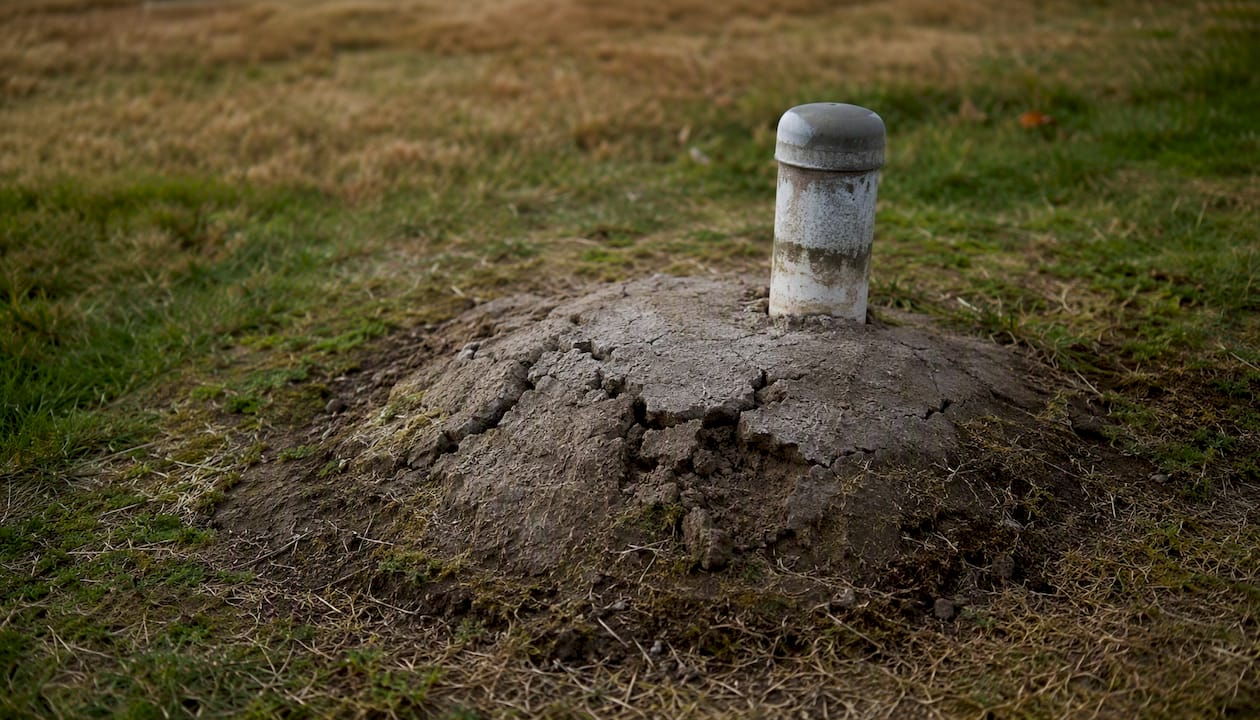
Clogging shows up as slow drains inside the house or visible surfacing near the field. The effluent filter is the first suspect, since it’s designed to catch exactly the solids that would otherwise clog distribution piping. If the filter is clean, the pump’s screen or the distribution laterals themselves may need flushing, a job for a licensed technician, not a DIY snake.
Pump failure announces itself with an alarm, but the underlying cause varies: a stuck float switch, a burned-out motor, or an electrical circuit issue. Because most codes require pumps on a dedicated circuit, checking a tripped breaker is a reasonable first step before assuming the pump itself has failed. If the alarm keeps sounding after a breaker reset, stop non-essential water use and call your contractor.
If you’re dealing with recurring drain slowness rather than a pump-specific alarm, Jmseptic’s sewer line cleaning guide covers how hydro jetting clears blockages in the piping between the house and tank, a separate issue from mound or field performance.
How Long Do These Systems Actually Last?
A well-designed and properly maintained mound, sand filter, or ATU typically lasts 20 to 30 years, comparable to a conventional buried field, though the components inside it don’t all age at the same rate. The tank and piping usually outlast the pump, which is a mechanical part with a realistic service life of 7 to 10 years before it needs replacement regardless of how well you maintain it.
Signs you’re approaching the end of a system’s useful life, rather than dealing with a routine repair, include repeated pump failures within a short span, a mound that no longer drains and stays visibly wet for days after use, persistent odors that don’t resolve after cap and vent repairs, or a sand media bed that has clogged to the point where dosing no longer percolates at the original rate. At that point, replacing the media bed or, in more severe cases, relocating and rebuilding the mound entirely, becomes more cost-effective than continuing to patch a system that’s lost its treatment capacity.
Holding tanks don’t really “wear out” the same way; the tank itself, if it’s a quality polyethylene or fiberglass unit, can last decades. What usually forces a change is the ongoing cost of pumping, which pushes many owners to explore whether their site has opened up new options for a permanent system, sometimes after a neighboring parcel’s development changes drainage patterns or a new well relocates a setback line.
An Installer’s Take on the One Thing Homeowners Skip
The mistake I see most often isn’t a bad design. It’s a homeowner who accepts a low bid before they’ve actually seen their own soil report. A cheap number on a mound system almost always means someone assumed favorable soil conditions instead of testing for them, and assumptions on a project like this get expensive fast once equipment is already on site.
Get the site evaluation and full soil profile in your hands before you compare a single bid. That report tells you the real vertical separation, the actual percolation rate, and whether the footprint you’re picturing even fits your lot’s setbacks. Once you have it, every contractor is bidding against the same facts instead of their own guess, and you’ll spot a lowball number the moment it ignores something the report clearly states.
The second thing worth doing yourself: walk the proposed equipment path before construction starts. If a mound needs forty truckloads of certified sand and your driveway can’t handle that traffic without tearing up landscaping or a neighbor’s easement, you want to know that during the estimate, not on day one of construction.
Let Jmseptic Handle the Site Assessment and the Build
If your property has a high water table, shallow bedrock, or a soil report that ruled out a conventional field, you don’t need to piece together a mound design from a handful of articles and a hopeful contractor bid. Jmseptic handles the full arc for homeowners across Alamance County and the Piedmont Triad: site assessment, soil testing coordination, engineered mound and ATU installation, holding tank service, and the routine pumping schedule that keeps any of these systems working for decades instead of years.

We work directly with Burlington, Mebane, Elon, Graham, Whitsett, and McLeansville homeowners who’ve already been told “conventional won’t work here” and need a contractor who actually specializes in what comes next. That local, above-grade experience is the gap between a mound that lasts thirty years and one that needs a rebuild in eight. Our septic systems for new construction guide walks through what to expect if you’re building new and already suspect your lot needs an engineered solution.
If you’ve got a soil report in hand, or you need one, call Jmseptic to schedule a site evaluation and get a real, itemized estimate before you commit to any system.
Where to Verify Regulations and Technical Guidance
- EPA: Types of Septic Systems explains how mounds, sand filters, and other alternative systems are engineered and why they get approved for sites conventional fields can’t handle.
- EPA: About Septic Systems covers the public health and water quality rationale behind proper design and routine maintenance.
- Texas A&M OSSF Holding-Tank Guidance breaks down when a holding tank is the only legal option and what ongoing pumping actually costs a full-time household.
- Ohio EPA OSTS Interim Guidance lays out the numeric design standards, vertical separation, trench length, and pretreatment triggers, that most state programs mirror in some form.
- Humboldt County: Understanding and Maintaining Mound Systems gives homeowner-level guidance on grading, grass cover, and keeping surface water off a finished mound.
Check your own county health department’s page directly before finalizing any design. Vertical separation requirements, minimum trench lengths, and permit fees vary by jurisdiction, and the numbers above are a starting point, not a substitute for your local code.
Frequently Asked Questions
What is the difference between an above-ground septic tank and an above-ground septic system?
An above-ground tank is typically a temporary holding solution, used on construction sites, for RVs, or at seasonal cottages, that stores raw sewage until it’s pumped out. An above-ground system, like a mound, sand filter, or ATU, is an engineered, permitted, permanent solution that actually treats wastewater before it reaches the soil.
How much does an above ground septic system cost to install?
Mound systems typically run $10,000 to $20,000, with a broader average range of $8,000 to $25,000 depending on site access and sand volume, according to cost data from Current Cost. ATUs often run $8,000 to $15,000-plus once you factor in the required service contract, and holding tanks cost less upfront but carry higher ongoing pumping expenses.
How often does an above ground septic tank need to be pumped?
A holding tank used for full-time occupancy typically needs pumping every two to six weeks depending on tank size and household water use. Mound and sand filter septic tanks follow a more standard schedule of every three to five years, similar to a conventional buried system.
Are above ground septic systems legal everywhere?
They’re legal in most jurisdictions when properly permitted, but requirements vary significantly by county and state. Your local health department has to approve the design based on your soil evaluation, vertical separation, and site conditions, so always confirm with that office before assuming any system is an option.
How long do above ground septic systems last?
A well-maintained mound, sand filter, or ATU typically lasts 20 to 30 years, similar to a conventional system, though the pump inside it usually needs replacement every 7 to 10 years regardless of overall system condition.
Sources
- Types of septic systems | US EPA
- Holding-tank guidance (TAMU OSSF)
- OSTS interim guidance (Ohio EPA)
- Above-Ground Septic Tanks: Types, Costs, and When to Use Each (Angi)
- Raised Septic System Cost: Price Ranges, Drivers, and Budget Tips 2026 – Current Cost